

What components of the conveyorised coating line can be customised to meet specific project requirements?
Key components of a conveyorised coating line can be customised to suit the part dimensions, coating specification, production volumes and available workspace. Options may include loading and unloading systems, conveyor configuration, pretreatment stages, spray booths, curing ovens, cooling sections and line controls.
A conveyorised coating line can be customised at the part-handling, process-control and application levels so that it matches the components being coated, the required finish and the production method. The most important design decisions concern how parts are presented, how they move through each stage, how coating parameters are controlled and how the system accommodates future production changes.
Part presentation and handling can be adapted to the geometry, weight and surface area of the workpieces. This may involve different hanger designs, adjustable spacing, dedicated jigs or rotating fixtures. Suitable fixtures help expose concealed faces, keep parts stable in transit and reduce contact marks on finished surfaces. The loading arrangement can also be configured around the number of operators, the available working area and whether products require manual, semi-automatic or integrated handling.
Conveyor movement can be specified around the required process dwell time and the mix of components. Relevant considerations include the conveyor route, height, track layout, accumulation points and the way carriers are indexed or moved continuously. A line processing several product types may need adjustable settings or recipe-based control, allowing the movement profile to change without redesigning the entire system.
Process sequencing is another area for project-specific design. The line can be arranged so that cleaning, rinsing, drying, coating and heat treatment occur in the necessary order for the substrate and coating system. Additional stages may be appropriate where parts need enhanced corrosion protection, specialist preparation or controlled handling between operations. The sequence should be assessed against the material, existing surface condition and the performance required from the finished coating.
Application equipment can be selected and positioned according to part size, profile and coating coverage. Gun placement, reciprocator movement, nozzle configuration and manual touch-up access all affect how effectively recessed areas, edges and broad faces are coated. Masking arrangements may also be incorporated for threads, contact points, machined faces or other areas that must remain free from powder.
Thermal control should be matched to the coating specification and the actual metal temperature required by the product. Oven zoning, air circulation and temperature monitoring can be configured to help maintain a consistent curing profile across the usable load area. This is particularly important when components vary in thickness, because thin sections can heat more quickly than heavier sections.
Controls and monitoring can be tailored to the information operators need during production. Depending on the line design, this may include adjustable conveyor settings, temperature displays, fault indication, interlocks, alarm history and stored programmes for different product families. Clear control logic helps identify whether a variation is linked to movement, preparation, application or curing rather than treating the line as a single undifferentiated process.
Customisation should also consider changeover and future use. If a manufacturer expects new component sizes, different coating types or increased batch variety, adjustable fixtures, accessible service points and expandable control functions may be more suitable than a design optimised for one product only. The correct specification is therefore based on representative parts, coating requirements, throughput expectations, workspace restrictions and the level of operator involvement required.
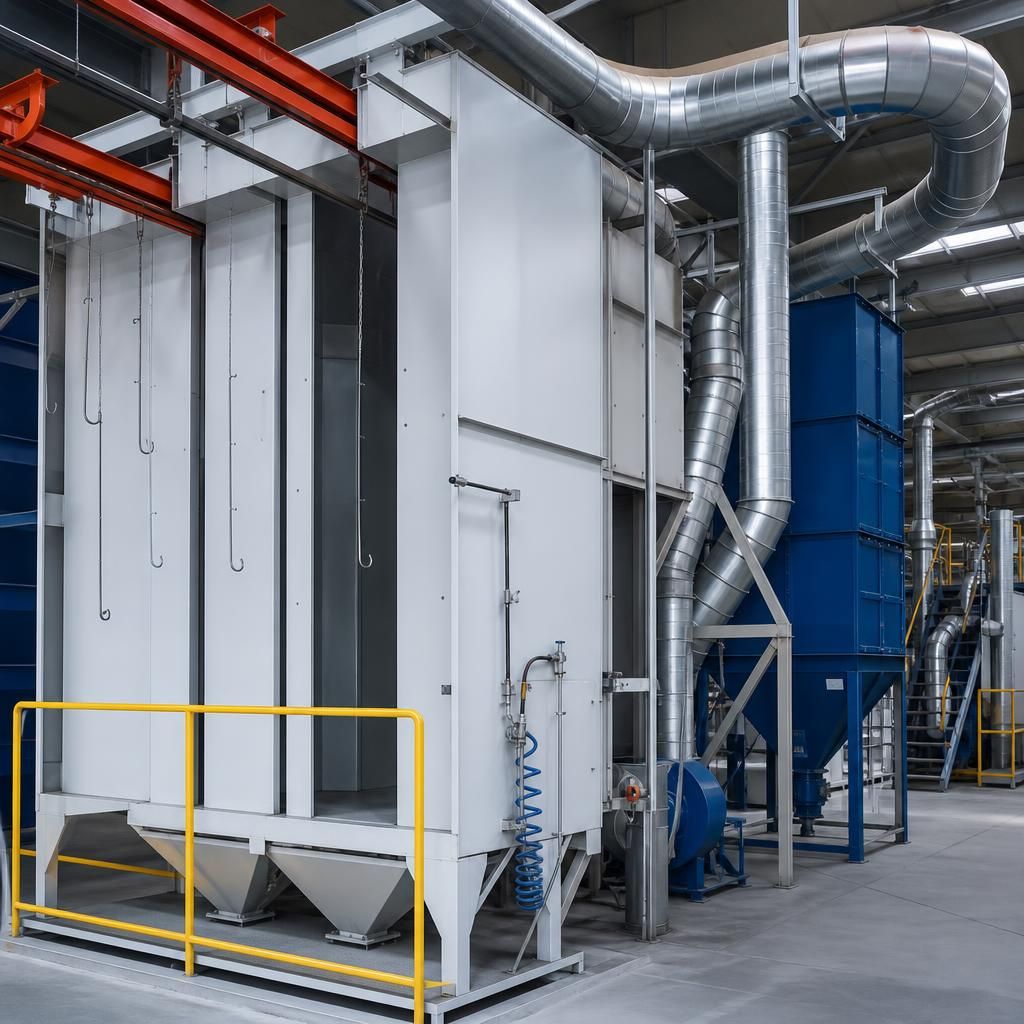
Extraction and powder-recovery equipment can be customised to suit the coating material, booth arrangement and production method. Airflow must contain overspray without disturbing the powder pattern, while filtration and recovery provisions help manage the working environment and reduce unwanted build-up within the application area.
The specification may include the extraction capacity, filter arrangement, ducting route, recovery method and access for cleaning or colour changes. These choices should be considered alongside the booth dimensions and the range of components being coated. A design handling frequent colour changes may prioritise accessible collection points and straightforward cleaning, whereas a dedicated production line may be configured around continuous recovery and consistent airflow.