

How can a conveyorised powder coating system be customised to meet the specific needs of different industries?
A conveyorised powder coating system can be customised around each industry’s materials, component dimensions, production volumes and finish requirements. The conveyor layout, part-hanging method, pretreatment stages, powder application equipment and curing process can be configured to suit products ranging from fabricated metalwork and automotive components to construction parts and specialist industrial items.
A conveyorised powder coating system is customised by matching its handling, preparation, application, curing, quality-control and material-recovery arrangements to the parts being processed and the way each industry manufactures them. The correct configuration depends not only on the required finish, but also on substrate, part geometry, thermal mass, contamination risks, colour changes, production sequence and the level of process traceability required.
Part handling and loading are central to the design. Components must be supported securely without obstructing the surfaces that need coating. Customised hooks, frames, jigs or rotating fixtures can be used where parts have awkward shapes, concealed faces, deep recesses or different orientations during processing. The loading arrangement should also allow operators to identify batches and maintain a repeatable spacing between components. Automotive parts, structural fabrications and smaller manufactured components may therefore require very different handling arrangements, even when the same coating principle is used.
Industry-specific surface preparation can be configured around the substrate and the contaminants likely to be present. The preparation sequence may need to address oil, mill scale, fabrication residues, corrosion or other surface conditions before powder is applied. Aluminium, mild steel, galvanised material and previously treated components can have different preparation requirements. Where a business processes more than one substrate, controls and chemical stages must be selected to avoid compromising adhesion or corrosion protection.
Application equipment can be selected according to part size, geometry, powder type and the required control of film build. Gun positioning, reciprocation, automatic and manual application points, and access to recessed areas all affect coverage. A system processing open fabricated sections may need a different gun arrangement from one coating enclosed brackets or components with Faraday-cage areas. Specialist finishes, including protective nylon coatings, may require equipment and process controls suited to the characteristics of that material rather than a standard decorative powder arrangement.
Oven design and heat control must reflect the component rather than simply the air temperature inside the oven. Parts with different wall thicknesses or thermal masses absorb heat at different rates, so the curing process needs to be assessed against the metal temperature and the powder manufacturer’s requirements. An industry producing thin sheet parts may have different heat-transfer considerations from one coating heavy fabrications. Zoning, airflow, insulation, conveyor dwell and temperature monitoring can all be specified to create a controllable curing profile while reducing the risk of under-curing, over-curing or distortion.
Production controls can be tailored to the manufacturing process. A line intended for repeat production may use recipe-based settings for recurring products, while a mixed-product operation may need straightforward adjustment between batches. Relevant controls can include:
- Conveyor speed and indexed movement to suit the required process dwell.
- Separate settings for different product families or powder types.
- Temperature monitoring at key stages of the oven.
- Interlocks and alarms for abnormal operating conditions.
- Operator controls that distinguish automatic application from manual touch-up.
- Batch identification and records for process traceability.
Colour and powder-change arrangements are particularly important for businesses handling multiple specifications. The system may be configured to make colour changes, cleaning and reclaim management more controlled. Powder recovery equipment can be selected around the powder type and the required separation of colours or materials. In some production environments, reclaiming powder is unsuitable for particular quality requirements, so the recovery approach must be agreed with the coating specification rather than treated as a standard feature.
Quality requirements also influence the configuration. Industries supplying visible architectural, automotive or finished manufactured parts may place close attention on appearance, while industrial and construction applications may prioritise corrosion resistance, edge coverage and consistent film thickness. Inspection points, test procedures and documentation can be incorporated into the operating method. Typical checks may include visual appearance, coating thickness, adhesion, cure and surface defects, with the exact inspection regime determined by the customer’s specification and end use.
Layout and integration should reflect the rest of the factory. The conveyor can be arranged to connect with loading, preparation, cooling, inspection, packing or onward assembly areas. Access for maintenance, safe movement of personnel, extraction, powder housekeeping and future changes should be considered before the equipment is installed. Where production includes unusually long components, high or heavy fabrications, or frequent product changeovers, the physical arrangement may need to prioritise access and flexibility over maximum line density.
Different industries therefore customise the same basic conveyorised concept in different ways. A fabricator may need robust fixtures and curing suited to heavy welded sections; an automotive manufacturer may require repeatable handling, controlled recipes and detailed traceability; a construction supplier may place greater emphasis on corrosion protection and consistent coverage across structural components; and a specialist industrial manufacturer may need application equipment and recovery arrangements designed around a particular powder or substrate. A suitable system is one in which these requirements are defined together, rather than selecting a standard line and attempting to adapt the process afterwards.
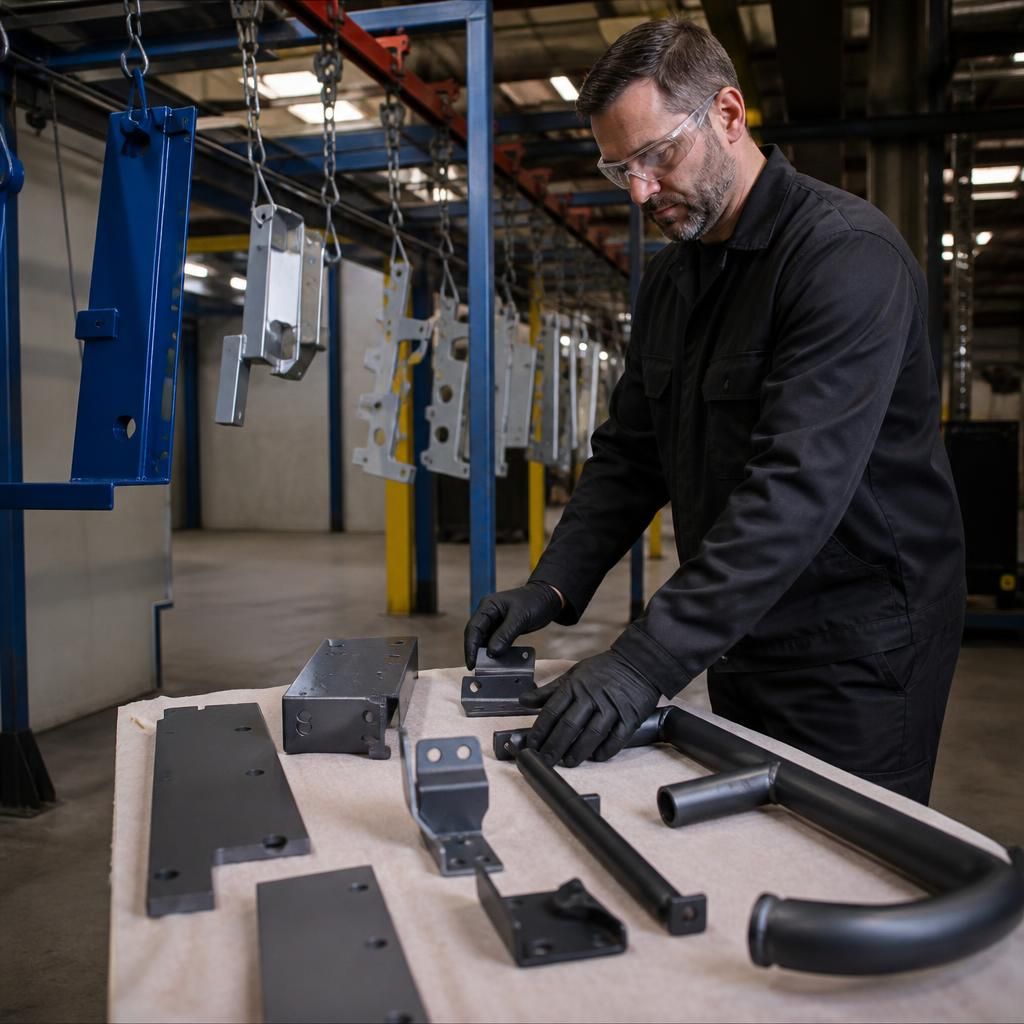
Representative sample parts should be used to validate a customised conveyorised powder coating system before the final specification is agreed. Testing actual components reveals practical issues that may not be apparent from drawings alone, such as poor access to recessed areas, unsuitable hanging points, powder build-up at contact points or a curing profile that does not suit a heavy section.
A useful validation process assesses the complete route through the line, including loading, part orientation, coating access, oven exposure, unloading and inspection. Samples from different product families can be compared to determine whether one configuration is suitable for all parts or whether interchangeable fixtures, adjustable gun positions or separate process recipes are needed. This approach helps define customisation around measurable production requirements rather than relying only on the industry sector or nominal component dimensions.
Discuss Your Custom Conveyorised Powder Coating Requirements
Discuss your product range and production requirements with the Powder-coatings.co.uk team to identify the most suitable conveyorised system configuration. Providing representative parts and coating specifications can help inform the next stage of assessment.