

How do industrial powder coating and traditional paint differ in durability and application?
Industrial powder coating is applied as a dry, electrostatically charged powder and then cured to form a hard, uniform film, whereas traditional paint is applied as a liquid and dries or cures through evaporation and chemical reaction. Powder coating typically provides stronger resistance to abrasion, impact, corrosion and weathering, while traditional paint can be more practical for on-site work, repairs and situations requiring very thin or flexible coats.
The more durable option depends on the component, service environment and application constraints. Industrial powder coating is generally preferred for repeatable factory finishing of metal parts that can withstand oven curing, while traditional liquid paint remains useful where application must take place on site, where the substrate is heat-sensitive, or where local repair and very fine film control are priorities.
How durability differs
Powder coating creates a chemically cross-linked film during curing. Once the powder has melted and bonded, the resulting surface is usually harder and less vulnerable to chipping, scuffing and general handling damage than many conventional liquid paint systems. This makes it appropriate for components exposed to regular contact, movement, workshop handling or outdoor conditions.
Liquid paint can also provide durable protection, but its performance depends more heavily on the selected resin system, primer, number of coats, drying conditions and application discipline. A correctly specified multi-coat paint system may be the better choice for particular chemical, temperature or repair requirements. Neither method is automatically durable on every substrate: poor cleaning, contamination, inadequate pretreatment or incorrect curing can cause either coating to fail prematurely.
Environmental exposure should be assessed rather than assumed. Humidity, salt, ultraviolet light, industrial pollutants, cleaning chemicals and abrasion affect coating systems in different ways. The coating specification should therefore reflect the component’s location and use. A finish for an indoor machine guard has different requirements from one for exterior structural metalwork or an automotive component exposed to road contaminants.
How application differs
- Powder coating: dry powder is applied to a prepared metal surface using an electrostatic process, then heated so the particles flow and cure into a continuous film. The component must generally be suitable for oven curing, and the geometry must allow the charged powder to reach the required surfaces.
- Traditional paint: liquid material is applied by methods such as spraying, brushing or rolling. It can be used on larger fixed items, selected heat-sensitive materials and components that cannot be transported through a curing oven. Drying or curing takes place through solvent or water evaporation and, depending on the product, chemical reaction.
Powder coating is well suited to batch production because a defined process can be repeated across similar parts. It produces no wet overspray on the finished component and does not require a solvent-rich liquid film to dry on the surface. However, the parts must be correctly hung, electrically connected and arranged so that recessed areas, internal corners and shielded sections receive adequate coverage. Deep recesses can create a Faraday-cage effect, where the electric field makes powder deposition less uniform.
Liquid paint can be more adaptable for complex assemblies, changes between colours, blended finishes and work that cannot be removed from its installation location. It is also easier to touch up in a localised area. On the other hand, wet application can be more sensitive to runs, sags, solvent entrapment, dust inclusion and variations in film thickness. Ambient temperature, humidity and ventilation can materially affect the result.
Finish quality and maintenance
Powder coating normally produces a consistent finish across production batches when the powder type, application settings, film build and oven profile are controlled. Colour, gloss, texture and protective properties still need to be specified before work begins. A visually attractive surface is not necessarily a suitable protective system, so finish selection should follow the component’s operating conditions.
Repair is an important distinction. A damaged powder-coated part can often be cleaned and locally recoated with a compatible liquid repair material, but the repaired area may differ in texture, gloss or colour from the original baked finish. Recoating an entire component may provide a more uniform appearance. Traditional paint is usually simpler to blend or reapply in a small area, which can be valuable for equipment that is difficult to remove or regularly maintained in service.
Which method should be selected?
Powder coating is usually the stronger candidate when the work involves repeat metal components, a controlled factory process, resistance to handling and outdoor exposure, and a finish that must remain consistent across a batch. Traditional paint may be more suitable for on-site work, heat-sensitive items, very large installed structures, intricate repair programmes or systems requiring several specialised wet coats.
Before choosing, compare the substrate, component dimensions, operating temperature, exposure conditions, required film thickness, appearance, repair strategy and expected production volumes. A coating specification should also identify the required preparation and curing conditions, because application method alone does not determine service life. For businesses sending metal components for industrial finishing, providing drawings, material details, intended use and any existing coating information helps establish whether powder coating or a liquid system is technically appropriate.
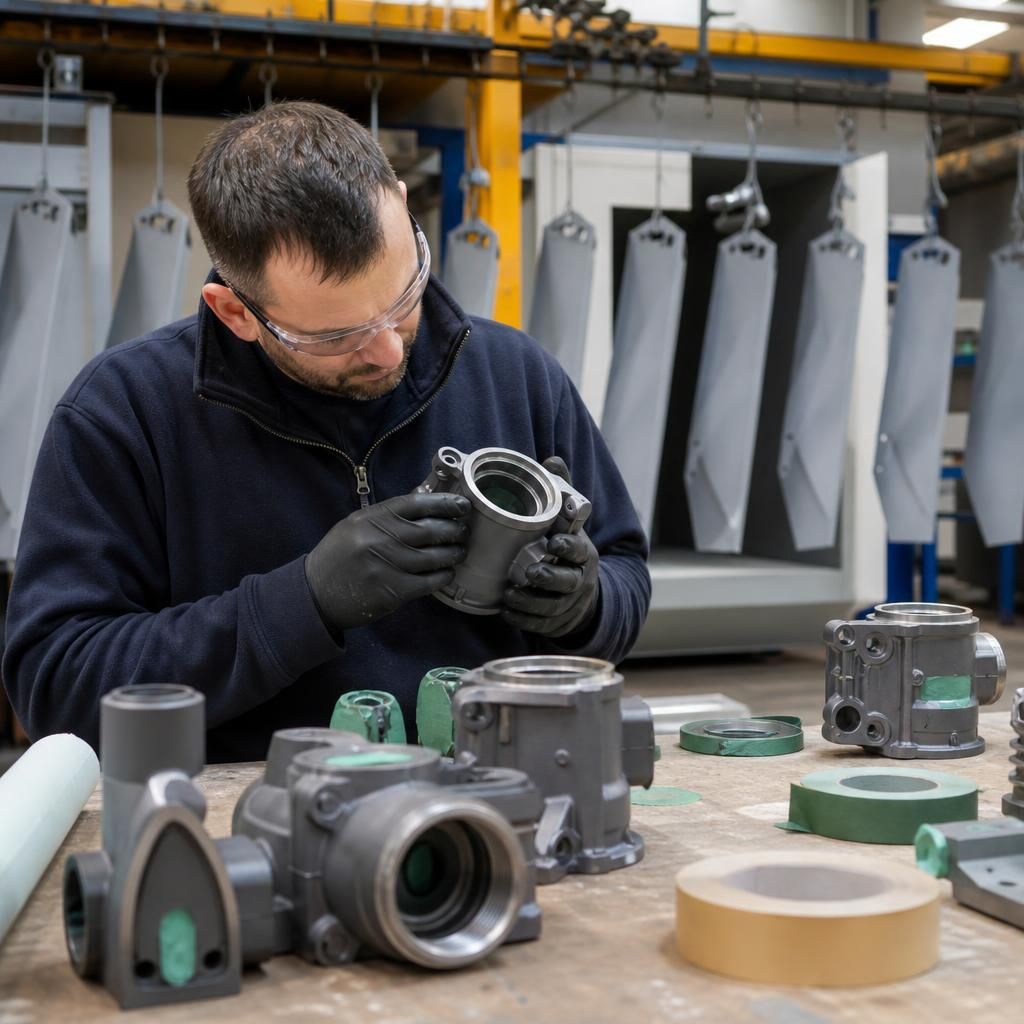
A key practical difference is how each coating system affects precision interfaces. Powder coating forms a cured film that can alter the fit of threads, bearing seats, sliding faces, press-fit areas and close-tolerance joints. These surfaces may therefore need masking, plugs or other protection before application. Traditional paint can also affect dimensions, particularly where several coats and a primer are used, but a liquid system may offer greater control for carefully defined thin-film areas. Drawings should identify surfaces that must remain uncoated, along with dimensional tolerances, so the chosen application method protects the component without interfering with assembly.
Discuss the right coating method for your components
Contact the powder-coating.co.uk team to discuss whether industrial powder coating or traditional paint is appropriate for your components. Share the relevant coating requirements so the most suitable application method can be considered for the intended use.