

How does the powder coating process ensure a long-lasting finish for metal components?
The powder coating process creates a long-lasting finish by preparing the metal surface thoroughly, applying charged powder evenly and curing it in an oven so the particles melt and cross-link into a continuous protective film. This bonded coating resists wear, impact, moisture and corrosion more effectively than an unprepared or inadequately cured finish.
A long-lasting powder-coated finish is produced by controlling the complete coating system: the condition of the metal, the preparation of its surface, the powder formulation, the deposited film and the curing schedule. Durability depends on these stages working together. A high-quality powder applied to contaminated metal, an unsuitable substrate or an incorrectly heated component can still fail prematurely.
Surface preparation creates the foundation for adhesion. Oil, grease, mill scale, rust, old coatings and handling contamination can prevent the powder from bonding properly. Preparation methods are selected according to the metal and its condition. Degreasing removes organic contamination, abrasive blasting can remove corrosion and provide a suitable surface profile, and chemical pretreatment can improve adhesion and resistance to corrosion. The prepared component must also be clean and dry before coating; otherwise, residues or trapped moisture may create defects beneath the film.
Preparation is particularly important at welds, folded edges, holes, joints and areas where dissimilar metals meet. Weld spatter, sharp projections and residues can interfere with coverage or create points where damage begins. Suitable fabrication and preparation before coating help the powder form a more consistent protective layer around the complete component rather than only across its broad, easily accessible faces.
The powder formulation is matched to the component’s service conditions. Different coating chemistries are designed for different combinations of indoor or outdoor exposure, ultraviolet light, moisture, abrasion, impact and chemical contact. The specification should take account of the component’s location, expected handling and the appearance required. A coating selected for decorative indoor use may not be appropriate for prolonged external exposure or aggressive industrial conditions.
Consistent film coverage reduces weak points. During application, the powder must reach the required areas at a controlled and even film build. Geometry affects this process: recesses, internal corners, narrow sections and Faraday-cage areas can attract less powder than exposed faces. Excessive build can also create defects, while insufficient coverage may leave the substrate less protected. Racking and earthing are therefore important because they help components remain correctly positioned and allow the electrostatic application system to operate effectively.
Edges deserve particular attention. They can receive a thinner coating as powder pulls away from a sharp corner, and they are more likely to be struck during transport or installation. Where a component’s design allows it, radiused edges and the removal of burrs support more uniform coverage. Drainage and venting provisions may also be needed for hollow fabrications so that pretreatment fluids do not remain trapped and create later corrosion or processing problems.
Curing converts the deposited powder into a continuous, mechanically stable film. The relevant temperature is the temperature of the metal itself, not simply the air temperature shown by the oven. Component thickness, mass, shape and how the parts are loaded all affect heat transfer. The curing cycle must therefore provide sufficient time at the specified part temperature throughout the component. Under-curing can leave the film with inadequate hardness, adhesion or chemical resistance; excessive heat or an unsuitable cycle can affect colour, gloss and coating performance.
Industrial coating control includes checking that the process is suitable for the thickest and thinnest sections in a batch. Parts that heat at different rates may require changes to the oven profile or loading arrangement. Keeping the substrate, powder and curing requirements compatible is especially important when a batch contains mixed component sizes or different metal thicknesses.
Inspection helps identify defects before components enter service. Depending on the specification, checks may include:
- visual inspection for pinholes, runs, craters, inclusions, poor coverage and colour or gloss variation;
- film-thickness measurement to confirm that the coating is within the agreed range;
- adhesion assessment to identify inadequate bonding;
- checks on cure and hardness where the coating’s performance requirements call for them; and
- examination of edges, recesses, welds and other areas that are more difficult to coat consistently.
These checks do not replace correct preparation and process control. They provide evidence that the finished parts meet the agreed requirements and can help separate an application problem from a substrate, design or handling issue. For repeat production, recording coating conditions and inspection results also supports consistency between batches.
Powder coating is durable, but it is not immune to severe damage or an unsuitable environment. Deep impact, prolonged exposure to aggressive chemicals, standing water, trapped dirt and contact with incompatible materials can shorten the service life of any finish. Correct component design, appropriate coating selection, careful handling during transport and installation, and routine cleaning all contribute to retaining the protective film.
For metal components, the most reliable specification considers the whole use case rather than choosing a colour alone. Substrate type, preparation method, coating chemistry, required appearance, component geometry, exposure conditions and inspection requirements should be agreed before production. This systems-based approach is what enables a powder-coated finish to provide dependable protection and appearance over extended service use.
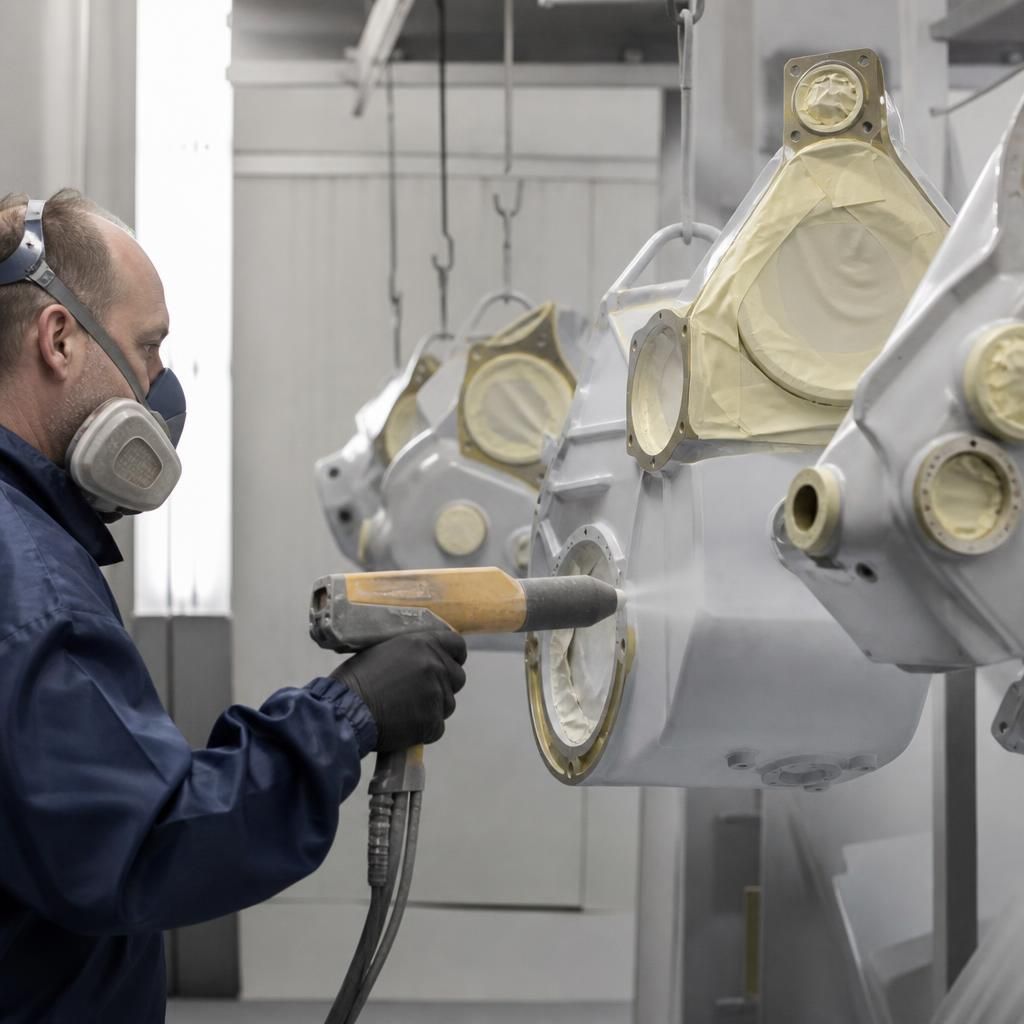
Correct masking helps preserve the finish during assembly. Threads, machined faces, bearing seats, drain holes and electrical contact points may need to remain free from powder. Masking these areas prevents coating build-up from affecting fit or forcing parts together, which could chip the surrounding finish and expose the metal to damage.
Masking also supports consistent results on components with close tolerances. When the coating specification identifies functional surfaces before production, the finished part can provide protection where required without compromising assembly, earthing or movement.