

What abrasive materials should be prioritised for specific metal types to maximise powder coating adhesion?
Prioritise aluminium oxide or garnet for carbon steel, using a grade that creates a consistent profile without excessive metal removal; for aluminium and stainless steel, choose clean non-ferrous media such as aluminium oxide, garnet or glass bead to prevent ferrous contamination. Softer metals and previously coated surfaces generally require a finer, less aggressive abrasive, while the final choice should reflect the substrate hardness, existing corrosion and profile specified for the powder coating system.
The most suitable abrasive depends on the metal’s hardness, its susceptibility to contamination and the surface profile required by the powder coating system. For most ferrous components, an angular abrasive is normally prioritised because it cuts through corrosion and creates a mechanical key; for non-ferrous metals, the priority is a clean, dedicated medium that prepares the surface without embedding iron or excessively eroding the substrate.
Carbon and mild steel can generally tolerate harder, angular media. Aluminium oxide is a controlled option for removing mill scale, light corrosion and previous finishes, while garnet is useful where a sharp, consistent profile is required with comparatively low dust generation. Steel grit can be suitable for robust, heavy steelwork, but its aggressive action needs to be matched to the component’s thickness and geometry. Steel shot is less suitable where a cutting action is needed, as its rounded shape mainly peens the surface rather than forming a pronounced anchor pattern.
- Use angular media for rust, scale and firmly bonded coatings.
- Use a less aggressive grade on thin sections, sharp edges and precision-machined areas.
- Do not use media that has previously blasted incompatible materials if cross-contamination could affect the finish.
Galvanised steel and zinc-coated parts require more restraint than uncoated mild steel. Zinc is relatively soft, so heavy steel grit or prolonged blasting can strip the coating, expose the underlying steel and create an uneven surface. A light sweep blast with a fine, clean non-ferrous abrasive is usually more appropriate. The aim is to remove surface contamination and provide a uniform key while retaining as much sound zinc as possible. Any areas where the zinc coating has been removed should be treated as exposed steel during subsequent preparation and coating assessment.
Aluminium is best handled with clean aluminium oxide, garnet or glass bead selected according to the required finish. Aluminium oxide and garnet provide more cutting action where oxidation or an old coating must be removed. Glass bead is a gentler alternative that can produce a more even satin appearance, but it may not remove firmly bonded corrosion or create enough profile for every powder system. Coarse or prolonged blasting can distort thin sheet, soften edges and leave an uneven texture, so nozzle distance, pressure and pass speed should be controlled as carefully as the abrasive itself.
Stainless steel should be blasted only with media that cannot introduce ordinary steel particles. Aluminium oxide, garnet, glass bead or a dedicated stainless-compatible medium can be considered, provided it is clean and has not been used on carbon steel. Ferrous particles driven into stainless steel may later oxidise and appear as rust staining, even though the base metal is corrosion-resistant. Separate storage and handling equipment for non-ferrous work is therefore as important as the nominal abrasive specification.
Cast iron normally benefits from an angular abrasive capable of reaching corrosion in its irregular surface. Aluminium oxide, garnet or an appropriately selected steel grit can remove rust and scale, but porous castings may retain oil, coolant or foundry residue below the visible surface. Blasting alone will not reliably remove contaminants that continue to migrate out of the metal. Degreasing, heat treatment where appropriate and inspection after blasting may be needed before powder coating, particularly on hydraulic, automotive or machinery components.
Copper, brass and other softer non-ferrous alloys need a gentler approach. Fine glass bead, fine garnet or a suitable plastic abrasive can clean the surface while reducing the risk of sharp undercutting, distortion and excessive material removal. Aggressive steel media should be avoided because it can embed ferrous particles and alter the appearance of the alloy. Plastic or organic media may be useful for removing an existing coating when preserving the underlying surface is more important than producing a deep profile, although the resulting key must still be compatible with the powder coating specification.
The shape of the abrasive affects the result as much as its hardness. Angular particles cut grooves and are normally preferred where the coating needs a clear mechanical key. Rounded glass bead or shot peens and smooths the surface, making it useful for light cleaning and cosmetic preparation but less suitable for heavy rust or thick coatings. Softer media, including some plastic and organic abrasives, can strip a finish with limited substrate damage, but they may leave too little profile for direct powder application unless a compatible adhesion system is specified.
Media selection should also account for contamination and reuse. Abrasive containing oil, moisture, old coating particles or salts can transfer defects to the prepared metal. Recycled media should be screened and monitored so that breakdown products and removed contaminants do not compromise cleanliness. Media changeover is particularly important when moving from carbon steel to aluminium, stainless steel, zinc or copper alloys.
Before production blasting, assess a representative area or test piece and check that the surface is clean, uniformly textured and free from embedded abrasive. Inspect edges, recesses, welds and drilled holes separately because these areas often receive a different impact from the blast stream. The final choice should then be confirmed against the powder manufacturer’s preparation requirements, the component’s dimensional tolerance and any pretreatment or primer that will follow. An abrasive is appropriate only when it removes the required contamination while leaving a stable, compatible surface for the complete coating system.
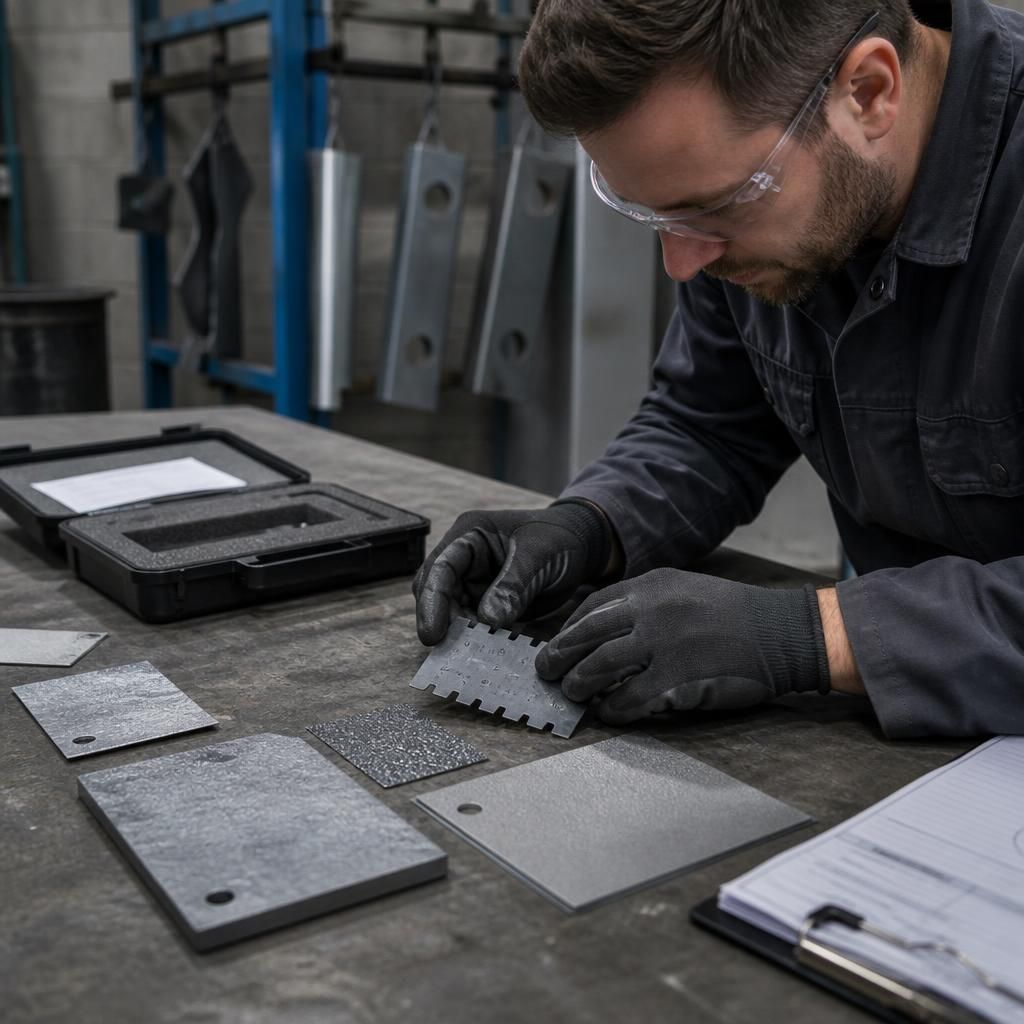
The abrasive should be selected to produce a measurable, consistent surface profile rather than simply a visibly rough finish. A surface that is too smooth may provide insufficient mechanical keying, while an excessively deep or uneven profile can make powder coverage inconsistent and leave peaks vulnerable to early damage. Check the prepared metal with a suitable surface-profile comparator or replica method, then compare the result with the powder coating system’s preparation specification.
Profile checks are especially useful where one component contains different sections, such as plate, welds, cast areas or machined faces. If the readings vary significantly, adjust the abrasive grade or blasting technique before processing the full batch. This helps ensure that the chosen medium is not only compatible with the metal type but also producing the surface texture required for uniform powder coating adhesion.
Discuss abrasive selection for your metal components
For a component-specific abrasive recommendation, discuss the metal type, existing coating and required surface profile with Powder-coatings.co.uk before processing the full batch. This helps establish a preparation approach suited to the complete powder coating system.