

How can the precision calibration of powder blasting equipment influence the quality of powder coating applications?
Precise calibration of powder blasting equipment controls abrasive pressure, media flow and coverage, helping produce a uniform surface profile for powder coating. Consistent preparation supports reliable adhesion and a more even, predictable finish by reducing the risk of over-blasting, missed areas or surface damage.
Precision calibration influences powder coating quality by making the blasting process repeatable and measurable. When equipment readings correspond accurately to the conditions at the nozzle and workpiece, operators can prepare each component to the intended specification rather than relying on approximate settings. This gives the coating process a more dependable foundation, particularly when parts are produced in batches or have complex shapes.
Calibration is not limited to checking a pressure gauge. A complete assessment may include the blast-pressure gauge, abrasive metering system, air supply, nozzle condition, hose connections and control valves. The displayed pressure should be compared with a suitable reference instrument, while the media delivery system should be checked for steady, controllable output. Worn nozzles can alter the shape and velocity of the blast stream, even when the gauge appears to show the correct pressure. As a result, nozzle inspection and replacement form part of effective calibration control.
Accurate settings help operators match the preparation method to the substrate and component design. A relatively delicate metal surface, thin section or detailed profile may require a different operating condition from a robust steel fabrication. If the equipment is not calibrated, an adjustment intended for one material may produce inconsistent results on another. Calibration therefore supports the use of documented, component-specific preparation instructions rather than informal trial and error.
The effect is particularly important on parts with recesses, edges, holes, welds or changes in section. Incorrect equipment behaviour can make it difficult to reproduce the same preparation in accessible and restricted areas. This may leave variations that become visible only after coating, or create differences in the way the powder film forms around edges and profiles. Properly checked equipment gives the operator greater control over these areas and makes the blasting technique easier to standardise.
Calibration also helps distinguish equipment-related problems from coating-process problems. If a finish shows poor adhesion, uneven appearance or premature breakdown, the investigation should consider preparation records alongside powder application and curing conditions. Reliable calibration records provide evidence of the settings used and whether the equipment was operating within the required range. Without that information, it is harder to identify whether the cause was the blasting process, the coating material, application conditions or the substrate itself.
A practical calibration and verification routine should include:
- checking pressure and media-flow controls against suitable reference equipment;
- examining nozzles, hoses, seals, valves and air lines for wear, blockage or leakage;
- confirming that abrasive delivery remains stable during operation rather than only at start-up;
- recording the settings used for each material, component type or preparation specification;
- verifying the prepared surface using the inspection method required for the job; and
- investigating any change in finish, equipment behaviour or preparation result before continuing production.
Verification after calibration is as important as the adjustment itself. Operators should assess representative workpieces and inspect difficult features, not just an easily accessible flat area. Suitable checks may include visual examination, assessment of the surface profile where specified, and confirmation that residues or preparation defects have not been introduced. The inspection method should be appropriate to the substrate and the coating specification.
Calibration intervals should reflect equipment use, abrasive wear, operating conditions and the consequences of an incorrect result. A heavily used system or one processing abrasive media that accelerates nozzle wear may need more frequent checks than equipment used intermittently. Calibration should also be revisited after significant maintenance, replacement of a nozzle or control component, changes to the air supply, or a change in the preparation specification.
For manufacturers and fabricators, the main benefit is process control: calibrated blasting equipment makes surface preparation more consistent, easier to inspect and easier to reproduce across batches. It does not replace correct abrasive selection, competent operation, suitable cleaning or controlled powder curing, but it reduces uncertainty at a critical stage. Accurate calibration therefore contributes to a more stable route from prepared metal to a sound, visually consistent powder coated finish.
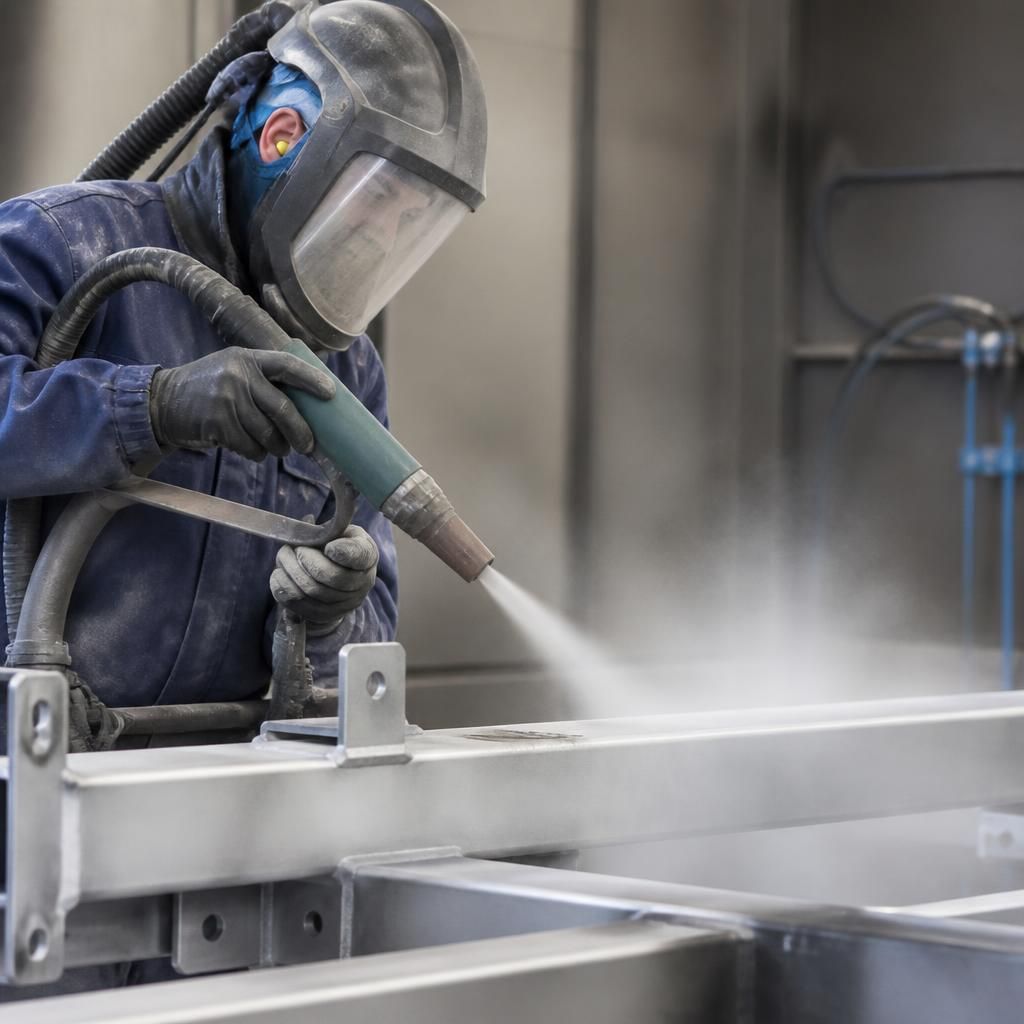
Calibration provides a reliable baseline, but the operator must also control how the blast is applied. Nozzle distance, angle, travel speed and dwell time affect the energy delivered to the metal, even when pressure and abrasive-flow readings remain unchanged.
For this reason, a calibrated system should be used alongside documented application technique. Keeping the nozzle at a consistent stand-off distance and angle, moving it at a controlled speed and avoiding excessive dwell on edges helps translate the equipment settings into a more even surface profile. This is especially important where a component combines broad panels with welds, corners or recessed features.
When these variables are controlled, calibration has greater practical value: it establishes the equipment condition, while the operator’s method controls how that condition is applied to each part.
Discuss Powder Blasting Equipment Calibration for Your Components
Discuss your component requirements with Powder-coatings.co.uk to establish how calibrated blasting equipment can support the specified surface preparation. Provide details of the metal, component design and coating requirements so the appropriate preparation approach can be considered.