

What safety precautions are taken during the shot blasting process?
Shot blasting safety precautions include using enclosed equipment, suitable personal protective equipment (PPE), controlled abrasive handling and effective dust extraction. Operators also follow documented risk assessments, equipment checks and safe operating procedures to control noise, airborne particles, impact hazards and residual dust.
Shot blasting is made safer by controlling access to the blast area, securing the workpiece, preventing unintended machine operation and managing the process before, during and after blasting. The main precautions extend beyond protective clothing and dust control: they also address stored energy, abrasive ricochet, manual handling, equipment isolation, contamination and the condition of the component being treated.
Before blasting, the work area and component are assessed. Operators confirm the coating and substrate are suitable for the selected blasting method, identify sharp edges or fragile features, and check that the component can withstand handling and blast impact. Openings, threaded sections, machined faces and other areas that must not be blasted are masked or protected where appropriate. Components are positioned securely so that they cannot shift, topple or swing while being treated.
Access to the operating zone is restricted while blasting is taking place. Barriers, doors, interlocks or equivalent controls help prevent people from entering the impact area unexpectedly. Warning notices and controlled access are particularly important where a blast cabinet, room or automated system is being used. Visitors and other personnel should remain clear unless they have been authorised and suitably instructed.
Machine isolation is an important precaution during intervention. If an operator needs to clear a blockage, adjust a fixture, change a component or enter an enclosed area, the relevant power, compressed air and abrasive feed sources must be shut off and isolated first. Stored pressure and moving parts must be allowed to discharge or stop, with the isolation confirmed before work begins. This reduces the risk of an unexpected blast cycle, movement of machinery or release of pressurised abrasive.
Operators also take care with loading and unloading. Lifting points, trolleys, hoists or other handling aids may be needed for large industrial components, while smaller parts still need to be placed in a stable position rather than dropped into the equipment. Good handling practice reduces crush, trap and strain risks and helps prevent damage that could later affect coating performance.
Blast parameters are selected to suit the job rather than applied indiscriminately. Abrasive type, pressure, flow, nozzle distance, angle and exposure time influence both safety and the condition of the metal. Excessive impact can deform thin sections, round edges, damage threads or expose weaknesses in a component. Controlled settings and appropriate nozzle movement help remove defective coating without creating avoidable damage or excessive rebound.
Where compressed air is used, hoses, couplings, nozzles and connections need to be suitable for the operating pressure and kept in sound condition. Hoses should be routed to reduce trip and snag risks, and the nozzle should never be directed towards another person. Operators should not use compressed air to blow contamination from clothing or skin, as this can drive particles into the body or disperse them into the surrounding area.
Housekeeping continues throughout the task. Spent abrasive and coating debris are collected using a suitable method rather than being allowed to accumulate around walkways, controls or access points. Floors and nearby surfaces are kept clear of slip and trip hazards, while waste is handled according to its composition. Removed coatings can contain substances that require controlled handling, so waste streams should not be mixed or discarded casually.
Particular care is needed when an existing coating may contain hazardous constituents. The coating history, specification or available material information should be reviewed where possible. If there is a reasonable concern about lead, chromates, asbestos-containing material or another hazardous substance, the work should be assessed under the relevant UK controls before blasting proceeds. This may require additional testing, containment, exposure controls and specialist waste arrangements.
After blasting, the component is handled carefully because sharp edges, hot surfaces, trapped abrasive or loosened debris may be present. Blind holes, cavities, folds and joints are checked so that residual abrasive does not interfere with assembly or the next finishing stage. The component and work area are then left in a condition that allows safe inspection, transport and preparation for powder coating or another specified finish.
Competence is another core safeguard. Operators need instruction in the particular equipment, abrasive, component type and emergency arrangements, not simply general workshop experience. They should know how to stop the process, report defects, deal with abnormal vibration or loss of control, and respond to an incident without placing themselves or others at further risk. Supervisors should review any change in coating, component design, abrasive or process setting before production continues.
For a B2B coating project, it is useful to provide the service with accurate information about the substrate, previous coating, dimensions, lifting requirements, protected areas and any known contamination. Clear information allows the blasting method and handling arrangements to be planned around the component, reducing the likelihood of unsafe improvisation and supporting consistent surface preparation.
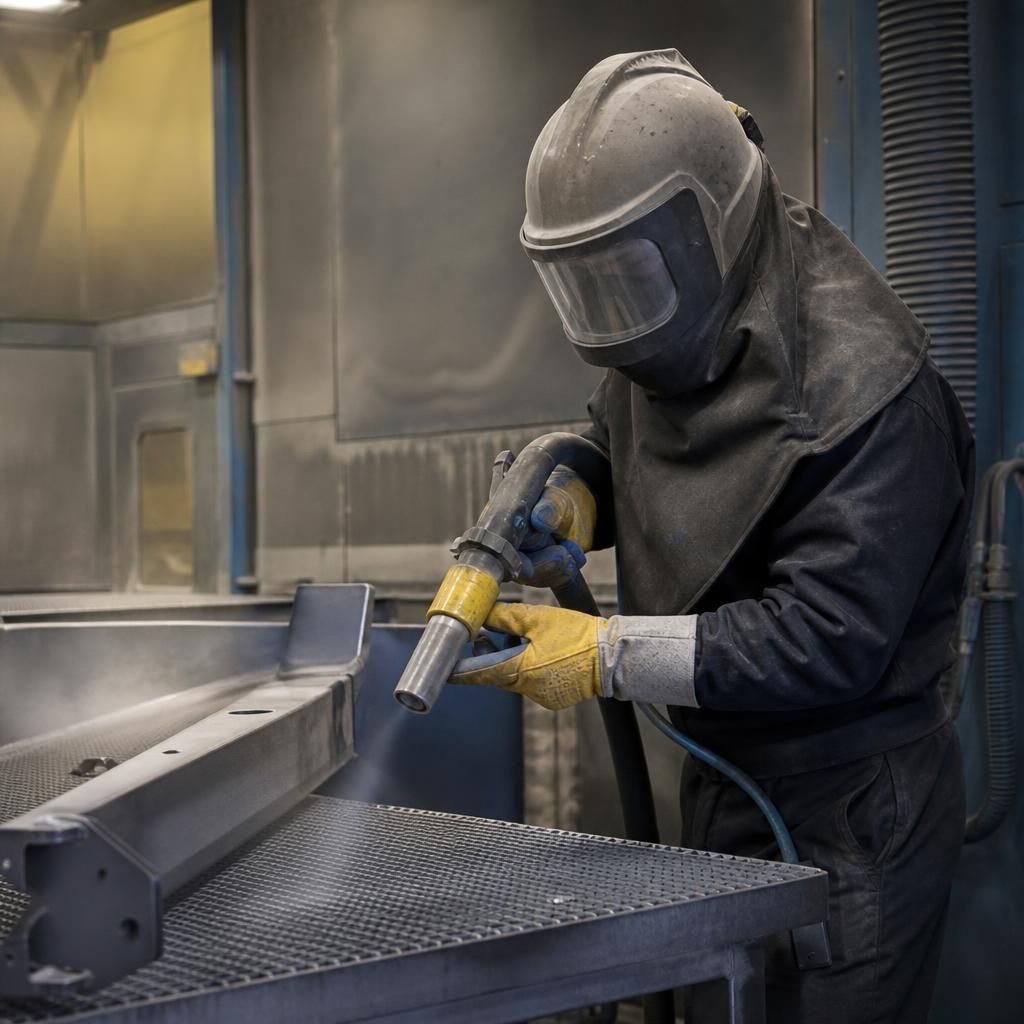
Personal protective equipment (PPE) is selected according to the hazards identified for the specific shot blasting operation, rather than treated as a standard set for every job. Respiratory protective equipment must be suitable for the airborne contaminants present and correctly fitted; tight-fitting masks require an appropriate face-fit test and a reliable seal. Eye and face protection, protective clothing, gloves and hearing protection may also be required, depending on the equipment and task.
PPE is only effective when it is compatible with other equipment, inspected before use and kept in a hygienic, serviceable condition. Filters, seals, visors and other components should be replaced or maintained in line with the relevant instructions. Operators should also remove contaminated clothing safely and avoid carrying abrasive or coating residue into clean areas.