

What materials are used in the shot blasting process?
Shot blasting commonly uses steel shot or steel grit, selected according to the metal surface and coating being removed. Other abrasive media, including glass beads and aluminium oxide, may be used where a finer finish or different surface profile is required.
The shot blasting process can use metallic, mineral, ceramic, plastic or organic abrasive media. The correct material depends on the coating being removed, the hardness and geometry of the component, the surface profile required, and whether the abrasive must be recoverable for repeated use.
Chilled-iron grit is a hard, angular metallic abrasive used for aggressive removal of corrosion, mill scale and firmly bonded coatings. Its sharp edges cut into the surface and create a pronounced profile, which can help a subsequent coating bond mechanically. It is more suited to robust components than thin sections or delicate edges, where excessive impact could cause distortion or unwanted roughness.
Stainless steel abrasive may be selected where ferrous contamination must be minimised. Conventional carbon-steel media can leave embedded particles that later contribute to staining or corrosion on some stainless or non-ferrous components. Stainless media is therefore considered for applications where the cleanliness and corrosion resistance of the prepared surface are particularly important.
Ceramic beads provide a durable, rounded abrasive for cleaning, deburring and producing a relatively uniform finish. Compared with angular media, they tend to peen and smooth the surface rather than cut deeply into it. This makes them useful for components where preserving dimensions, edges or a controlled appearance matters more than creating a deep anchor profile.
Plastic media, including specially formulated thermoset particles, is used where the substrate or component geometry is vulnerable to aggressive impact. It can remove certain paints and coatings while reducing the risk of damaging softer metals, sharp profiles or intricate features. The grade must be matched carefully to the coating, because plastic media is not suitable for every heavy or strongly bonded deposit.
Mineral abrasives include materials such as garnet, silicon carbide and other naturally occurring or manufactured hard particles. Garnet can provide effective cleaning with a comparatively controlled profile, while silicon carbide is extremely hard and suited to demanding cutting action. Their performance varies according to particle size, angularity, hardness and the type of surface contamination present.
Organic media, such as crushed walnut shell, is used for lighter cleaning where the underlying surface must be protected. These particles are less aggressive than hard mineral or metallic abrasives and can remove deposits from some components without substantially altering the base material. They are generally considered for sensitive parts, delicate details or applications where a heavy blast profile would be undesirable.
The physical form of the abrasive is as important as its chemical composition. Rounded particles deliver a peening effect and tend to produce a smoother profile, whereas angular particles cut into the coating and substrate more sharply. Particle size also affects the result: coarse media removes material quickly and can create a deeper profile, while fine media reaches smaller recesses and gives greater control over the finish.
Media selection should also account for contamination and recovery. Reusable metallic or ceramic abrasives can often be separated from removed coating and debris, screened and returned to the blasting system until their working size reduces. Single-use or less durable media may be appropriate where cross-contamination is a concern, but spent abrasive and removed coating must then be collected and handled in line with applicable waste requirements.
For industrial components, the practical choice is a balance between removal rate, surface profile, dimensional control and cleanliness. A suitable blasting specification identifies the substrate, coating thickness and type, required finish, acceptable roughness, media grade and inspection method before work begins. This prevents an abrasive that is effective on a robust fabricated part from being used inappropriately on a thin, complex or corrosion-sensitive component.
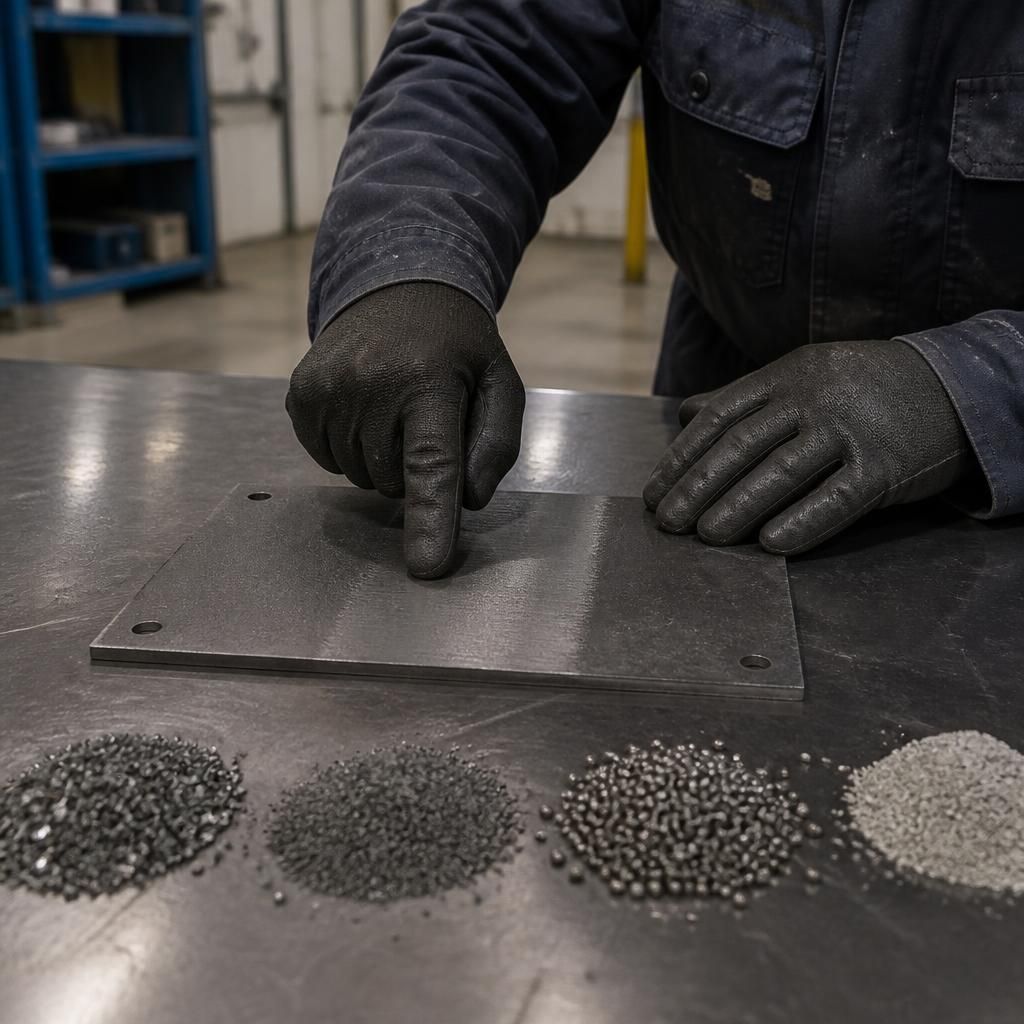
Abrasive media should be assessed on a representative test area before full-scale shot blasting begins. This confirms that the selected material removes the defective coating without leaving unacceptable impact marks, embedded particles or an unsuitable surface texture.
The test should examine the exposed metal as well as the removed coating. Checks may include visual cleanliness, remaining coating in recesses, dust or abrasive residue, edge condition and the resulting surface profile. This is particularly important where a component combines different metal sections, includes welds or has thin edges that may respond differently to the same blast media.