

How does shot blasting enhance powder coating adhesion?
Shot blasting enhances powder coating adhesion by removing rust, scale, old coating and surface contaminants while creating a consistent, lightly textured profile on the metal. This clean, keyed surface gives the powder coating a stronger mechanical grip during curing, helping the finished layer resist lifting, flaking and premature failure.
Shot blasting enhances powder coating adhesion by preparing the metal so the coating can bond consistently during application and curing. The process improves the condition, cleanliness and surface profile of the substrate, while reducing the risk that residues or weakly attached material will become a failure point beneath the new finish.
It improves the bonding surface. Powder coating is applied as a dry powder and then heated until the particles melt, flow and cure into a continuous film. For this film to remain attached, it must contact sound metal rather than loose corrosion, embedded dirt, machining residue or remnants of an incompatible coating. Shot blasting exposes a more uniform substrate, giving the applicator a reliable surface on which to apply the powder.
The resulting profile supports mechanical keying. Blasting creates microscopic peaks and valleys in the metal. Once cured, the coating flows around this profile, increasing the effective contact between the powder film and the substrate. The profile must be controlled: insufficient preparation may leave the coating with a weak foundation, while overly aggressive blasting can produce an unnecessarily rough surface, alter dimensions or affect the appearance of the finished part.
Consistent preparation helps avoid local adhesion failures. A component can appear clean while still carrying small areas of residue, corrosion products or tightly bonded previous coating. These isolated areas may prevent the powder from wetting and bonding evenly. Shot blasting treats the surface mechanically and can provide greater uniformity across welds, edges, recessed areas and other locations where contamination or coating breakdown commonly begins.
Surface preparation also affects the durability of the coating system as a whole. If the powder film is applied over unstable material, moisture or corrosion can work beneath it and cause blistering, flaking or delamination. Removing the unsound layer before coating reduces the likelihood that a defect will continue underneath the new finish. It does not, however, correct structural damage, active leakage, unsuitable metal or contamination introduced after blasting.
Process control is essential to adhesion. The abrasive type, particle size, blasting pressure, angle, travel speed and stand-off distance should be selected for the component and its existing condition. Thin sections, sharp edges, castings, fabricated assemblies and intricate parts may require different settings. The objective is an even, appropriately keyed surface without distortion, excessive edge rounding or damage to details that affect fit and function.
After blasting, the prepared metal should be handled and transferred in a way that prevents recontamination. Dust, oil from handling, workshop dirt and moisture can undermine the benefit of preparation. Parts may therefore require inspection, suitable cleaning and prompt progression to the next coating stage. Any specified chemical pretreatment or primer must also be compatible with both the substrate and the powder system; blasting is a preparation method, not a substitute for every required pretreatment.
Inspection should consider the complete surface rather than relying only on its visual appearance. Relevant checks may include whether the previous coating has been removed where required, whether the profile is even, whether edges and recesses have been reached, and whether there are signs of oil, dust or flash rust. The required standard depends on the metal, the service environment, the powder system and the performance expected from the finished component.
For industrial parts, this is why powder coating adhesion should be assessed as a process rather than as a property of the powder alone. Suitable blasting, controlled handling, correct powder application and full curing work together. Where components are produced in batches, maintaining the same preparation parameters and inspection approach helps ensure that each part presents a comparable surface for coating.
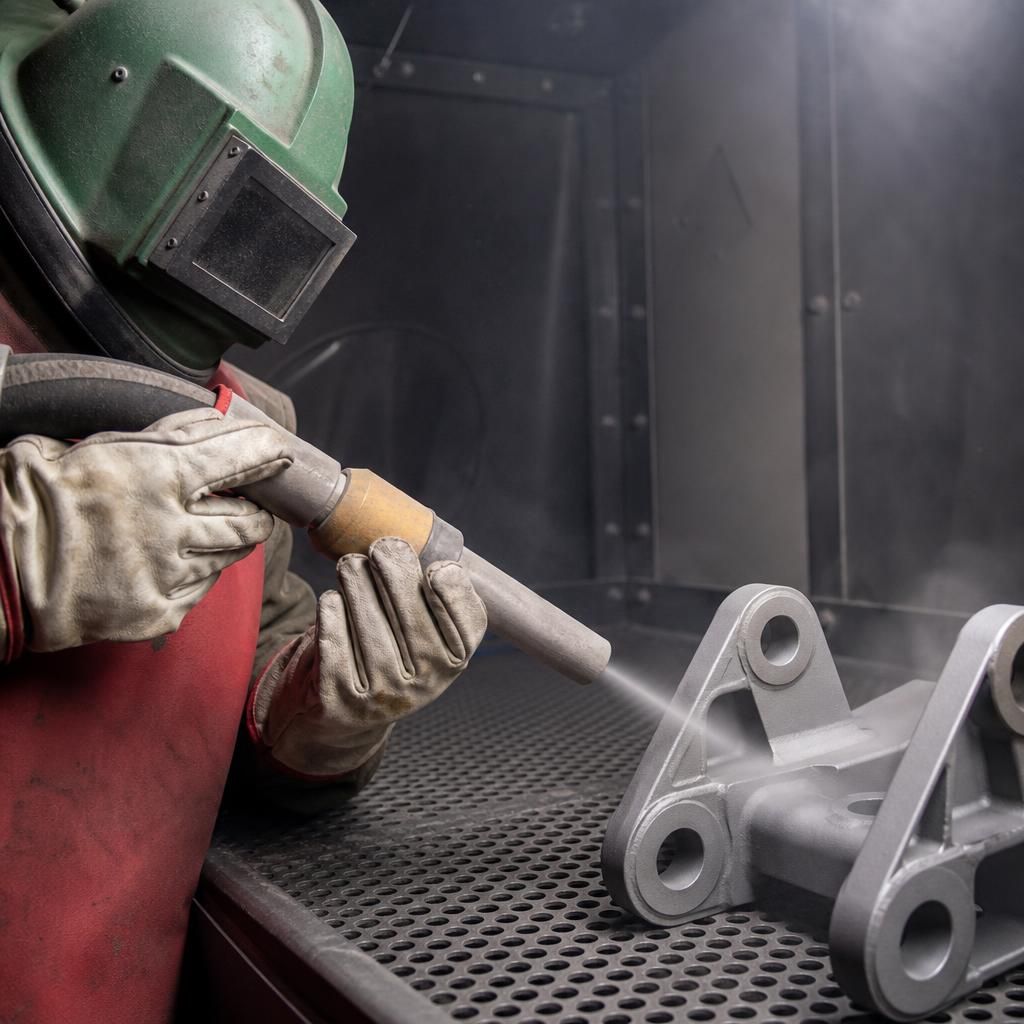
Shot blasting improves adhesion by removing the weak boundary layer between the powder coating and the metal. Rust, scale and remnants of an old finish may appear firmly attached, yet provide an unreliable surface for the new coating to bond to. Once these layers are removed, the molten powder can wet and contact sound metal more consistently during curing. This means the coating is supported by the substrate itself rather than relying on the strength of material that could later separate from it.
Discuss your shot blasting and powder coating requirements
If you are assessing a component for powder coating, discuss its substrate, existing finish and preparation requirements with the powder-coating.co.uk team. Sharing details of the part and intended use can help establish whether shot blasting is suitable before coating begins.