

What types of metal surfaces can benefit most from sandblasting in the powder coating repair process?
The metal surfaces that benefit most from sandblasting during powder coating repair are robust steel, cast iron and suitably prepared aluminium components with corrosion, mill scale, failed coating or embedded contamination. Sandblasting removes these defects and creates a clean, keyed surface, although softer or thin sections require carefully controlled abrasive pressure to prevent distortion.
The metal surfaces that benefit most from sandblasting in a powder coating repair process are substantial, accessible components with a coating or contamination that cannot be removed reliably by light mechanical cleaning alone. The greatest benefit is usually seen on fabricated mild-steel assemblies, structural sections, brackets, machinery parts and other components where the existing finish has failed across several areas rather than in one isolated scratch.
Fabricated and welded steelwork is particularly suitable because weld zones, heat-affected areas, sharp transitions and recessed sections often retain old coating, weld residue or surface contamination. Abrasive blasting can treat these changes in profile more consistently than hand tools, provided the operator controls the blast angle and intensity around edges and thin sections.
Large, heavy or irregular components can also gain considerably from this preparation method. Items such as machine frames, fabricated housings, support brackets and industrial guards may have corners, joints and partially enclosed areas that are difficult to prepare evenly. Their mass generally makes them less susceptible to distortion than light-gauge sheet, although enclosed cavities and drainage points still need careful inspection before coating.
Stainless steel can be sandblasted for powder coating repair, but it requires disciplined process control. The abrasive must not introduce iron contamination, as transferred ferrous particles can later create staining or corrosion on the stainless surface. A suitable clean abrasive, dedicated equipment and appropriate post-blast cleaning are important where the original corrosion resistance and appearance of the substrate must be preserved.
Galvanised or zinc-coated steel may benefit from a carefully controlled sweep blast when the coating needs a suitable preparation for powder coating. It is not normally treated in the same way as heavy steel: excessive abrasion can remove too much zinc and expose the underlying steel. The condition of the galvanising, the thickness of the coating and the intended repair system should therefore determine whether blasting is appropriate and how aggressively it is carried out.
Aluminium and other relatively soft non-ferrous metals can be prepared successfully, especially where oxidation, handling residue or a failed finish is present. However, the material is more vulnerable to peening, edge rounding and distortion than heavier steel. Lower-pressure blasting with a compatible, non-contaminating medium is generally more suitable than using an aggressive abrasive selected for ferrous work.
The component’s condition is often more important than its material. Sandblasting is most useful where the surface has:
- several layers of firmly attached or partially failed coating;
- corrosion products or oxidation spread across the component;
- contamination embedded in an uneven or previously weathered finish;
- weld spatter, scale or residues around fabricated joints; or
- complex geometry that makes uniform hand preparation impractical.
Thin sheet, delicate fins, narrow edges and precision-machined faces need greater caution. Blasting may alter dimensions, close small openings, round edges or create distortion if the pressure, nozzle distance or abrasive is unsuitable. Masking or an alternative preparation method may be preferable for bearing surfaces, threaded sections, sealing faces and areas where dimensional accuracy is critical.
Before selecting the treatment, the coater should identify the base metal, assess the remaining coating and check for dents, cracks, weld defects, trapped moisture and inaccessible cavities. A test area can confirm whether the chosen abrasive and settings remove the unwanted material without damaging the substrate. This assessment is what determines whether a surface is a good candidate for sandblasting, rather than its appearance alone.
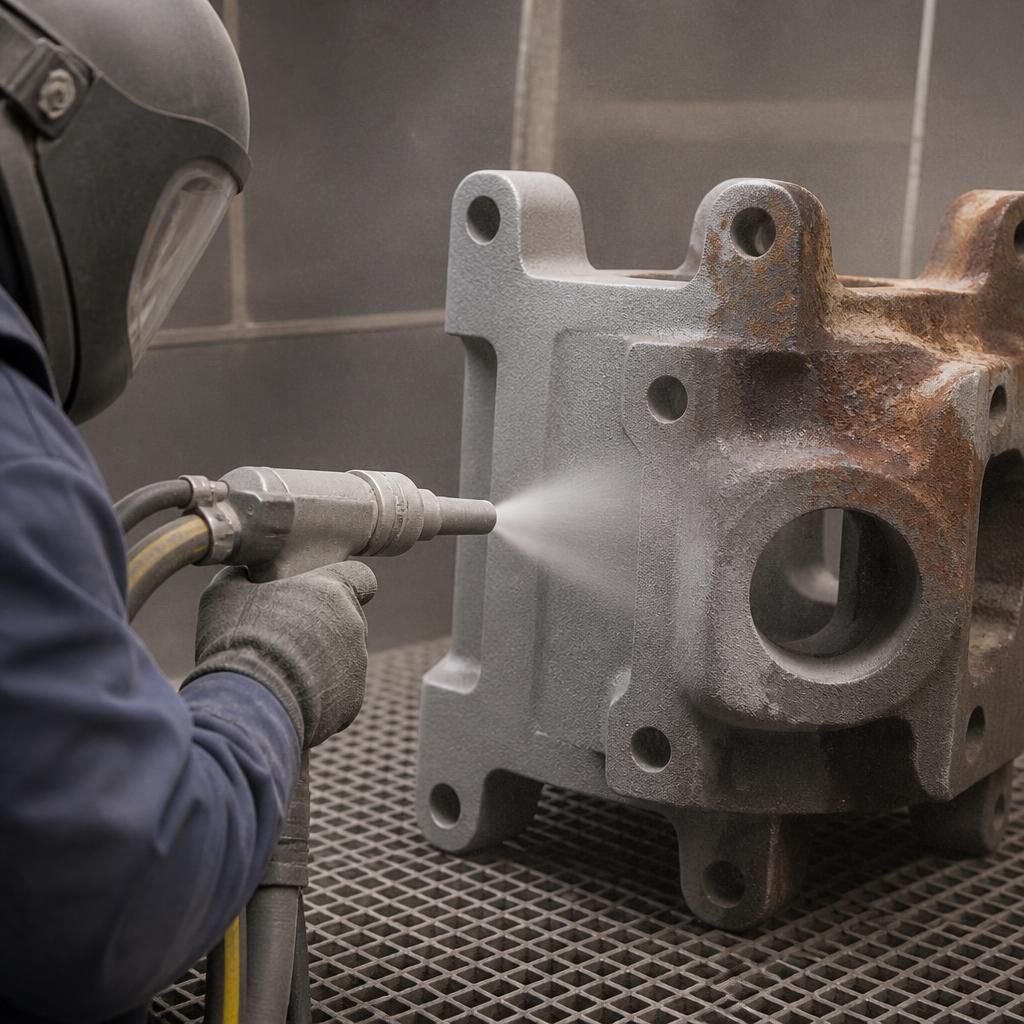
Cast iron is a strong candidate when corrosion has developed in its naturally textured surface. Abrasive blasting can reach rust and failed coating within shallow pits, casting marks and awkward recesses that are difficult to clean consistently by hand. This makes it useful for cast brackets, housings, machine components and similar industrial parts being prepared for powder coating repair.
Castings should be degreased before blasting because oil can remain in pores and may be driven further into the surface rather than removed. After blasting, the component should be checked for remaining contamination, loose particles and deep corrosion pits. These checks help distinguish a genuinely clean surface from one that only appears bright after the old coating has been removed.
Discuss Your Metal Surface and Powder Coating Repair Needs
Discuss your component with the powder coating repair team, including the base metal, existing coating and any areas where dimensions or surface condition are critical. They can assess whether controlled sandblasting is suitable and advise on the appropriate preparation approach.