

What safety and environmental considerations should be taken into account during sandblasting for powder coating repairs?
Sandblasting for powder coating repairs should be carried out with suitable respiratory and personal protective equipment, controlled abrasive-media handling, and effective containment to prevent dust exposure and protect nearby people and equipment. Environmental controls should include dust extraction, preventing contaminated residue from entering drains or soil, and disposing of spent abrasive and removed coating in accordance with applicable waste and hazardous-material requirements.
Safety and environmental control during sandblasting for powder coating repairs depends on assessing the existing coating, selecting a suitable abrasive and managing the process as a controlled engineering task. The main risks are not limited to airborne dust: old coatings may contain hazardous substances, blasting equipment operates at high pressure, and the process can generate noise, vibration, static electricity and contaminated waste.
Identify the existing coating before work begins. A repair may involve several layers of powder coating, paint, primer, corrosion products or previous repair materials. If the composition is unknown, it should be assessed before blasting so that the correct control measures and waste classification can be established. Particular caution is required where lead, chromates or other hazardous coating constituents may be present. A competent person should decide whether sampling or specialist analysis is necessary, especially for older industrial components or equipment with an uncertain history.
Carry out a task-specific risk assessment. The assessment should consider the substrate, coating condition, abrasive type, blasting pressure, workpiece geometry and the surrounding workplace. It should also cover access, manual handling, visibility, lighting, emergency arrangements and the possibility of abrasive ricochet. Controls should be recorded and communicated to everyone involved rather than relying on informal instructions.
Use trained operators and maintained equipment. Operators should understand the blasting system, abrasive characteristics and hazards associated with the coating being removed. Hoses, couplings, nozzles, valves, deadman controls, pressure vessels and other components should be inspected and maintained in line with the equipment manufacturer’s instructions. Damaged hoses, unsecured connections or defective shut-off controls can create serious impact and pressure-related hazards. Equipment should be isolated before maintenance, nozzle changes or clearing blockages.
Control pressure, rebound and workpiece movement. The selected pressure should be sufficient for the repair without unnecessarily damaging the metal substrate, edges, threads or machined surfaces. Components must be stable and supported so they cannot shift when struck by the abrasive stream. Operators should avoid directing the nozzle towards people, fragile fittings, unprotected machinery or surfaces that could produce a dangerous rebound. Smaller parts may require secure fixturing, while large components may need a planned lifting and handling method.
Consider hazardous abrasive materials carefully. Abrasives should be chosen for both surface-preparation performance and health risk. Materials containing respirable crystalline silica are subject to strict controls and restrictions when used for abrasive blasting. Alternatives may be more appropriate, depending on the required profile, coating thickness and substrate. Abrasive safety data should be reviewed before use, including information on composition, handling, storage and any hazards created when it becomes mixed with removed coating.
Account for noise, vibration and physical strain. Blasting equipment can produce high noise levels, so the assessment should determine whether hearing protection, exposure controls or health surveillance are required. Prolonged nozzle handling may also cause vibration and fatigue. Work should be organised to reduce awkward postures, excessive grip force and repetitive exposure. Mechanical handling aids can reduce the risk of strain when moving heavy components or abrasive containers.
Prevent ignition and electrical hazards. Dry abrasive blasting can generate static electricity, particularly where hoses, components or coatings are not suitably bonded. Appropriate earthing and bonding arrangements should be considered for the equipment and workpiece. Flammable materials, ignition sources and incompatible chemicals should be kept away from the blasting operation. Any coating residue or cleaning material that could create a fire risk should be identified before preparation begins.
Keep the work area controlled. Access should be restricted to people who need to be present, with clear instructions about the active blasting area and the risks from rebound, noise and equipment movement. Nearby machinery, electrical systems, bearings and finished surfaces should be protected from abrasive ingress where necessary. After blasting, the area and component should be checked for residual abrasive before the part is moved to inspection, masking or powder coating.
Manage contaminated material separately. Spent abrasive is not automatically ordinary waste. Its classification may depend on the abrasive itself and the coating, corrosion products or contaminants collected during use. Records should identify what was removed and how the resulting material was handled. Where hazardous substances are suspected, the waste should be kept in suitable labelled containers and transferred through an appropriate waste route. Reuse of abrasive is only suitable where the equipment and process allow it and the material remains fit for purpose; contaminated or degraded media should not be reused simply to reduce waste.
Reduce environmental impact at source. Practical measures include selecting an abrasive with an appropriate service life, avoiding excessive blasting pressure, using only the quantity required and preventing unnecessary rework. Abrasive residues should not be swept into general workplace areas or allowed to migrate beyond the controlled process. Any cleaning method used afterwards should be selected so that it does not create a separate contaminated water or chemical-handling problem.
Maintain records and investigate irregularities. A controlled process should record the component identity, coating concerns, abrasive selected, inspection findings and any unusual event such as equipment failure, unexpected coating composition or damage to the substrate. Near misses and defects should be reviewed before the next batch is processed. This provides traceability and helps ensure that a repair is safe to continue through preparation and powder coating.
For industrial repair work, the safest approach is to treat sandblasting as one stage in a documented surface-preparation process. The condition and chemistry of the old coating, the integrity of the metal, the suitability of the abrasive and the final waste route should all be confirmed before blasting starts.
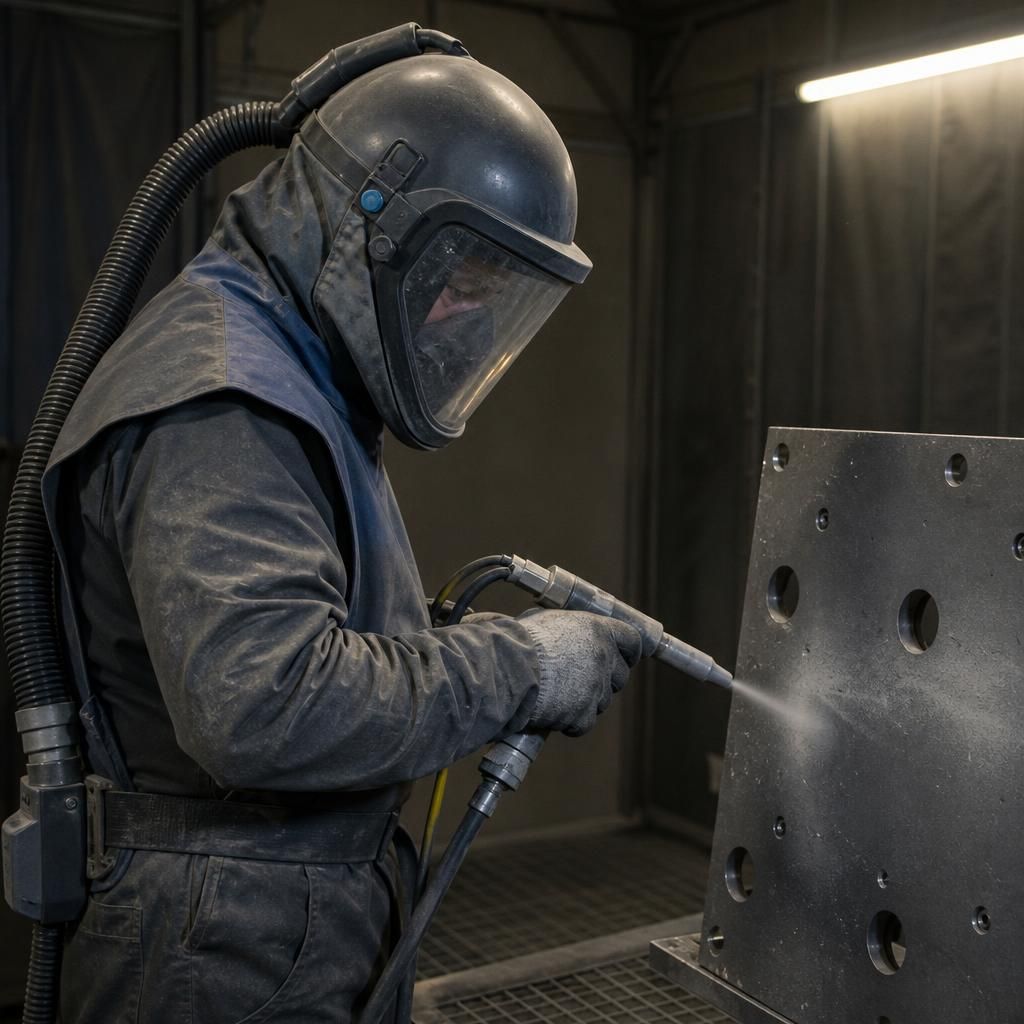
Respiratory protection for sandblasting must be selected according to the abrasive dust and the coating being removed, rather than treated as a standard disposable-mask requirement. The risk assessment should confirm whether suitable powered or supplied-air respiratory protective equipment is needed, and whether its filters protect against the identified contaminants.
RPE is only effective when it fits correctly and is compatible with other protective equipment. Tight-fitting masks require face-fit testing and a clean sealing area; facial hair, damaged seals or incorrect adjustment can allow contaminated air to bypass the filter. Operators should also follow the manufacturer’s instructions for inspection, cleaning, storage and filter replacement, particularly after blasting coatings of uncertain composition.
Discuss Safer Sandblasting for Powder Coating Repairs
Discuss your component and existing coating with a powder-coating specialist before arranging repair work, particularly where the coating history or potential contaminants are uncertain. They can help determine whether controlled sandblasting is suitable and what preparation and waste-handling requirements apply.