

What are the risks of neglecting rust and corrosion issues on powder-coated metal components, and how can timely repairs mitigate these risks?
Neglected rust and corrosion can spread beneath the powder coating, reduce the strength and serviceability of metal components, and lead to more extensive repairs or replacement. Timely repair involves removing corrosion, treating the affected metal, addressing coating damage and applying a suitable new finish before the problem progresses.
Neglecting rust and corrosion on powder-coated metal can turn a local coating defect into a wider operational, safety and maintenance problem. Timely repair limits the period in which moisture and contaminants can reach the metal, identifies whether the component remains suitable for use, and restores protection before corrosion affects fit, function or structural details.
Powder coating is a barrier rather than a cure for corrosion. Once the finish is damaged, poorly bonded or exposed at an edge, water can enter through scratches, chips, drilled holes, cut ends, welds, joints and fixing points. Crevices and water traps are particularly vulnerable because they can retain moisture and contaminants for extended periods. Corrosion may therefore develop in areas that are difficult to see during a routine visual inspection.
- Loss of dimensional accuracy: corrosion products can build up around mating faces, apertures, threads and sliding parts. This may affect assembly, adjustment or the clearance between components.
- Damage to fixings and joints: rust around bolts, brackets, hinges and welded connections can interfere with removal and weaken the reliability of the joint. Seized fixings can also make later maintenance more disruptive.
- Contamination of surrounding areas: loose rust, staining and coating fragments can transfer to adjacent parts, finished surfaces, products or drainage systems.
- Reduced visual and specification compliance: visible staining, blistering, flaking or uneven repairs may make a component unsuitable for a customer-facing installation or a project with defined finish requirements.
- Greater safety exposure: corrosion affecting guards, supports, access equipment, vehicle parts or other safety-relevant components requires careful assessment. A coating repair must not be treated as a substitute for an engineering inspection where metal loss may affect load-bearing performance.
- More difficult future maintenance: corrosion that is left in place can make preparation more extensive, particularly where rust has entered joints, hollow sections or inaccessible areas.
The first response should be an assessment rather than simply applying fresh powder over the affected area. The component should be examined for the source and extent of the defect, including water retention, damaged edges, incompatible contact with other metals, failed sealants, mechanical impact and unsuitable previous preparation. The inspection should distinguish superficial surface staining from pitting, section loss, cracking or damage that requires engineering attention.
Timely repair normally starts with removing loose or compromised coating and corrosion until a sound substrate is available. The preparation method depends on the component, the existing finish and the degree of corrosion; it may involve mechanical preparation, abrasive treatment or another controlled method suitable for the metal. Dirt, oil, salts and preparation residues must also be removed, because contamination can interfere with adhesion and encourage recurrence.
Where corrosion has caused only limited surface damage, the prepared metal can be treated and recoated using a compatible protective system. Where pitting or metal loss is present, the component may need a separate metal repair, replacement of a damaged section or an engineering decision that coating alone is insufficient. Threads, mating faces, drainage paths and moving interfaces should be protected from unwanted coating build-up so that the repaired part remains usable.
The choice between a local repair and full stripping and recoating depends on the extent of the damage, the component’s geometry, the condition of the surrounding finish and the required appearance. A local repair can be appropriate when the affected area is clearly contained and the surrounding coating is sound. A larger-area or complete recoat may be more suitable where adhesion is uncertain, corrosion is present at several points, or a consistent finish is required across the component.
Repair also provides an opportunity to address the condition that allowed corrosion to start. This can include improving drainage, sealing an exposed joint, protecting a cut edge, correcting handling damage or reviewing contact between dissimilar metals. Without addressing that cause, a visually satisfactory repair may remain vulnerable to the same failure mechanism.
After recoating, checks should cover the repaired areas as well as nearby edges, recesses, holes and interfaces. The finish should be examined for missed preparation defects, incomplete coverage, contamination, blistering and damage caused during handling. Components should then be stored and transported in a way that prevents abrasion and trapped moisture before installation.
For manufacturers, fabricators, construction firms and automotive businesses, early reporting is especially useful when corrosion appears on a batch or on components exposed to the same environment. Comparing affected parts can reveal whether the issue relates to design, pretreatment, handling, installation or service conditions. A coating specialist can help establish the repair scope, while any concern about structural integrity, safety or metal section loss should be referred to the relevant engineer or responsible person.
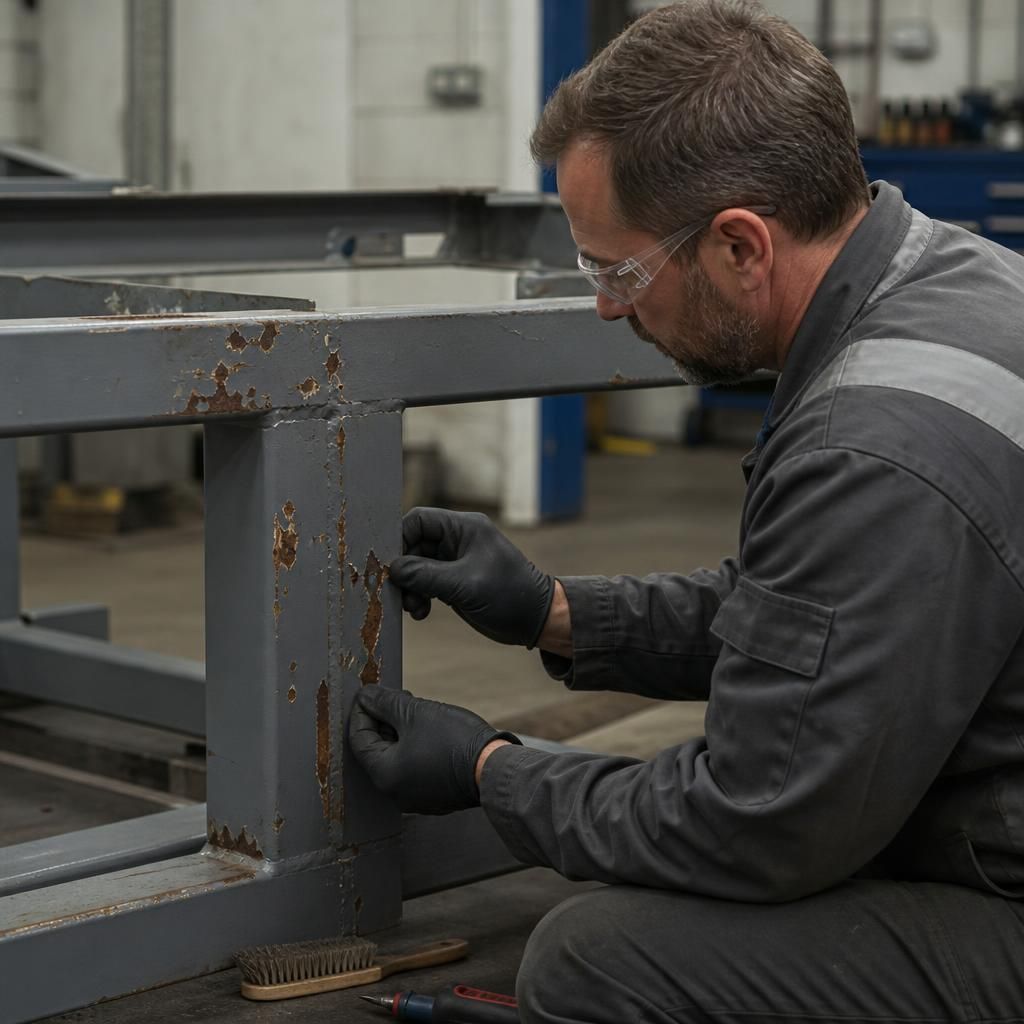
The urgency of a rust repair depends on the component’s service environment as well as the visible size of the defect. Metal exposed to road salt, industrial chemicals, washdown water, condensation or persistent outdoor moisture can deteriorate more quickly than a similar component in a dry indoor setting. A small chip should therefore be prioritised where contamination or water can repeatedly reach the exposed substrate.
Timely repair reduces this exposure by removing the damaged finish, preparing the affected metal and reinstating a continuous protective coating. Assessing the surrounding environment also helps determine whether the repaired component needs improved edge protection, sealing or a coating system suited to its service conditions, rather than simply matching the existing colour.
Discuss Rust and Corrosion Repair for Your Components
If rust or corrosion has appeared on a powder-coated component, contact a specialist to discuss the affected metal, its service conditions and the appropriate repair scope. Provide component details and photographs where possible so the condition can be assessed before deciding between local repair and wider recoating.