

Why is it important to thoroughly clean and degrease metal surfaces after removing old coatings?
Thorough cleaning and degreasing removes oils, grease, dust, salts and stripping residues that can interfere with powder adhesion and curing. If these contaminants remain, they may cause defects such as cratering, blistering, poor coverage or premature corrosion, reducing the durability of the refinished metal surface.
Thorough cleaning and degreasing after old coating has been removed is essential because it establishes a chemically suitable, uniformly wettable surface for the next stage of finishing. Stripping may expose the metal, but it does not necessarily leave it ready for pretreatment or powder coating. The removal process can alter the surface by leaving behind chemicals, fine abrasive particles, softened coating, or corrosion products that must be dealt with separately.
Cleaning and degreasing are related but different operations. Cleaning removes loose material and water-soluble contamination, while degreasing targets tightly held organic contamination such as machining lubricant, handling marks, wax and process oils. A component may appear visually clean and still fail a practical cleanliness check if water pulls away from parts of the surface rather than forming an even film. This uneven wetting indicates that contamination remains.
Any residue from chemical stripping requires particular attention. Strippers can lodge in seams, threaded holes, folded edges, weld irregularities and other areas that are difficult to rinse. If they are not removed, they may continue reacting with the substrate or interfere with subsequent preparation. Absorbent blasting media and loose particles can create a similar problem where they remain trapped in recesses. Cleaning therefore needs to address the complete component, not only the broad faces that are easy to reach.
The appropriate cleaning method depends on the substrate, the type of contamination and the component’s construction. Common options include:
- Water-based alkaline cleaning: suitable for removing many workshop and manufacturing contaminants, provided the cleaner is compatible with the metal and is thoroughly rinsed afterwards.
- Solvent degreasing: useful for localised or persistent organic contamination, but it must be controlled carefully and followed by suitable handling so the cleaned surface is not immediately recontaminated.
- Pressure rinsing: helps flush residues from joints, cavities and profiles, although the pressure and temperature must not force contamination deeper into the component or damage delicate features.
- Mechanical cleaning: brushing or controlled abrasion may assist with deposits that are not removed chemically, but it should not be used in a way that unnecessarily changes dimensions or creates an unsuitable surface profile.
After the cleaning stage, rinsing is just as important as the choice of cleaner. Remaining detergent or dissolved contamination can affect later pretreatment and may leave deposits as the water evaporates. Components should be allowed to drain fully, with particular care taken around overlaps, hollow sections, drilled holes and internal corners. Drying must be complete before further preparation because trapped moisture can contribute to flash corrosion on ferrous metals and can dilute or disrupt subsequent treatment.
The cleaned metal should then be inspected under suitable lighting. Inspection should cover edges, welds, recesses, fixing points and areas that were previously concealed by the old coating. The aim is to identify remaining contamination as well as defects in the substrate, including pitting, corrosion, sharp edges, weld spatter and damage revealed by stripping. Cleaning cannot correct those physical conditions, but it makes them easier to assess before a new finish is applied.
Handling controls are also important at this stage. Bare metal should be touched as little as possible, and clean gloves, protected work surfaces and uncontaminated tools help prevent the return of skin oils or workshop debris. Components should not be placed directly on dirty benches or allowed to collect dust while waiting for the next operation. If contamination reappears, the affected area may need to be cleaned again rather than relying on the powder coating process to conceal it.
For steel, the interval between final cleaning and subsequent preparation should be managed carefully because newly exposed metal can begin to oxidise. Aluminium and other non-ferrous substrates have different chemical requirements and may need a compatible conversion or adhesion-promoting pretreatment. The cleaning process must therefore be selected with the base metal, its condition and the intended coating system in mind.
In practice, a sound sequence is to remove loose material, degrease, rinse, inspect, dry completely and then carry out the specified pretreatment or final preparation. Keeping these stages separate makes it easier to identify whether a problem comes from residual contamination, the substrate itself or the coating application. For components being prepared for refurbishment, this assessment is particularly important because the condition revealed after stripping determines whether cleaning alone is sufficient or whether additional surface preparation is required.
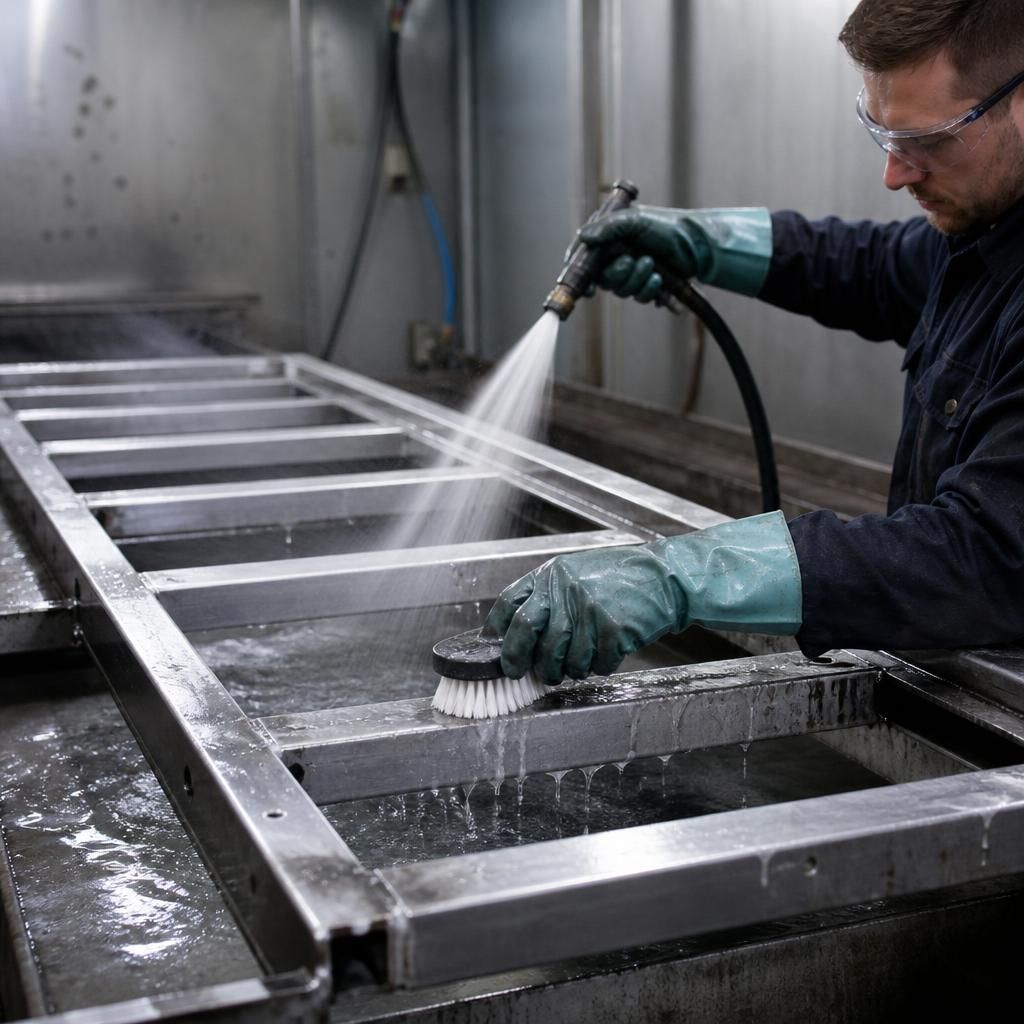
Cleaning and degreasing must remove contamination without damaging the newly exposed substrate. A cleaner that is too aggressive, poorly matched to the metal or left on the surface can etch aluminium, attack zinc-rich areas, alter the surface condition or leave deposits that compromise the next treatment.
This is why the cleaning stage should be selected according to the base metal and the coating system that will follow. Steel, aluminium and galvanised components do not necessarily tolerate the same chemistry or contact conditions. Controlled cleaning, thorough removal of the cleaning agent and careful handling help ensure that the surface is prepared for genuine adhesion rather than merely made to look clean.