

What are the advantages of using chemical stripping over mechanical methods for removing old powder coatings?
Chemical stripping can remove old powder coating from complex shapes, recesses and awkward areas without the abrasion, distortion or profile changes that mechanical methods may cause. It is therefore often preferable where preserving the metal substrate and reaching a consistent, coating-free surface are more important than removing material by force.
Chemical stripping offers several advantages over mechanical powder coating removal because it dissolves, softens or lifts the coating through a controlled chemical reaction rather than relying on cutting, blasting or abrasion. This can reduce physical loading on the component, retain original dimensions and provide a more practical route for removing coatings that are strongly bonded or difficult to access mechanically.
Key advantages of chemical stripping include:
- Less risk of altering dimensions: Mechanical methods remove material through impact or abrasion. On precision components, prolonged blasting, grinding or sanding can affect edges, tolerances and surface geometry. A compatible chemical process attacks the coating while leaving the underlying metal substantially unaffected when correctly controlled.
- Reduced risk of embedding abrasive media: Blasting can leave abrasive particles in recesses, joints or porous areas. Chemical stripping avoids introducing a blasting medium, although the component still requires thorough rinsing and cleaning afterwards to remove softened coating and chemical residues.
- Access to enclosed and detailed construction: Chemical solutions can enter joints, channels, threaded areas and other features that are difficult to treat consistently with a mechanical tool. This is particularly useful where a component has multiple faces or a coating must be removed from areas that cannot be reached directly.
- Lower risk of heat-related damage: Grinding and some high-energy mechanical processes generate localised heat. Excessive heat can affect thin sections, distort components or create difficulties where the metal has already been repaired or heat-treated. Chemical stripping is generally a lower-temperature process, subject to the specification of the treatment system.
- More uniform treatment of batches: In a controlled chemical process, components can be treated using defined immersion times, solution conditions and rinsing stages. This can make the removal process more repeatable across batches than relying entirely on the pressure, angle and duration applied by an operator using hand-held equipment.
- Potentially lower manual effort: Once the correct chemical system has been selected, the coating can be loosened before it is washed or removed. This may reduce the amount of prolonged hand grinding or scraping needed, particularly on parts with extensive coating coverage. The overall effort still depends on coating thickness, cure level, substrate, component size and the condition of the stripping solution.
- Better preparation for inspection and repair: Removing the coating without heavily marking the metal can make it easier to examine welds, joints, pits, corrosion and other defects. This gives the repair or finishing process a clearer view of the substrate before remedial work and recoating are considered.
These benefits depend on matching the stripping chemistry to the substrate and the existing coating. Steel, aluminium, galvanised metal and other alloys do not necessarily tolerate the same products or process conditions. The wrong formulation, concentration or exposure time can stain, etch or otherwise attack the metal, so chemical stripping should be selected and controlled by someone familiar with the component material and its intended finish.
Chemical stripping is not automatically preferable in every situation. Mechanical removal may be more suitable for localised coating defects, small accessible areas or components that cannot be safely immersed. Chemical treatment can also generate contaminated liquid, sludge and rinse water that must be contained, handled and disposed of in accordance with applicable environmental requirements. Operators must use the specified protective equipment, ventilation and handling procedures for the chemicals involved.
After stripping, the component normally needs a defined cleaning and preparation sequence. Rinsing removes remaining chemicals and loosened coating; drying prevents flash corrosion on susceptible metals; and further cleaning or surface preparation may be required before a new powder coating is applied. If residues remain, they can interfere with adhesion, cause surface defects or affect the durability of the replacement finish.
In practice, chemical stripping is most advantageous where the component has valuable or tightly controlled dimensions, contains areas that are difficult to treat with tools, or needs to be processed in a consistent batch system. The decision should consider the metal alloy, coating type, component construction, required turnaround through the process, waste controls and the surface condition required before repair or recoating.
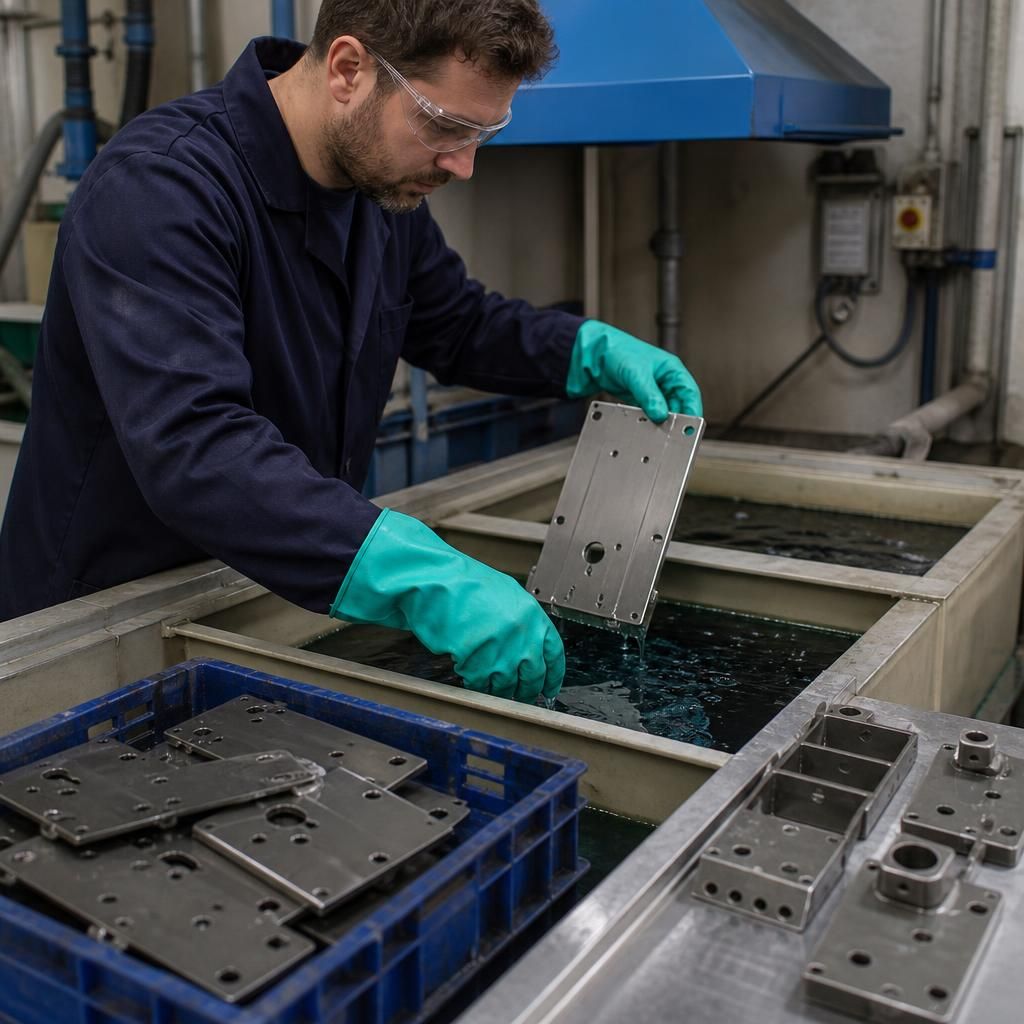
A controlled trial is an important advantage of chemical stripping because it allows the treatment to be assessed on a representative component before the full batch is processed. The trial can confirm that the selected chemistry removes the powder coating without staining, etching or adversely affecting the particular metal alloy.
Assessment should include the stripped surface, edges, recesses, threaded features and any repaired areas. It should also establish suitable immersion, rinsing and neutralisation conditions. This validation helps prevent an unsuitable process from being applied across a batch and provides a defined basis for the subsequent repair or recoating preparation.