

How does the condition of the existing coating affect the choice of removal method?
The condition of the existing coating determines how aggressively it needs to be removed and which method is least likely to damage the metal beneath. Firm, well-bonded coatings may require mechanical or chemical stripping, while flaking, cracked or poorly adhered coatings can often be removed with a less intensive approach before the substrate is assessed and prepared.
The condition of an existing coating determines whether removal should be selective, progressive or complete. The main factors are adhesion, coating thickness, the number of coating layers, the presence of corrosion or contamination, and how securely the coating is attached around edges, joints and damaged areas. A sound coating may need a controlled stripping process, whereas a deteriorated coating can often be removed with less aggressive preparation before the metal is assessed.
Adhesion is one of the first considerations. A firmly bonded powder coating resists light abrasion and may require more sustained mechanical action, abrasive blasting or a suitable chemical stripper. If adhesion varies across the component, using one aggressive method over the whole surface can be inefficient and may create unnecessary damage in areas where the coating is already loose. Scraping, brushing or low-intensity abrasion may be appropriate for lifting detached sections before treating the remaining bonded material.
Cracking, blistering and flaking indicate different removal requirements. Flaking coating can sometimes be lifted mechanically, but cracks and blisters may conceal corrosion, trapped moisture or contamination. These areas should not simply be smoothed over. The defective coating needs to be removed far enough to establish whether the problem is limited to the finish or extends into the metal beneath it. Where corrosion has undermined the coating, abrasive preparation may be needed to expose and clean the affected area, subject to the geometry and sensitivity of the component.
Coating thickness and layered finishes also affect method selection. Multiple powder coats, powder over primer, or powder applied over an older paint system can take longer to remove than a single, intact layer. Mechanical work may remove the upper layer while leaving an older coating behind, making visual inspection important. Chemical stripping can be useful where several layers need to be softened together, although the stripper must be compatible with the metal and any areas that should remain protected. Thick deposits may be dealt with in stages rather than by applying excessive force or heat at once.
Contamination can change the practical choice. Oil, grease, road dirt, sealants and production residues may prevent a chemical stripper from reaching the coating evenly or clog abrasive media. Heavy contamination generally needs to be identified and dealt with before the main removal process. Similarly, a coating that has absorbed contaminants or has degraded unevenly may produce an inconsistent result, so a small test area can help establish how it responds before the complete component is treated.
The condition of the coating should also be considered alongside the shape and construction of the part. Mechanical methods are more controllable on accessible, flat areas, but can be difficult around recesses, welds, threads and intricate profiles. Chemical methods can reach complex surfaces, although residues may remain in joints or cavities if the process is not carefully controlled. Heat-based removal can affect the coating and any underlying treatment, so it is not automatically suitable simply because the finish is old or damaged.
A practical assessment normally includes:
- checking whether the coating is firmly attached, locally detached or failing across the whole part;
- identifying cracks, blisters, corrosion staining, impact damage and areas of exposed metal;
- examining edges, holes, welds, folds and recesses where coating failure or residue may be concentrated;
- determining whether the finish is a single layer or part of a multi-layer system;
- looking for oil, grease, sealants or other materials that could interfere with removal; and
- testing the proposed process on a representative area where the coating condition is variable.
In many cases, the most suitable approach is a combination of methods rather than a choice between one method and another. Loose material may be removed first, firmly bonded areas treated with controlled abrasion or stripping, and difficult edges or recesses finished separately. The process should stop once the required coating has been removed and the metal is suitable for inspection and subsequent preparation; continuing to work an already exposed area can alter its profile or create avoidable marks.
For industrial components, recording the coating condition before removal helps explain why different areas receive different treatment. It also makes it easier to identify whether a defect originated in the old coating, the underlying metal or an earlier preparation stage. The removal method should therefore be selected not only for how quickly it breaks down the coating, but for how reliably it exposes the surface without compromising the component’s condition for repair or recoating.
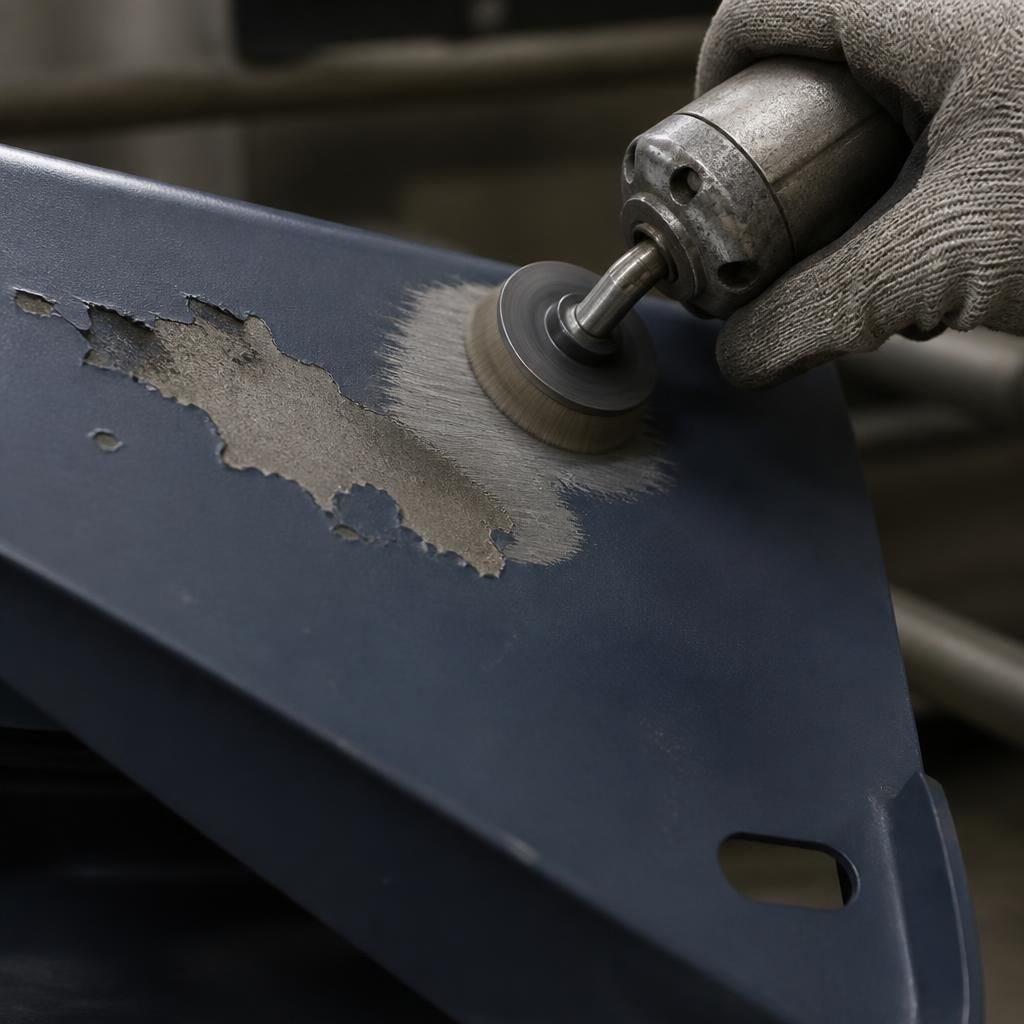
The condition of the coating edge is important when removal is limited to a damaged area. A hard boundary between removed and retained coating can leave a visible step and make subsequent repair or recoating less reliable. Controlled mechanical abrasion is often suited to feathering the edge gradually into sound coating, whereas a broad chemical treatment may remove more material than the repair requires.
Where the coating has lifted around an impact, chip or blister, removal should extend beyond the visibly defective spot until the remaining edge is firmly bonded. The transition should then be checked for trapped residue, undercutting and loose film before preparation continues. This approach uses the condition of the surrounding coating to define the removal boundary, rather than relying on the damaged area alone.