

What are the key factors to consider when selecting a primer for industrial powder coating repairs?
Select a primer for industrial powder coating repairs by assessing the substrate, existing coating, corrosion risk, service environment and required adhesion. Confirm that the primer is chemically and thermally compatible with the repair coating, suitable for the preparation method, and capable of curing within the repair process.
Selecting a primer for an industrial powder coating repair requires more than choosing a product labelled as corrosion-resistant. The decision should also account for the size and location of the repair, the required film build, the application method, the recoat window, edge coverage, appearance and the conditions under which the repaired component will be handled or installed.
Define the repair scope first. A small chip, a cut edge, a drilled area and a larger section of coating loss may require different primer characteristics. Localised damage usually benefits from a primer that can be applied accurately without excessive build at the boundary of the sound powder coating. Larger repairs may require a product that can be applied evenly over a wider area and integrated with the subsequent topcoat. The repair specification should state whether the primer is intended for bare metal only or may also overlap the existing coating.
Consider the geometry of the component. Corners, welds, folded edges, recesses, holes and narrow profiles can be difficult to coat uniformly. A primer with suitable flow and edge coverage can reduce the risk of thin areas at exposed edges, while excessive flow may cause runs or pooling in corners. On fabricated parts, weld spatter, sharp transitions and heat-affected areas should be considered when deciding how the primer will be applied and inspected.
Match the primer to the required film build. The product data should specify the recommended dry film thickness and any limitations on applying it in a single coat. Too little primer may leave inadequate protection at the repair, whereas excessive thickness can affect drying, adhesion, surface appearance and the fit of adjoining components. Film build is particularly important where the repaired part must meet dimensional tolerances or where a powder topcoat will be applied over the primer.
Check the application method and equipment. A primer suitable for brush application may not produce the same result when sprayed, and some products require a particular thinner, nozzle arrangement or application technique. The choice should reflect the equipment available for the repair and the accessibility of the damaged area. The technical documentation should also clarify mixing requirements, pot life for two-component materials, induction time where applicable and cleaning requirements between applications.
Review the recoat window carefully. The primer must remain suitable for receiving the repair coating within the planned process. Applying the topcoat too soon may disturb or soften the primer, while exceeding the stated recoat interval may require additional surface preparation before coating. These limits matter when repaired parts are handled in stages or when the primer and finishing coat are applied by different teams.
Assess the finish requirements. A protective primer may be hidden beneath the final powder coating, but its colour, texture and surface profile can still influence the appearance of the repair. This is relevant to smooth, fine-textured, matt and gloss finishes, as well as to light colours where uneven coverage or localised build may be more visible. The selected system should allow the topcoat to reproduce the required finish without visible mapping, pinholing or edge telegraphing.
Confirm the repair process is documented. A suitable specification should record:
- the permitted primer type and intended use;
- the preparation and application method;
- the target dry film thickness;
- the required drying or curing conditions;
- the minimum and maximum recoat intervals;
- the topcoat system to be applied;
- the inspection method and acceptance criteria.
Use technical data and a controlled trial where necessary. Product literature should be treated as the starting point, not as a substitute for checking the complete repair system. A small test area can reveal problems with wetting, edge appearance, colour development, surface texture or adhesion before the process is used on production components. Testing is especially useful where the existing powder coating is unidentified, the repair crosses several substrates or the component has demanding appearance requirements.
Consider handling and installation conditions. The primer and topcoat should have developed sufficient resistance before the component is packed, transported, assembled or exposed to its working environment. A coating that appears dry at the surface may not yet have reached its required hardness or resistance throughout the film. The repair specification should therefore distinguish between surface-dry time, recoat readiness and full cure, rather than treating them as the same stage.
For industrial work, the most reliable choice is the primer that fits the complete repair procedure rather than the product with the broadest claim on its label. Substrate condition, coating system, application controls, film thickness, recoat timing, appearance and handling requirements should be reviewed together, with the final selection supported by the manufacturer’s technical documentation and, where appropriate, a representative trial.
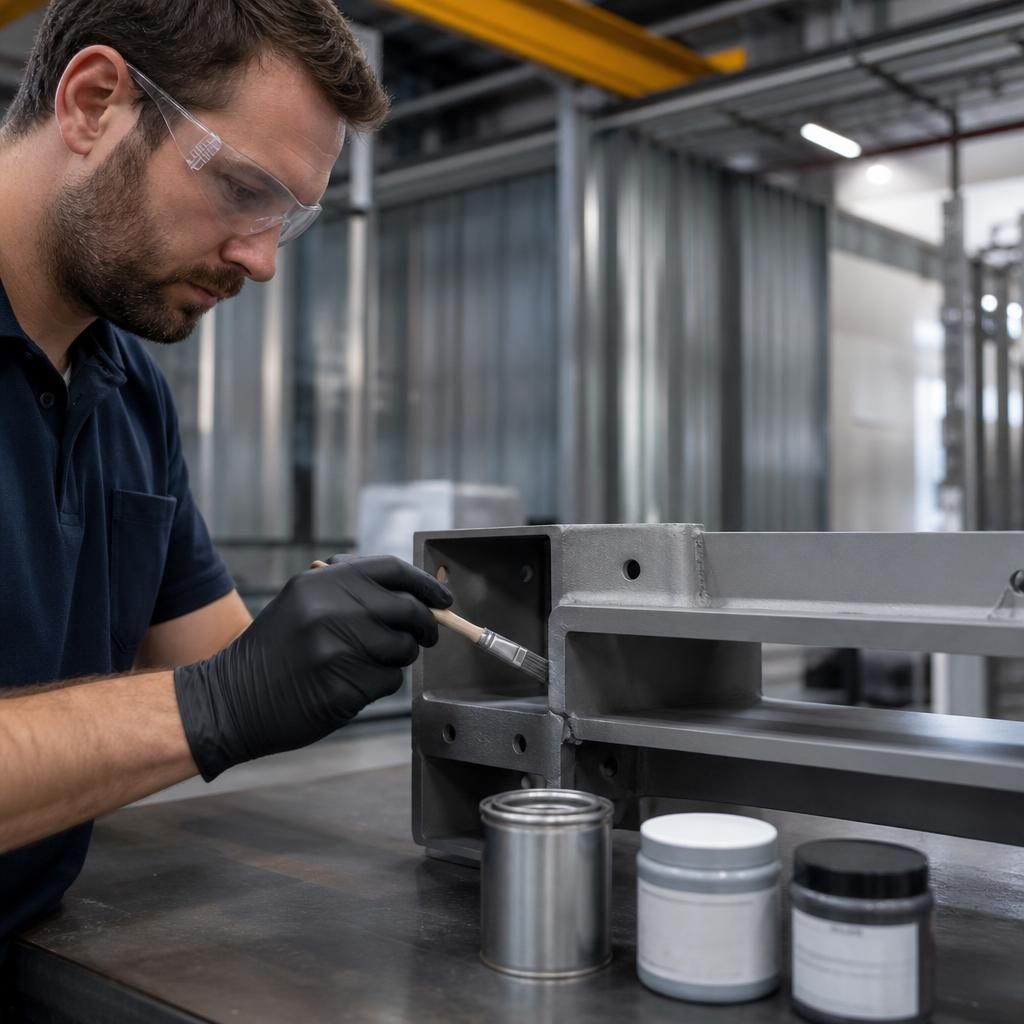
For repairs involving dissimilar metals, galvanic compatibility is an important primer-selection factor. If aluminium, galvanised steel, mild steel or stainless steel are joined in the same component, moisture at an exposed repair can allow an electrochemical reaction between the metals. The primer should therefore be suitable for the specific substrate and able to provide a continuous barrier beneath the repair coating.
Check whether the primer is approved for use on each exposed metal, particularly where the repair crosses a joint, weld or fixing. A product suitable for prepared steel may not provide reliable adhesion or protection on aluminium or galvanised surfaces. The technical data should also identify any restrictions involving zinc-rich products, conductive primers or contact with adjacent metals.
Where the substrate combination is uncertain, assess the complete repair arrangement rather than selecting a primer from the topcoat colour or finish alone. Confirm compatibility with the existing powder coating, the exposed metals and any sealants or adjacent materials, then inspect the repaired area for continuous coverage at joints and edges.