

How do protective primers enhance adhesion and corrosion resistance in powder coating repairs?
Protective primers enhance powder coating repairs by creating a stable bonding layer between the prepared metal and the repair coating, helping it adhere securely. They also provide an additional barrier against moisture and corrosion, particularly where the original finish has been damaged or the substrate is exposed.
Protective primers improve a powder coating repair by controlling the interface between the exposed metal and the replacement coating. Their contribution is greatest when the repair area has lost its original finish, contains feathered coating edges, or is exposed to moisture, salts, chemicals or repeated wetting and drying. The primer must be selected and applied as part of a compatible coating system; it cannot compensate for contamination, loose coating or inadequate preparation.
How primers improve adhesion
Adhesion depends on the repair coating making close, continuous contact with a suitably prepared surface. A protective primer helps in several ways:
- Improved wetting: the primer can flow across the prepared substrate and reduce small gaps between the surface and the repair coating. This is particularly useful on irregular metal, feathered powder coating edges and areas affected by light surface pitting.
- Mechanical keying: a correctly prepared primer layer provides a controlled surface profile for the subsequent coating to grip. Abrasion must be sufficient to remove weak material and create a sound key without leaving deep scratches that remain visible through the repair.
- Chemical compatibility: some primers are formulated to bond with particular substrates or coating types. The selected product should be suitable for the metal, the existing powder coating and the repair material, including the intended curing conditions.
- Edge reinforcement: repairs often include a transition between intact powder coating and exposed substrate. A primer can help protect this boundary, provided the original coating is firmly attached and the edge has been tapered rather than left as a sharp, lifting step.
These effects are only reliable when the substrate is sound. Oil, grease, fingerprints, salts, dust, rust scale and residues from previous cleaning can prevent the primer from contacting the surface properly. Any loose or poorly bonded powder coating should be removed, and the surrounding finish should be abraded and cleaned according to the requirements of the chosen system.
How primers help resist corrosion
Corrosion begins when moisture and contaminants reach a susceptible metal surface. A protective primer reduces the opportunity for this process by limiting access to the substrate and, depending on its formulation, by providing additional corrosion-inhibiting properties. This is important at scratches, chips, drilled edges, joints and other discontinuities where the original powder coating no longer provides complete coverage.
Primer protection is not simply a matter of applying a thicker layer. A continuous, properly cured film is more useful than excessive thickness that remains soft, cracks or interferes with the finish coat. The coating system should also cover the full repair profile, including edges and recessed areas, without leaving pinholes or uncoated sections. Where corrosion has already formed, visible rust and corrosion products need to be removed or treated in accordance with the selected primer’s technical requirements. Painting over active corrosion can leave the defect progressing beneath the repair.
The primer also helps reduce the risk that a small coating defect develops into a larger area of underfilm corrosion. If moisture enters through a chip or damaged edge, corrosion can spread laterally beneath a poorly bonded coating. Sound preparation, firm edge treatment and a compatible primer reduce the routes by which moisture can travel, although the level of protection depends on the environment and the condition of the underlying metal.
Factors that determine the result
Primer performance is influenced by the complete repair process rather than by product choice alone. Important considerations include:
- Substrate type: steel, galvanised steel, aluminium and other metals can require different preparation methods and primer chemistries. A product suitable for one substrate may not provide the same adhesion or corrosion protection on another.
- Condition of the existing finish: firmly attached powder coating can normally be prepared around the repair, but blistered, delaminated or contaminated coating can undermine the new system if it is left in place.
- Environmental exposure: humidity, condensation, road salts, industrial pollutants, cleaning chemicals and immersion impose different demands. A primer intended for a relatively mild indoor application may be unsuitable for an exposed or corrosive location.
- Film thickness and coverage: the manufacturer’s specified application range should be followed. Insufficient coverage may leave weak points, while excessive application can affect curing, appearance and intercoat adhesion.
- Recoat interval and curing: the repair coating must be applied within the primer’s permitted recoat window. If the primer has fully cured beyond that window, additional preparation may be needed. If it has not cured sufficiently, solvents or subsequent curing can disturb the interface.
- Finish-coat compatibility: the primer and powder coating should be assessed as a system. Differences in chemistry, curing temperature, flexibility or solvent resistance can lead to lifting, wrinkling, poor adhesion or premature failure.
Typical repair sequence
- Inspect the damaged area and establish whether the surrounding powder coating remains securely bonded.
- Remove loose coating, rust, scale and other unstable material, extending preparation far enough to reach sound edges.
- Degrease and clean the surface using a method compatible with both the substrate and the coating system.
- Abrade or otherwise prepare the exposed metal and the adjacent intact coating to provide a suitable key.
- Apply the selected protective primer evenly, paying particular attention to exposed edges, corners, recesses and other areas where coverage can be missed.
- Allow the primer to cure under the specified conditions, then apply the compatible repair powder or other approved finish within the required recoat conditions.
- Inspect the completed repair for missed areas, pinholes, runs, poor edge blending and visible signs of incomplete cure.
Where the original powder coating has suffered extensive loss, widespread corrosion or repeated coating failure, a local touch-up may not be the appropriate solution. In such cases, the condition of the component, the exposure environment and the required appearance should be reviewed before deciding whether a larger area needs preparation and recoating. For manufacturers, fabricators, construction firms and automotive businesses across the Midlands, a specialist powder coating service can assess the component and advise on a repair approach suited to its substrate and operating conditions, with collection and delivery options available across the region.
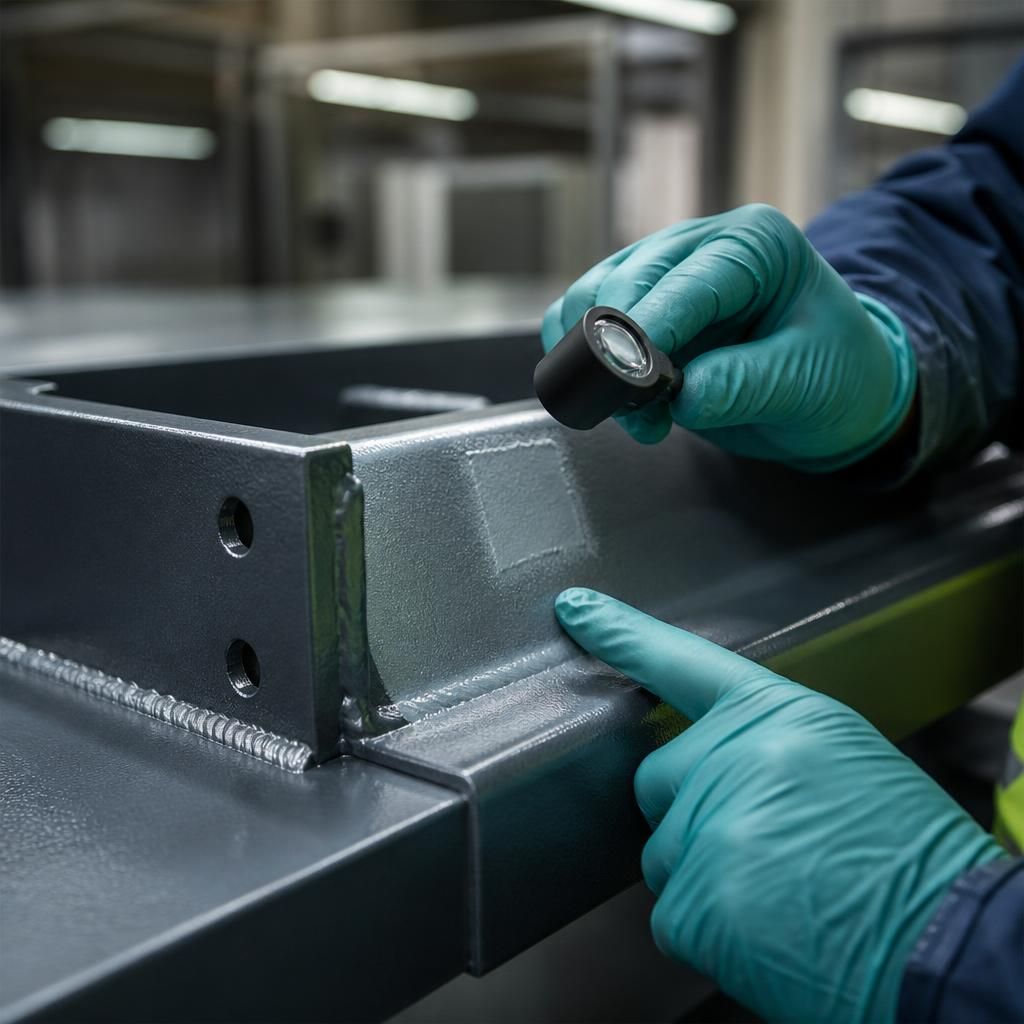
The contribution of a protective primer should be verified at the coating interface, not judged by appearance alone. A small trial area or representative test piece can confirm that the primer wets the prepared surface, remains firmly attached after curing and accepts the intended repair coating without lifting, wrinkling or other signs of incompatibility.
Inspection should also check for discontinuities in the primer film, particularly around edges, corners and surface imperfections. Areas that appear covered may still contain pinholes or thin spots that allow moisture to reach the metal. Confirming adhesion and continuous coverage before completing a larger repair helps identify application or compatibility problems while they can still be corrected.