

How can the choice of primer influence the longevity and performance of a powder coating repair?
The right primer improves the longevity and performance of a powder coating repair by promoting adhesion and protecting exposed metal from corrosion beneath the repaired area. An incompatible or poorly applied primer can reduce bond strength, cause blistering or flaking, and allow corrosion to undermine the finish.
Primer choice affects the service life of a powder coating repair by determining how well the repair tolerates its operating conditions, how consistently it cures, and how effectively it bridges the transition between exposed substrate and the surrounding coating. The best selection is therefore based on the metal, the existing coating system, the repair environment and the application method rather than on primer type alone.
Compatibility with the existing coating system
A repair primer must be suitable for use beneath the chosen powder topcoat and must not soften, wrinkle or otherwise disturb the sound coating around the damaged area. Compatibility includes the primer’s resin chemistry, recommended overcoating window and curing requirements. If the primer remains too soft, is over-cured or is applied outside its specified interval, the topcoat may not form a stable, uniform film. This can affect appearance as well as mechanical performance.
The repair specification should identify the original powder coating where possible, including its finish and intended use. Smooth, textured, matt and gloss finishes can respond differently to local preparation and recoating. A primer that is technically suitable for metal may still be unsuitable for a particular powder system, so the complete primer-and-topcoat combination should be confirmed before larger areas are treated.
Primer chemistry and the substrate
Different metals and levels of exposure call for different forms of protection. Steel, galvanised steel and aluminium each present different surface conditions, and a primer selected without regard to the substrate may produce uneven wetting, poor film formation or an unstable repair edge. The presence of mill scale, oxidation, galvanising residues, old paint or embedded contamination also affects the result.
For repairs exposed to moisture, salts, chemicals or outdoor weathering, the primer must be able to tolerate the expected service environment. A general-purpose product may be adequate for a sheltered component but inappropriate for a part exposed to persistent condensation or aggressive industrial contaminants. In more demanding conditions, the primer specification should be supported by the coating manufacturer’s technical data and, where appropriate, a trial application.
Surface preparation and primer film build
Primer cannot compensate for inadequate preparation. Damaged coating should be removed to a sound boundary, loose corrosion eliminated and the exposed area cleaned using a method appropriate to the substrate. The edge of the remaining powder coating should be feathered or otherwise profiled so that the repair does not finish on a sharp step. Dust, oil, moisture and cleaning residues must be removed before application.
Film thickness is equally important. Too little primer may leave weak points at edges, corners and areas of exposed metal; too much can extend drying or curing time, create runs and interfere with the powder coat’s surface profile. The specified thickness should be achieved consistently rather than relying on a single heavy application. Particular attention is needed around welds, drilled holes, folds and other locations where coverage is difficult to maintain.
Cure and overcoating conditions
The way a primer cures has a direct bearing on repair performance. Drying at the surface does not necessarily mean that the full film has reached its required state. Temperature, humidity, substrate temperature, ventilation and film thickness can all influence curing. Applying powder before the primer is ready may trap solvents or create defects; waiting beyond the recommended overcoating period may require additional preparation.
Where the repair is cured in an oven, the part’s actual metal temperature and the powder manufacturer’s cure schedule should be considered. Large or heavy components can heat differently from small sections, while recessed areas may receive less effective treatment. For site-applied repairs, the product’s specified application and drying conditions should be followed closely, particularly where the component cannot be removed for controlled curing.
How the primer affects practical performance
- Impact and abrasion: the primer and topcoat need sufficient flexibility and intercoat strength to withstand handling, vibration and contact without cracking or lifting.
- Edges and discontinuities: a suitable primer can help maintain protection at cut edges, chips and small transitions, provided these areas have been properly prepared and covered.
- Chemical exposure: resistance should be assessed against the actual fluids or cleaning agents encountered in service, not assumed from a general industrial classification.
- Appearance: excessive primer build, incomplete sanding or an unsuitable colour can telegraph through a thin or light-coloured topcoat and make the repair visibly different.
- Repairability: a primer that can be applied consistently using the available equipment is more likely to produce a repeatable result than one requiring conditions the repair process cannot control.
Selection and verification process
- Record the substrate, the location and size of the damage, the original powder finish and the component’s exposure conditions.
- Determine whether the repair will be oven-cured or applied and cured in a more localised process.
- Check the primer’s technical data for substrate suitability, preparation requirements, film thickness, recoat interval and cure conditions.
- Confirm that the primer is compatible with the selected powder topcoat and the sound coating surrounding the repair.
- Carry out a small trial where the original coating, substrate or service environment is uncertain.
- Inspect the finished repair for coverage, edge transition, cure, surface defects and consistency with the surrounding finish.
For industrial components, these details should be recorded as part of the repair specification. A clear specification reduces variation between batches and makes it easier to identify whether a later defect is related to preparation, primer selection, application or curing. When the component is important to production or exposed to a demanding environment, consultation with a powder coating specialist can help match the primer system to the actual repair conditions rather than selecting a product solely by its general description.
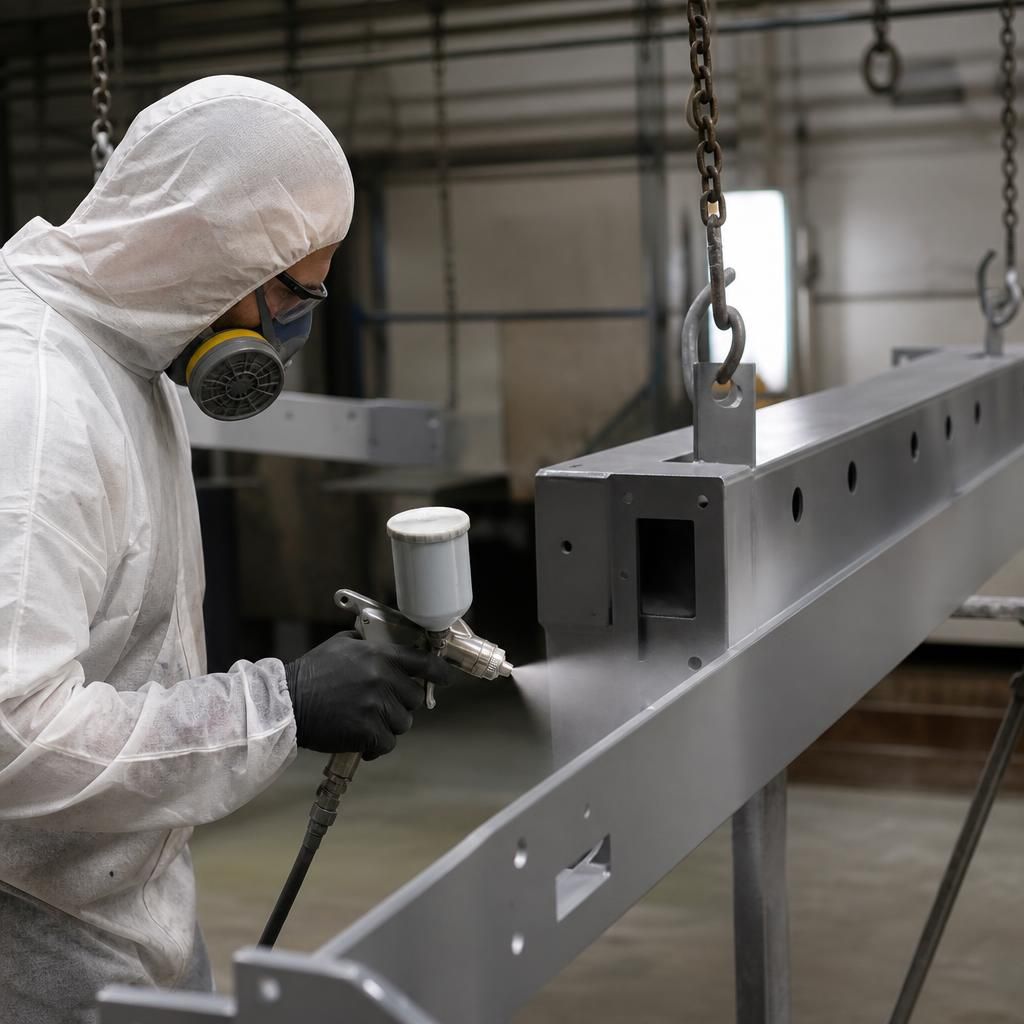
A primer also influences how mechanical stresses are transferred through the repaired area. Bare metal, primer and powder topcoat can respond differently to impact, vibration and temperature changes, so the primer needs suitable flexibility and intercoat strength for the component’s service conditions. A well-matched layer helps the repair act as a continuous coating system rather than a weak boundary between dissimilar materials.
This is particularly important where the damage lies near an edge, corner, weld or joint, because these areas can concentrate stress. If the primer is too brittle, too soft or poorly bonded, movement may cause cracking or lifting to spread beyond the original defect. Selecting the primer as part of the complete repair system—not as an isolated corrosion barrier—therefore supports more consistent long-term performance.