

What role does the quality of powder coating materials play in preventing coating failures, and how can one ensure they are using the best materials for their application?
Quality powder coating materials help prevent failures by providing consistent formulation, reliable adhesion, correct curing behaviour and the durability required for the service environment. To select the best material, match the powder chemistry and performance specification to the substrate, pretreatment, application method, curing conditions and expected exposure, then confirm suitability through technical data and representative test panels.
The quality of the powder directly affects whether a coating remains intact, performs as specified and develops the intended appearance. A well-controlled material has a stable resin system, evenly dispersed pigments and additives, predictable flow and a defined cure response. Poorly controlled, contaminated or unsuitable powder can cause defects such as weak adhesion, under-cure, over-bake, colour variation, pinholes, orange peel, poor edge coverage and premature loss of protection.
Material quality is not simply a matter of choosing the most expensive product. The powder must be appropriate for the component, the metal substrate, the pretreatment system and the conditions in which the finished part will be used. A coating selected for interior equipment may not provide the resistance needed for external exposure, while a decorative formulation may be unsuitable for components exposed to chemicals, abrasion, moisture or elevated temperatures.
Powder coatings are based on different resin chemistries, each with distinct properties. Epoxy systems generally provide strong chemical and corrosion resistance but are not normally selected where long-term direct sunlight exposure is the main requirement. Polyester systems are widely used for exterior durability and colour retention. Hybrid systems combine resin types for particular interior applications, while specialist formulations may be developed for flexibility, texture, heat resistance, electrical insulation or enhanced wear resistance. The correct choice depends on the service conditions rather than on the material name alone.
Several material characteristics have a direct bearing on failure prevention:
- Particle size distribution: Consistent particle size supports even transport, deposition and film formation. Excessive variation can contribute to uneven coverage, roughness or inconsistent thickness.
- Flow and levelling behaviour: The powder must melt and flow sufficiently during curing to form a continuous film without creating excessive sagging, craters or surface texture.
- Cure response: The formulation should have a clearly defined time and temperature requirement. A powder that is not fully cured may remain vulnerable to chemical attack, marking and loss of adhesion.
- Pigment and additive dispersion: Uneven dispersion can produce colour differences, gloss variation, weak areas or inconsistent functional performance.
- Film flexibility and impact resistance: These properties matter where parts are formed, handled, assembled or exposed to vibration. A hard but brittle film may crack when the component is bent or struck.
- Resistance properties: The required resistance to moisture, salt, chemicals, abrasion, ultraviolet exposure or heat should be established before material selection.
Material compatibility is equally important. A powder may be technically sound but still perform poorly if it is applied over an unsuitable pretreatment, contaminated surface or incompatible existing coating. Coating systems should therefore be assessed as a complete process rather than as an isolated powder choice. The substrate, cleaning stages, conversion coating, primer if used, powder and curing schedule all influence the final result.
Technical documentation is the starting point for checking suitability. Request the product data sheet and review the stated application range, recommended film thickness, curing schedule, storage requirements, appearance options and resistance information. Where corrosion protection is important, examine the relevant performance evidence and confirm whether it applies to the intended substrate, pretreatment and exposure. A general statement that a product is suitable for exterior or industrial use is not enough to establish suitability for every environment.
Pay particular attention to the cure schedule. Powder manufacturers may express curing requirements in terms of the metal temperature rather than the oven air temperature. The component must reach the required temperature for the specified duration; relying only on the oven display can result in under-cured parts, especially where sections have different thicknesses or where the load is dense. Conversely, excessive heat or an unnecessarily long cycle can alter colour, gloss and surface appearance. A representative trial can help confirm that the selected material cures correctly on the actual component.
Storage and handling can undermine a good formulation. Powder should be kept in the conditions stated by its supplier, protected from moisture, excessive heat and contamination. Containers should remain sealed when material is not being used, and older stock should be managed so that its suitability is not assumed indefinitely. Powder that has absorbed moisture or formed hard agglomerates may not fluidise or apply consistently. Sieving or reclaiming such material does not automatically restore its original performance.
Reclaimed powder also requires control. Overspray collected from a recovery system can contain a mixture of colours, chemistries or particle sizes if the system has not been cleaned and segregated correctly. Reclaim ratios should be controlled according to the material supplier’s guidance, and reclaimed powder should not be treated as interchangeable with fresh powder without confirming its effect on appearance and performance. For critical work, using fresh material or a validated blend may provide more predictable results.
Before production, confirm the following points with the powder supplier or coating specialist:
- the exact resin chemistry and intended service environment;
- the approved substrate and pretreatment requirements;
- the metal-temperature cure schedule and permitted process range;
- the target film thickness and any limitations on applying the material too heavily or too lightly;
- the expected appearance, including gloss, texture and colour tolerance;
- resistance to the chemicals, weather, moisture, heat or abrasion relevant to the component;
- storage, shelf-life and reclaim instructions; and
- the test method or evidence used to support the stated performance.
Representative test panels are useful when the application is new, the substrate has changed, or the service environment is demanding. Use the proposed powder, substrate, pretreatment and application settings rather than testing the powder in isolation. Inspect the cured panel for colour, gloss, coverage, edge performance and visible defects, then carry out appropriate adhesion, thickness and resistance checks. Testing should reflect the likely failure mechanism: for example, a component exposed to cleaning chemicals needs relevant chemical-resistance assessment, while an outdoor part requires evidence related to weathering and corrosion protection.
Batch control helps distinguish a material problem from a process problem. Record the powder identification, batch reference, storage conditions, substrate, pretreatment, application settings, film thickness and curing conditions. If a defect appears, these records allow the coating team to determine whether the cause was a change in material, contamination, incorrect handling, insufficient cure or another stage of production. Retaining an approved panel or colour standard also makes later comparison more objective.
In practice, the best material is the one supported by a documented specification and demonstrated under the actual process conditions. Powder coating specialists serving manufacturers and fabricators can help compare material requirements with the component’s use, production method and finish expectations. That review should take place before material is purchased in quantity, particularly for large batches, specialist nylon coatings or components where failure would be difficult to repair or replace.
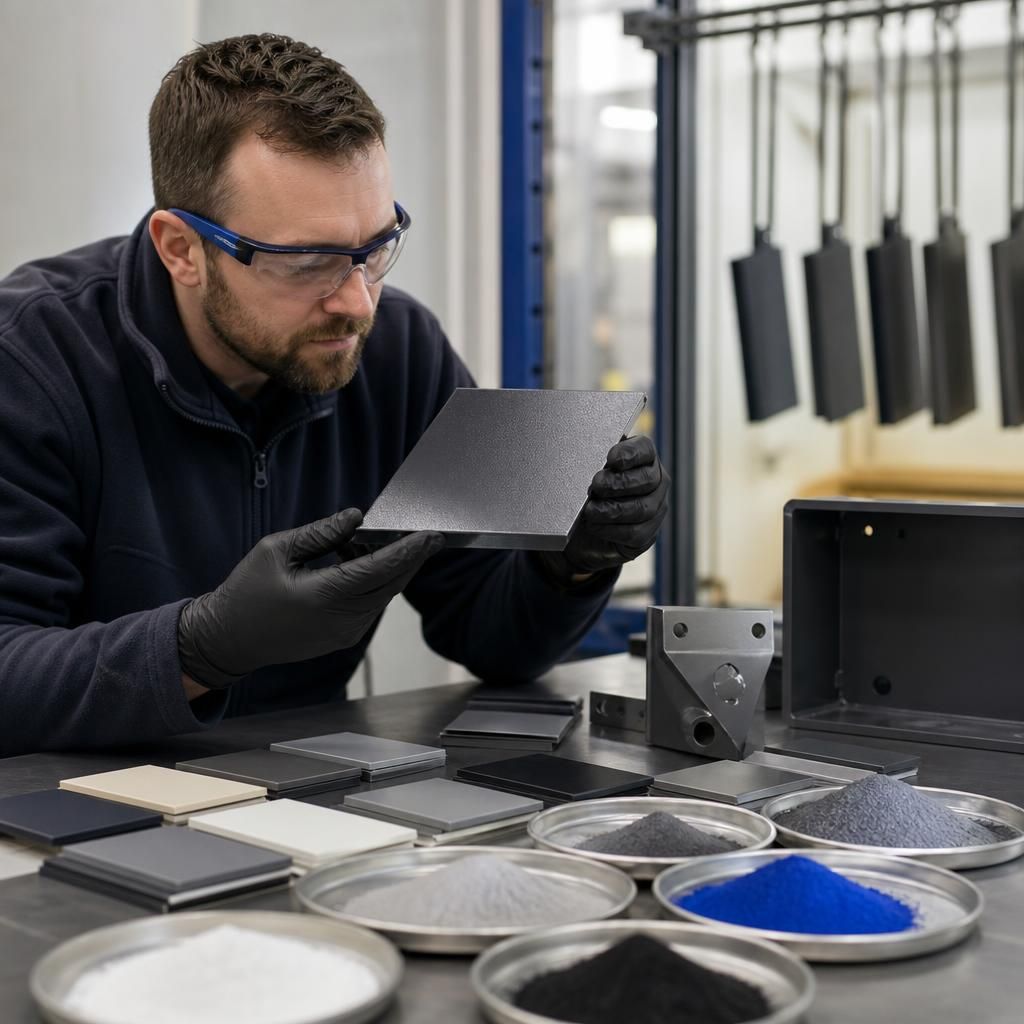
Material quality should also be judged by how consistently the powder behaves during application, not only by the appearance of the finished coating. This is particularly important for specialist materials such as nylon, where the application method, melt behaviour and required film build may differ from those of conventional thermoset powders. Using the wrong process settings can leave thin areas, incomplete coverage or a finish that does not provide the intended mechanical protection, even when the powder itself is suitable.
Before approving a material, confirm that its processing requirements match the coating equipment and component design. Check how the powder should be applied to edges, recesses, welds and other difficult areas, and establish whether the specified finish can be achieved consistently across the whole part. A controlled trial using representative components is more informative than judging material quality from a small, visually attractive sample alone.
Discuss the Right Powder Coating Materials for Your Application
Discuss your component, service environment and proposed production process with a powder coating specialist before approving the material. This helps establish a suitable specification and identify any testing needed for the application.