

What are the most common causes of powder coating adhesion failure?
Powder coating adhesion failure is usually caused by contamination, inadequate surface preparation, incorrect pretreatment, unsuitable powder, or incomplete curing. These issues prevent the coating from bonding properly to the metal, leading to peeling, flaking, blistering or premature loss of protection.
Powder coating adhesion failure occurs when the cured film cannot maintain a reliable bond with the metal substrate or with the coating system beneath it. The visible result may be lifting at an edge, peeling under light pressure, flaking after impact, or progressive separation beneath an apparently sound surface. Identifying the failure pattern is important because adhesion loss is not always caused by the same stage of production.
Incorrect or excessive film thickness
A film that is too thin may not provide continuous coverage, particularly over edges, welds, corners and textured metal. A film that is too thick can also create problems: the coating may become brittle, trap gases, or develop internal stress as it cools. That stress can pull the film away from the substrate, especially where the bond is already weaker at an edge or around a sharp profile.
Film thickness should be checked across representative areas rather than at one convenient flat point. Measurements should include edges, recesses and areas close to welds. Application settings, powder flow and gun distance may need adjustment if the coating distribution is uneven.
Outgassing from the substrate
Castings, porous steel, zinc-coated components and some fabricated parts can release trapped air, moisture or process residues when heated. This creates pinholes, craters or blister-like defects. Once a void forms at the interface, water and air can move beneath the coating and cause local lifting.
Outgassing is more likely where the component has a porous structure, enclosed cavities, weld porosity or an absorbent residue. Suitable preheating, venting of enclosed sections and an appropriate powder system can reduce the risk. Any preheating process must be controlled so that it does not create a different problem, such as uneven coating deposition or premature powder melt.
Substrate condition and material compatibility
Different metals do not behave identically during coating. Aluminium, galvanised steel, mild steel, cast metal and previously coated components can require different preparation and coating parameters. A process that performs well on one substrate may produce poor adhesion on another because of differences in surface chemistry, porosity, oxide formation or thermal behaviour.
Previously coated or repaired parts require particular care. The existing layer may have weak adhesion of its own, may soften during recoating, or may be chemically incompatible with the new powder. A coating specification should therefore identify the substrate, any existing finish and the required service conditions before production begins.
Application equipment and electrical settings
Powder coating depends on electrostatic attraction to place powder on the component before curing. Incorrect voltage, current, powder flow, gun distance or grounding can produce an unstable deposit. In recessed areas, excessive electrical charge can repel newly applied powder, creating thin coverage or uneven bonding. Poor grounding can also reduce transfer efficiency and leave the deposited layer inconsistent.
These faults may be mistaken for a material problem because the coating can look acceptable from a distance. Checking the earth path, gun settings, hoses, nozzles and powder delivery system helps establish whether the defect is localised to particular geometries or affects the whole batch.
Handling before the film has developed full strength
A coating can appear dry while still being vulnerable to marking, pressure and edge damage. Sliding parts across racks, stacking them before they have cooled sufficiently, or using unsuitable hooks can create small breaks in the film. These breaks may later develop into apparent adhesion failure when moisture or impact reaches the exposed metal.
Components should be supported at suitable contact points and handled in a way that avoids rubbing coated faces together. Racks, hooks and protective packaging should be kept clean and designed to minimise contact with finished surfaces.
How to distinguish adhesion failure from other coating defects
- Adhesive failure: the film separates from the metal or from an underlying layer, often leaving a comparatively clean substrate.
- Cohesive failure: the coating itself splits internally, leaving coating material on both surfaces.
- Impact or abrasion damage: the film is removed at a point of force or contact rather than lifting progressively from the surrounding area.
- Blistering: raised areas indicate pressure beneath the film, commonly associated with trapped gas, moisture or corrosion progressing under the coating.
A cross-cut or cross-hatch adhesion assessment can help compare the bond against the required specification, but it should not be used in isolation. The result needs to be considered alongside film thickness, cure verification, substrate type, defect location and the conditions in which the component will be used. For critical work, sample panels or trial components can reveal process problems before a full batch is coated.
Practical investigation sequence
- Record where the failure occurs: edges, welds, recesses, broad flat areas or contact points.
- Identify the substrate and whether the component has been previously coated, repaired, cast or galvanised.
- Measure coating thickness at several locations and compare thin and heavy areas.
- Inspect for pinholes, blisters, craters, voids and signs of gas release.
- Check grounding, application settings, powder delivery and the condition of contact equipment.
- Review handling, racking, storage and packaging for pressure or abrasion damage.
- Repeat a controlled test on representative material before releasing further production.
Reliable adhesion is therefore the result of compatibility between the substrate, coating build, application system, handling method and intended service environment. When a failure occurs, correcting only the visible peeling may leave the underlying cause unresolved. A structured examination of the defect location and coating structure usually gives a more dependable route to a lasting corrective action.
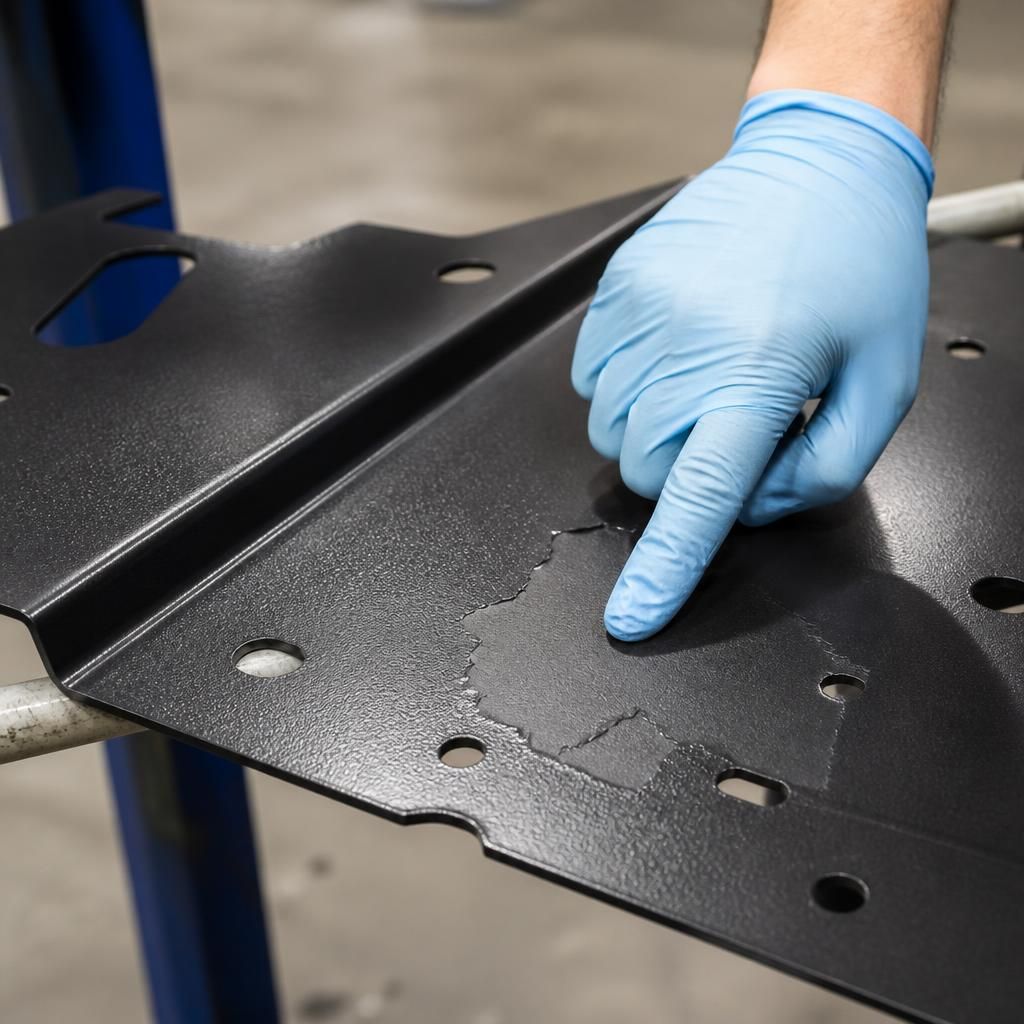
Invisible chemical contamination is a common cause of localised powder coating adhesion failure. Silicone, oil, grease, cutting-fluid residue, adhesive traces and handling marks can remain on the metal even when the surface appears clean. During curing, these substances interrupt contact between the powder film and the substrate, producing fisheyes, craters, peeling or lifting around affected areas.
The location of the defect can help identify the source. Repeated marks near handling points may indicate transfer from gloves, racks or packaging, while defects around machined sections can point to lubricant or coolant residue. When adhesion loss follows a particular component feature or production stage, that pattern should be investigated before changing powder or application settings. Controlled sample testing on representative parts can confirm whether the suspected contaminant has been removed.