

How can the powder coating pretreatment process prevent failures?
The powder coating pretreatment process prevents failures by removing contaminants, preparing the metal surface and creating the conditions needed for strong, consistent adhesion. Effective cleaning, rinsing, drying and chemical preparation reduce risks such as peeling, blistering, corrosion and premature loss of the finish.
Pretreatment prevents powder coating failures by establishing a chemically compatible, stable interface between the metal and the cured powder film. Its purpose is not simply to make a component look clean. It must leave the surface in a condition that allows the coating to bond, withstand handling and resist moisture, chemicals and corrosion throughout its service life.
The process should begin with a substrate assessment. Steel, galvanised steel, aluminium and previously coated components do not respond identically to pretreatment. The coater should identify the base metal, the condition of the surface and any features that could affect processing, including weld spatter, mill scale, oxidation, casting residue, sharp edges, recesses and threaded sections. Oil, grease, marker residue, silicone and fabrication products may also require specific treatment rather than a standard cycle.
Surface condition determines how the chemical stages should be selected. A new fabricated part may require treatment for fabrication oils and weld residues, whereas a weathered or corroded component may need additional mechanical preparation before it enters the chemical line. Galvanised surfaces can contain passivation layers or white corrosion products, while aluminium may have a tenacious oxide layer. Treating every substrate in exactly the same way can produce an apparently sound finish that later loses adhesion.
Each stage must be compatible with the next. A preparation system can include alkaline or specialist cleaning, surface conditioning, conversion treatment and controlled rinsing, depending on the metal and the performance required. The conversion layer is particularly important because it modifies the metal surface and provides a more receptive base for the powder film. If the chemistry is too weak, too aggressive or unsuitable for the substrate, it may leave residues, attack the metal or provide insufficient protection beneath the coating.
- Cleaning stages must break down oils, grease and fabrication residues without spreading them across the component.
- Surface conditioning should address oxidation, scale or other films that could act as a barrier between the metal and coating.
- Conversion treatment should be appropriate to the substrate and the required corrosion performance.
- Rinse stages must remove chemical carry-over so that salts or residues do not remain under the powder.
- Dry-off must remove retained moisture from joints, folds, hollow sections and other difficult-to-drain areas.
Rinsing quality is a major control point. Chemical residues left on the surface can contribute to blistering, staining, under-film corrosion or inconsistent adhesion. The risk is higher on components with overlapping sections, blind holes or complex geometry, where liquid can collect and later migrate beneath the coating. Parts should therefore be positioned and processed so that solutions can drain effectively, rather than relying only on the visible faces appearing dry.
Drying must be judged by the component, not just by the equipment setting. Water trapped in seams or cavities can become vapour during curing and create pinholes, bubbles or local adhesion defects. Handling after pretreatment also needs control: touching prepared surfaces with bare hands can introduce oils, while unsuitable storage can allow flash rust or renewed contamination before powder application.
Process control helps distinguish pretreatment faults from application or curing faults. Useful checks include monitoring chemical concentration, bath condition, temperature, contact time, rinse quality and the condition of the prepared surface. Operators should also inspect representative parts for residues, water retention, visible oxidation and uneven treatment. Records make it easier to identify whether a recurring defect is linked to a particular substrate, component design, chemical stage or change in production conditions.
Good pretreatment also reduces failures that may not appear immediately. Weak adhesion can allow moisture to travel beneath the film after impact or edge damage, leading to corrosion creep and progressive lifting. Residues trapped beneath the coating can cause defects during curing or shorten the useful life of the finish. Correct preparation gives the powder film a more reliable foundation, so the coating is less dependent on luck or on the visual appearance of the metal before application.
For demanding components, the pretreatment specification should be agreed alongside the substrate, end-use environment, coating system and required durability. A powder coater can then select a suitable preparation route, identify areas requiring additional fabrication or mechanical work and check that the completed part is ready for powder application. This approach prevents the common mistake of treating pretreatment as a preliminary wash rather than as a controlled part of the coating system.
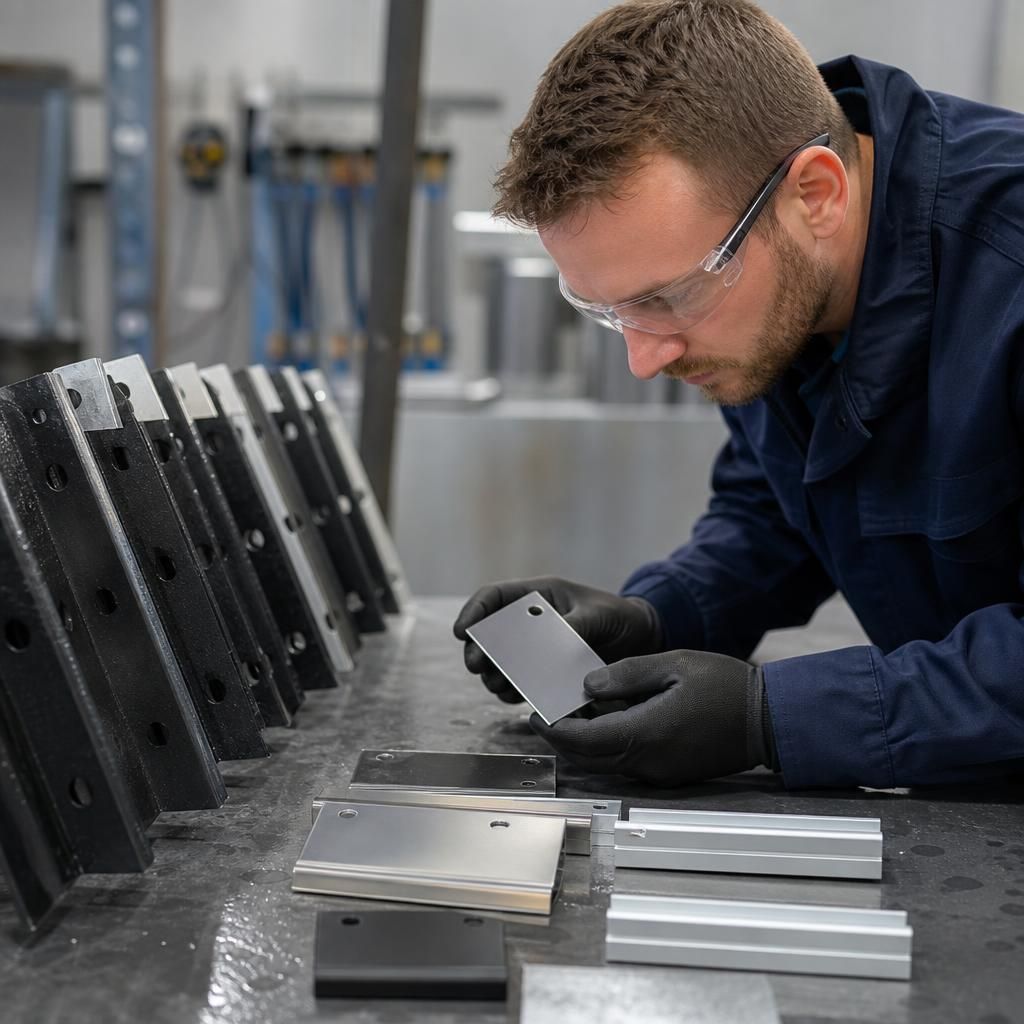
Pretreatment should be verified on representative test pieces before a production batch is coated. A visual inspection can identify staining, uneven chemical treatment or retained moisture, while adhesion testing can reveal whether the prepared surface provides a sound bond. Where corrosion resistance is important, the complete coating system should also be assessed against the conditions expected in service.
These checks help separate a pretreatment problem from a powder application or curing problem. If a test piece fails before the full batch is processed, the preparation route can be reviewed without risking all the components. Verification is particularly useful when the substrate, fabrication method, surface condition or required performance changes.