

What factors should be considered when selecting electrostatic powder spray guns for recoating applications?
When selecting an electrostatic powder spray gun for recoating applications, consider the component’s size, shape, surface condition and powder type, together with the gun’s control over voltage and powder flow. Also assess spray-pattern adjustment, access to recessed areas, ease of cleaning and compatibility with the existing powder-coating system, as these factors affect coverage, finish consistency and changeover efficiency.
The most important considerations when selecting an electrostatic powder spray gun for recoating are its control of electrostatic output, suitability for previously coated substrates, powder-feed stability, grounding requirements, operator control and compatibility with the wider application process. A suitable gun should allow the applicator to reproduce settings reliably while reducing defects such as back-ionisation, uneven deposition and poor adhesion.
Electrostatic control
Recoating often requires more careful electrostatic adjustment than coating bare, conductive steel. An existing powder coating can reduce the conductivity of the surface and alter how the charged powder is deposited. Select a gun with separately adjustable voltage and current, or with application modes designed for recoating and difficult substrates. Lower electrostatic output may be appropriate in some situations to limit excessive charge build-up, particularly where the first coating remains intact. The useful range of adjustment matters more than a high maximum voltage alone.
The controls should also make it clear which settings are being used. Digital displays, stored programmes or repeatable presets can help operators apply consistent parameters to recurring components. Any preset should still be checked against the powder, substrate and condition of the part rather than treated as universally suitable.
Control of powder delivery
The gun must work with a powder pump and feed arrangement that delivers a stable, controllable quantity of powder. Pulsing or surging in the powder stream can produce variation in film build, particularly when a recoated part requires a light corrective layer rather than a full application. Consider how precisely the system can regulate powder output, how well it handles the intended powder formulation and whether adjustments can be made without interrupting the application process.
Powder properties also affect gun selection. Particle size distribution, formulation, density and electrical behaviour influence fluidisation, transport and deposition. A gun that performs well with one powder may require different settings or equipment when used with another, so compatibility should be confirmed through technical information and application trials.
Performance on previously coated surfaces
Recoating is not simply a second pass over a new metal surface. The existing finish may be sound, partially removed, contaminated or locally damaged. The gun should therefore support controlled deposition at the edges of repaired areas and in places where the old coating changes the electrical response of the component. Features such as selectable operating modes, current limiting and fine adjustment can help the operator manage these changes.
Application trials should assess whether the gun can achieve the required overlap without excessive build-up, roughness, pinholing or visible transition lines. The final result also depends on preparation, the condition of the existing coating and curing, so spray-gun performance should be assessed as part of the complete recoating process.
Grounding and electrical safety
Reliable grounding is essential because it provides the electrical path needed for effective powder attraction and helps control the electrostatic field. The gun should be used with a system that supports proper grounding of the workpiece, hooks, racks and relevant booth equipment. Poor grounding can reduce transfer efficiency and encourage inconsistent deposition, regardless of the sophistication of the gun.
Check the equipment’s electrical safety features, interlocks and operating instructions before selection. The gun and control unit should be appropriate for the booth, recovery equipment and site risk assessment. Operators should be trained to verify grounding and follow the manufacturer’s safety procedure rather than compensating for an electrical problem by increasing output.
Nozzle and electrode arrangements
The available nozzle and electrode configurations influence how powder is distributed and how the charged cloud behaves around the component. Select arrangements that suit the required finish and the range of work being processed. A configuration that produces a broad cloud may be useful for suitable open areas, while a more controlled arrangement can help with detailed sections. This is a matter of matching the equipment to the application rather than choosing the largest possible spray pattern.
Electrode design and condition should also be considered. An electrode that is difficult to inspect or replace can make fault-finding and routine process control more complicated. Consumable parts should be readily identifiable, correctly specified and practical to change without disturbing other calibrated settings.
Ergonomics and operator control
For batch recoating, the gun should be comfortable to hold and balanced with the hose attached. Weight, trigger operation, handle shape and the position of controls affect how consistently an operator can maintain the required gun-to-part movement. Excessive fatigue can lead to changes in distance, travel speed or overlap, creating variation that cannot be corrected through electrical settings alone.
Controls should be protected from accidental adjustment but easy to operate when a parameter needs changing. The hose should be flexible enough for the work area and routed to avoid snagging, while remaining suitable for the powder being used. These practical details are particularly important where components require repeated passes or careful work around repaired sections.
Cleaning, changeover and maintenance requirements
Recoating operations may involve several powder colours or formulations. The gun should allow powder-contact components to be removed, inspected and cleaned without unnecessary dismantling. Smooth internal surfaces, accessible passages and clearly defined wear parts reduce the risk of contamination between jobs. If powder remains in the gun or hose, the next coating can contain unwanted particles or show colour variation.
Review the availability of replacement electrodes, nozzles, seals and powder hoses, together with the inspection intervals specified for the equipment. A gun that is easy to maintain is more likely to retain stable powder delivery and electrostatic performance over its service life. Cleaning methods must be compatible with the equipment and should avoid damaging electrodes, seals or insulating components.
Integration with the existing installation
Before purchase, confirm that the gun can connect to the current control unit, powder pump, hose arrangement and booth system. Check electrical connections, control signals, compressed-air requirements and the operating range of the existing equipment. A gun that cannot communicate correctly with the control unit may limit adjustment or prevent the intended safety functions from operating.
For a business processing different component types, it is also worth considering whether one control platform can support multiple guns or application stations. Consistent controls can simplify operator training and make it easier to compare settings between recoating jobs, provided each application is validated independently.
How to evaluate a gun before selection
- Identify the powders, substrates and existing coating conditions involved in the recoating work.
- Define the required finish, acceptable film-build range and areas where defects are most likely to occur.
- Check the gun’s voltage, current and powder-output adjustment range against those requirements.
- Confirm grounding, compressed-air, electrical and booth-system compatibility.
- Test representative parts, including damaged and previously coated areas, rather than relying only on a trial with clean metal.
- Record the settings and inspect the cured finish for coverage, adhesion, texture and visible defects.
The best selection is therefore the gun that provides controlled, repeatable deposition under the actual recoating conditions, not necessarily the model with the highest output or the greatest number of features. For industrial work, a practical assessment on representative components is the most reliable way to confirm that the equipment can be integrated into the existing powder-coating process.
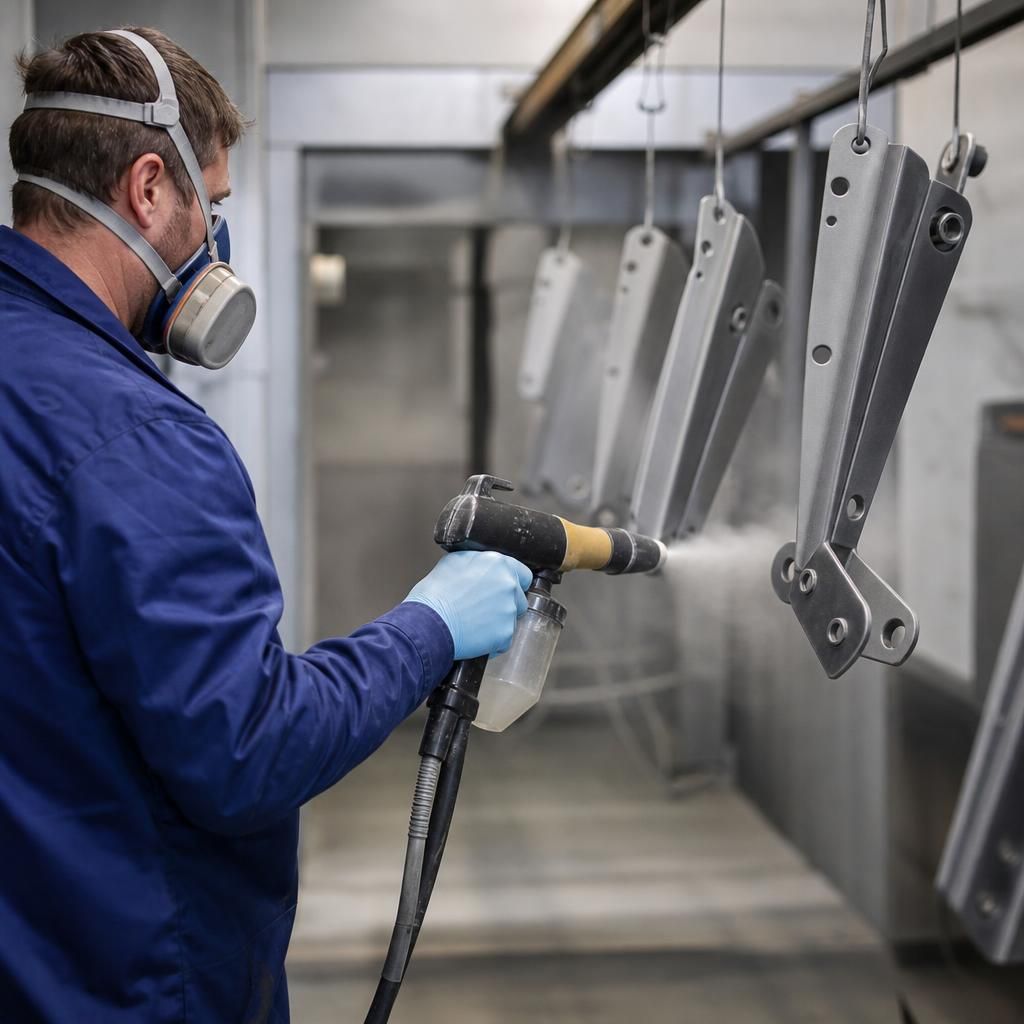
The charging method is an important selection factor when choosing an electrostatic powder spray gun for recoating. Corona guns charge powder using a high-voltage electrode, while tribo guns charge particles through friction as they pass through a specially designed passage. These different methods affect powder behaviour, transfer characteristics and suitability for particular recoating conditions.
A corona gun may offer broad adjustment of electrostatic output, whereas a tribo system can be useful where a softer charge is preferred around recesses or previously coated areas. The choice should be based on the powder formulation, component geometry and required finish rather than charging method alone. Trial both the sound and repaired sections of representative parts, then compare penetration, edge coverage, surface texture and cured-film appearance before selecting the equipment.
Discuss your electrostatic powder spray gun selection requirements
Discuss your electrostatic powder spray gun selection requirements with the Powder-coatings.co.uk team, providing details of the powder, component geometry and existing coating condition for an informed assessment of your recoating process.