

What are the specific advantages of using electrostatic powder coating equipment for recoating metal parts?
Electrostatic powder coating equipment charges powder particles so they are attracted to and adhere to earthed metal parts, helping produce an even, durable finish during recoating. It can improve powder transfer, reduce overspray and support consistent coverage on complex surfaces, making it suitable for controlled industrial refurbishment of metal components.
Electrostatic powder coating equipment is particularly advantageous for recoating metal parts because it allows the operator to control powder delivery, electrical charge and application area more precisely than a basic spray arrangement. This makes it easier to refurbish selected components, match a repeatable coating specification and manage the practical difficulties of applying a new finish over an existing surface.
Controlled application to repair areas
Recoating does not always require the entire assembly to be treated. A powder spray gun can be directed at exposed, worn or damaged sections while masking areas that must remain unaffected. This is useful for fabricated assemblies, brackets, panels and machine components where removing every part of the original finish would be unnecessary or impractical. The equipment gives the operator control over gun distance, movement, powder output and charging settings, helping to limit application beyond the intended zone.
Repeatable coating conditions
For batch recoating, repeatability is a major advantage. The operator can establish a consistent combination of powder feed, air pressure, gun movement and voltage for similar parts. Repeating those conditions helps reduce variation between components and makes it easier to identify whether a defect has resulted from surface preparation, application or curing. This is important where refurbished parts need to fit alongside newly coated components or meet an internal finish standard.
Better control around edges and profiles
Metal parts often include corners, returns, apertures, brackets and changes in section. Electrostatic equipment can be adjusted as the gun approaches these features, rather than applying the same setting indiscriminately across the whole component. Lower electrical settings or altered gun positioning may be appropriate around recessed areas and sharp edges, where excessive charge can contribute to back-ionisation or uneven deposition. The benefit is not that every difficult feature coats automatically, but that the equipment gives the operator the control needed to respond to the part’s geometry.
Useful for localised industrial refurbishment
Equipment designed for powder application can support the recoating of individual parts or smaller batches without requiring a full production line. This can be practical when a component has been returned from service, damaged during handling or found to need a finish before assembly. A suitable arrangement may include a spray gun, powder feed unit, electrical controls, compressed-air filtration and an appropriately sized curing oven. The scale and configuration should match the component dimensions, coating material and expected workload.
Reduced dependence on liquid solvents
Powder coating uses dry coating material rather than a liquid paint carrier. Consequently, the application stage does not depend on solvent evaporation to form the coating film. This can simplify certain handling requirements and avoids introducing wet paint runs or solvent entrapment as application defects. It does not remove the need for extraction, housekeeping or suitable protective equipment: airborne powder still requires proper control, and the finished powder layer still needs an appropriate cure.
Efficient use of controllable equipment settings
Modern electrostatic systems allow the operator to adjust the charge and powder flow for different part sizes, shapes and coating requirements. A high setting is not automatically the best setting. Excessive charge can cause powder to repel from the surface, while insufficient charge may reduce deposition. Having adjustable controls allows the application to be tuned rather than relying on one fixed operating condition for every recoating job.
Important limits when recoating
The equipment cannot compensate for a contaminated, unstable or unsuitable substrate. Oil, corrosion, loose existing coating and residues must be removed, and the remaining surface must be assessed for adhesion and compatibility. An old coating that is poorly bonded may cause the new system to fail even when application is carefully controlled. The component must also be capable of tolerating the curing cycle; heat-sensitive inserts, seals or assembled parts may need removal before coating.
Electrostatic attraction is also affected by grounding. The metal part must have a reliable earth path, and contact points should be clean enough to maintain that path. Recesses and enclosed sections may receive less powder because of the Faraday cage effect, so gun angle, voltage, powder output and application sequence may need adjustment. These considerations are part of using the equipment correctly rather than disadvantages that can be ignored.
For businesses refurbishing metal components, the main value of electrostatic powder coating equipment is therefore controllability: it supports targeted application, repeatable settings and adaptation to different component geometries. The equipment works best alongside thorough preparation, suitable masking, verified coating compatibility and controlled curing. Specialist coating providers serving manufacturers, fabricators, construction firms and automotive businesses can assess whether electrostatic recoating is appropriate for the part and its existing finish.
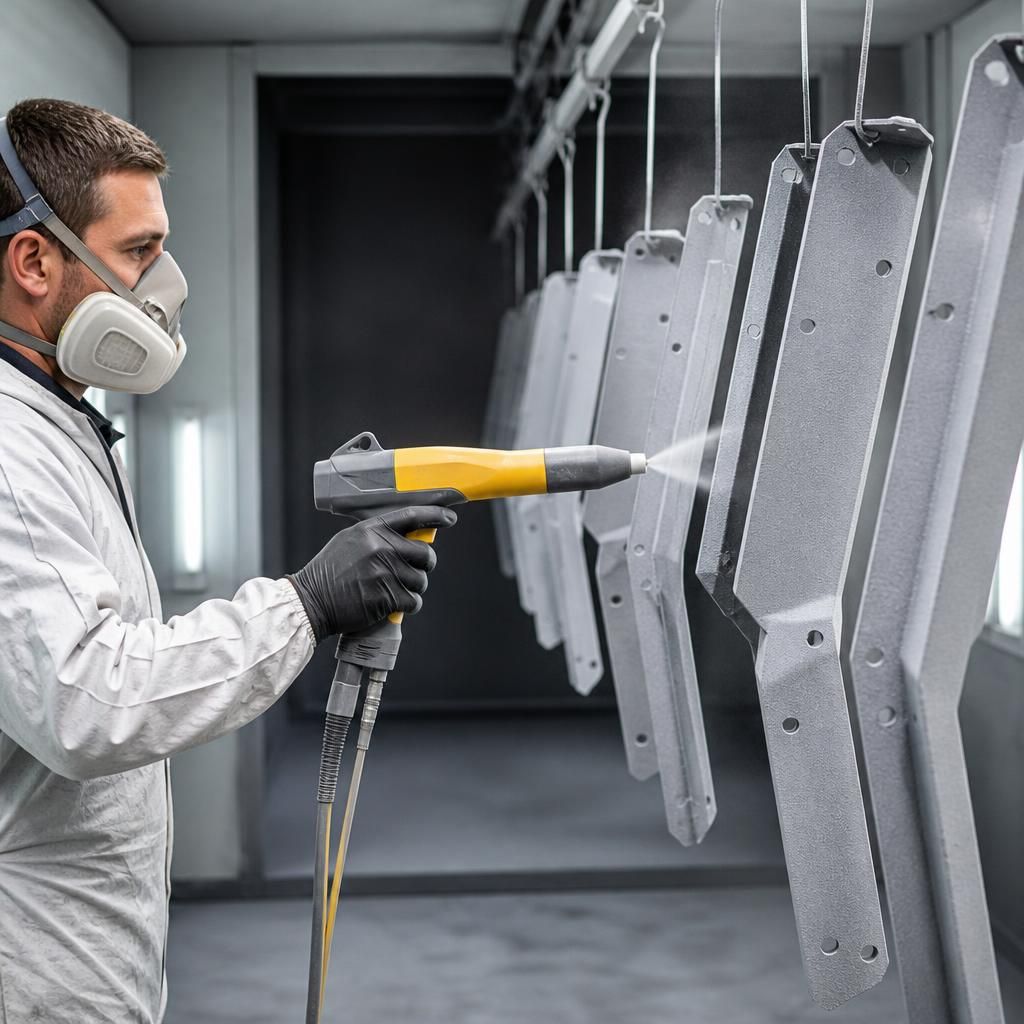
Electrostatic powder coating equipment can help control coating build on metal parts where dimensional accuracy matters. A consistent, suitably controlled layer is important on mating faces, threaded areas, locating points and moving clearances, because excessive build-up may affect assembly or component movement.
Operators can reduce powder delivery, adjust gun movement and mask critical surfaces to keep coating away from areas that must remain within a defined tolerance. Dry-film-thickness checks should still be used to confirm the result; electrostatic equipment supports dimensional control but does not replace inspection or careful preparation.