

What factors should be considered when choosing an automated powder coating line for repair operations?
When choosing an automated powder coating line for repair operations, assess throughput, component size and weight, coating and curing requirements, colour-change flexibility, line footprint, operator access, maintenance needs and integration with existing preparation and finishing equipment. The system should also provide the process control and adaptability needed to handle varied repair batches while meeting relevant quality, safety and environmental requirements.
Choosing an automated powder coating line for repair operations requires a different assessment from selecting a system for a repetitive production line. The most suitable arrangement is one that can identify, isolate, prepare, coat, inspect and release variable repair work without creating excessive handling, rework or contamination. The decision should therefore be based on the complete repair workflow, not simply on conveyor speed or oven capacity.
Examine the nature of the repair workload. Start by grouping work according to the condition of the parts, the amount of coating to be removed, the substrate, the required finish and the likely batch size. Repair operations may include single components, mixed batches and urgent replacement parts alongside routine work. A line designed around one uniform product can become inefficient if operators must repeatedly interrupt it to accommodate exceptional items. Consider whether the system can process standard work automatically while allowing non-standard parts to be diverted to a controlled manual route.
Consider loading, identification and traceability. Repaired components should be linked to the correct job information throughout the process. Useful controls may include barcode or job-number scanning, electronic recipe selection, identification labels and records of preparation, coating and inspection stages. This helps prevent parts from being mixed between customers or repair orders, particularly where components look similar but require different powders, masking arrangements or acceptance criteria. The system should also make it possible to record non-conformances and send failed parts back for correction without losing their process history.
Assess how parts will be mounted. Hangers, racks and fixtures must hold each component securely while exposing the surfaces that require coating. Repair work often involves awkward shapes, pre-existing holes, threaded sections or areas that must remain free from powder. Check whether the proposed fixtures can be changed without lengthy adjustments and whether they can accommodate the full range of part geometries. Poor hanging practice can cause shadowing, contact marks, powder build-up and uneven coverage, even where the application equipment itself is correctly set.
Fixtures should also be designed with electrical contact and cleaning in mind. A reliable earth path is essential for electrostatic application, while accumulated coating on hooks and contact points can reduce transfer efficiency. The cost and practicality of cleaning, replacing and storing fixtures should be included in the selection exercise. For a repair line, a flexible fixture strategy is often more valuable than a highly specialised arrangement that performs well for only one component.
Plan for inspection and rework within the layout. The line should provide a defined point for checking appearance, coverage, film thickness where required, adhesion and the condition of masked areas. Inspection lighting and access should be suitable for finding defects such as pinholes, inclusions, missed edges, poor coverage or surface contamination. If a part fails inspection, there should be a clear route to quarantine, repair and reprocess it without obstructing accepted work.
Rework capacity is particularly important because repair coating may expose defects that were not visible before stripping or preparation. Include space for cooling, inspection, temporary holding and controlled re-entry. A line with no practical rework route may appear efficient in normal operation but create queues and manual handling whenever a component needs attention.
Review the powder and contamination controls. Repair work can bring greater variation in incoming surface condition, and different customers may require contrasting colours or finishes. The line should support procedures for controlling residue from previous jobs, cleaning application equipment and managing recovered powder. Powder recovery arrangements need to be assessed for the types of material being processed and for the degree of colour or finish separation required. Where recovery is unsuitable for a particular repair batch, the operating procedure should define how that powder is handled and disposed of.
Also consider the cleanliness of the surrounding area, the separation of stripped parts from finished parts and the protection of prepared metal before coating. These controls reduce the risk of dust, blasting media, oil or old coating contaminating the finish. They should be practical for the expected repair mix rather than relying entirely on operator memory.
Check operator interaction and safe access. Automation does not remove the need for skilled intervention. Operators may need to load unusual components, verify a repair instruction, change fixtures, inspect a coating or respond to a rejected part. Controls should be positioned where they can be used safely, with clear status information and guarded access to moving equipment and heated areas. Safe isolation, emergency stops, maintenance access and cleaning procedures should be considered during the design review rather than added afterwards.
Training requirements should be documented for normal operation, fault recovery, powder handling, fixture changes and quality checks. A system that depends on one experienced operator to resolve common interruptions can create a practical risk for the repair department.
Evaluate controls, data and integration. The automation should exchange the right information with the repair business’s existing job, production or quality systems where appropriate. At a minimum, the controls should make recipes, alarms, line status and inspection records understandable to the people using them. Access permissions can help prevent unauthorised changes to approved process settings, while an audit trail can support investigations when a finish does not meet the required standard.
Ask how faults are diagnosed, whether trends can be reviewed and how software or control components will be supported over the expected life of the line. Obsolete controls, proprietary interfaces and difficult-to-source replacement components can affect long-term maintainability, even if the initial equipment performs well.
Compare the complete cost of ownership. The purchase price is only one part of the decision. Include installation, extraction, electrical work, commissioning, operator training, fixture manufacture, cleaning materials, powder usage, energy consumption, planned maintenance, unplanned downtime and eventual component replacement. For repair work, also assess the cost of unused capacity if the line is designed for volumes or part sizes that the operation does not regularly receive.
A useful comparison is between the proposed automated line, a semi-automated arrangement and a flexible manual cell. Automation is more likely to be appropriate where repeatable stages can be controlled consistently and where handling or inspection can be organised without excessive exceptions. A less automated solution may be more suitable when every repair is substantially different. The right choice is the arrangement that controls the repeatable parts of the process while preserving sensible flexibility for atypical work.
Before committing to equipment, map several representative repair jobs from receipt through dispatch. Include a straightforward batch, a mixed batch, a part requiring extensive masking, a rejected component and a job that must be reprocessed. This exercise can reveal hidden requirements for storage, fixtures, inspection, cleaning, operator access and rework. It also gives the coating team and equipment supplier a practical basis for testing the proposed line against real components rather than theoretical specifications.
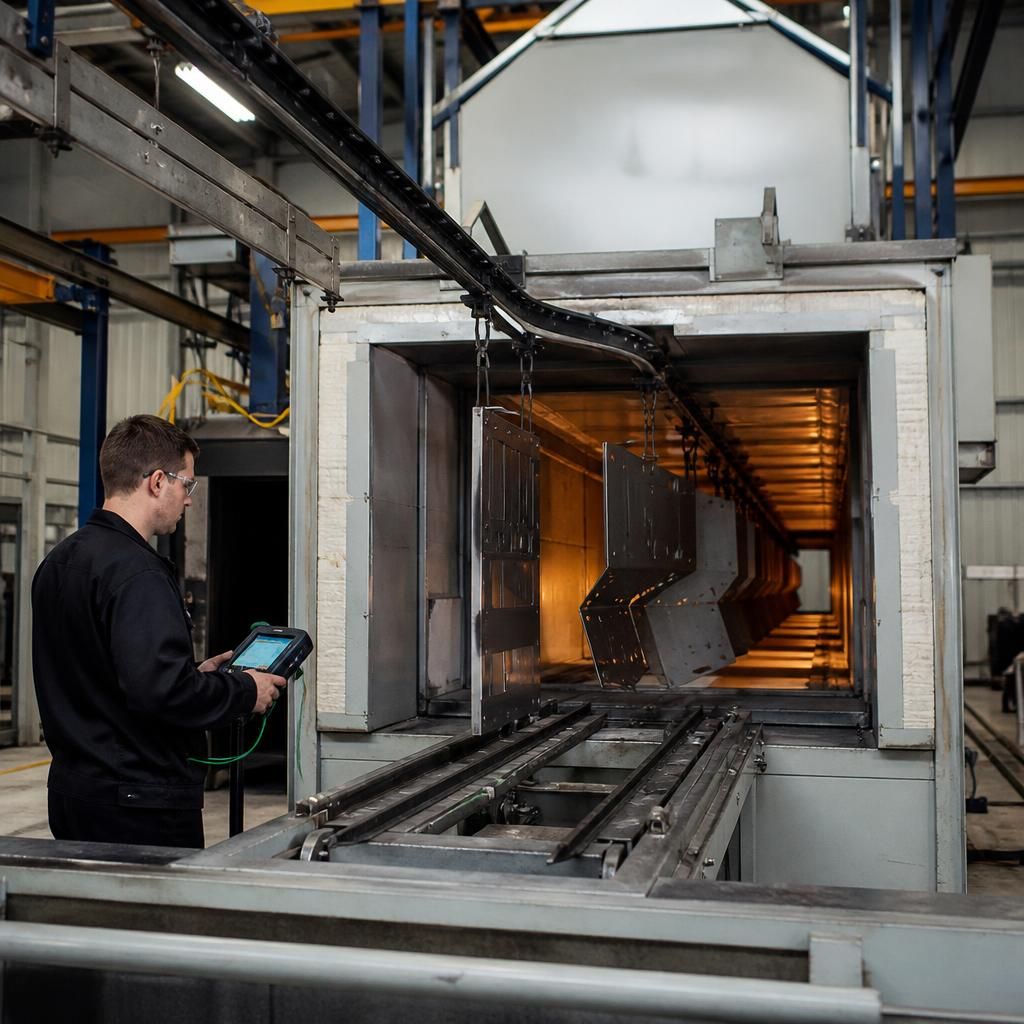
Thermal profiling is a key consideration when selecting an automated powder coating line for repair operations. The curing oven must achieve the required metal temperature throughout each component, rather than simply maintaining a set air temperature. Parts with different wall thicknesses, shapes and loads can absorb heat at different rates, affecting cure quality.
Assess whether the proposed line can accommodate representative repair components and whether its oven performance can be checked during commissioning and process validation. Consider:
- the maximum and minimum component dimensions and mass;
- heating and cooling requirements for sensitive or heavily built-up parts;
- the available oven length, temperature range and air circulation;
- the ability to record temperature profiles for different repair jobs; and
- how changes in conveyor speed or batch loading may affect curing.
Testing should include parts that reflect the actual repair mix, not only simple test panels. This can identify cold areas, excessive heat exposure or unsuitable dwell times before the line is adopted for routine work.
Discuss Your Automated Powder Coating Line Requirements
Discuss your representative repair components, process constraints and automation objectives with the Powder-coatings.co.uk team. Together, you can assess whether an automated powder coating line is suitable for your operation and identify the requirements for a practical system.