

What are the key advantages of integrating an automated conveyor system into existing powder coating operations?
Integrating an automated conveyor system into existing powder coating operations creates a controlled, repeatable flow of components through preparation, coating and curing. It can improve handling consistency, reduce manual movement and support greater production capacity without requiring every process stage to be redesigned.
An automated conveyor system adds value to an established powder coating operation by linking existing preparation, application and curing equipment into a more measurable production system. The main advantages are improved process control, clearer production planning, safer component movement and better use of labour and equipment, provided the conveyor is designed around the parts, coatings and layout already in use.
More consistent coating conditions
A conveyor can regulate how components are presented to each process stage. This helps maintain a defined exposure time in the pretreatment system, spray booth and curing oven, rather than relying on individual operators to judge when an item should move forward. Consistent line speed and hanger spacing also make it easier to identify the relationship between conveyor settings and coating results.
This is particularly relevant where the finished coating depends on correct oven exposure. Powder must reach the required curing condition throughout the component, not simply remain inside the oven for a nominal period. Conveyor integration allows production teams to assess line speed, oven temperature and component loading together when investigating under-cure, over-cure or uneven finishes.
Better process control and traceability
Automated lines can provide a clearer operating record than a process based entirely on manual movement. Depending on the equipment and controls selected, operators may be able to monitor line speed, oven temperatures, booth settings and stoppages from a central control point. This creates useful information for quality checks and fault investigation.
Traceability can also be strengthened by linking job information to production stages. A business may be able to record which batch was processed, which coating specification was used and whether any interruption occurred during preparation or curing. This is valuable when customers require evidence of process control or when a component needs to be assessed after a quality issue.
More predictable production planning
Once the operating characteristics of a conveyor line are established, planners can schedule work using known process stages rather than estimating every movement manually. This supports more reliable sequencing of batches, particularly where parts require different colours, coating systems, masking arrangements or oven settings.
The benefit is not simply a faster line. A properly planned system can make work in progress easier to see, reduce uncertainty between departments and highlight bottlenecks such as preparation, inspection or packing. It can also help a business decide whether a job is suitable for the automated line or should remain on a more flexible manual route.
Improved use of skilled labour
Automation does not remove the need for experienced powder coating personnel. It changes where their time is most useful. Instead of repeatedly moving components between stages, operators can focus on masking, gun setup, coating inspection, colour changes, defect correction and control of the process parameters that most affect finish quality.
Mechanical assistance can also reduce the physical demands associated with repeated lifting, pushing and positioning. The exact benefit depends on component weight, hanger design and loading arrangements, but reducing unnecessary manual movement can support a more consistent working method and help separate handling tasks from specialist coating decisions.
Efficient use of existing equipment and floor space
An automated conveyor does not always require a completely new powder coating plant. In some operations, the conveyor can be designed to connect with existing pretreatment equipment, spray booths, curing ovens, cooling areas and inspection points. This may allow the business to modernise a specific constraint rather than replace every part of the operation at once.
Integration still requires detailed assessment. The available floor area, ceiling height, oven dimensions, loading points, extraction arrangements, access routes and maintenance clearances all affect the feasible design. Hanger pitch and conveyor speed must also suit the smallest and largest components that the line is expected to process. A system designed only around current work may become restrictive if future component sizes or coating requirements change.
Fewer avoidable interruptions
Automated loading, indexing and line controls can make the causes of interruption more visible. For example, a conveyor control system may identify a stop caused by an obstruction, a safety circuit, an oven fault or a problem at the loading station. This is more useful than treating every delay as a general production slowdown.
However, automation introduces its own maintenance requirements. Conveyor chains, drives, bearings, sensors, hangers and control equipment need inspection and servicing. A planned maintenance regime is therefore essential. Accessible components, suitable spares and clear recovery procedures should be considered during system design rather than after installation.
Greater suitability for repeat work
Conveyor integration is most advantageous where components follow a reasonably repeatable route and are produced in batches or regular product families. The system can support standardised loading, masking and inspection instructions, making it easier to reproduce an approved process.
It is less suitable as the only route where every item has a different shape, coating specification or handling requirement. A hybrid operation, combining automated production for suitable work with manual or specialist processing for unusual components, may provide better operational flexibility than attempting to automate every job.
What must be checked before integration
- Whether the existing oven has sufficient usable length, temperature control and access for the proposed line speed.
- Whether the conveyor and hanger design can support component weight, dimensions, orientation and masking requirements.
- How colour changes, coating changes, rejected parts and rework will be managed without disrupting other production.
- Whether guarding, emergency stops, extraction, electrical systems and operator access meet the relevant safety requirements.
- How cleaning, inspection and planned maintenance will be carried out around the integrated equipment.
- Whether the controls can provide the level of monitoring and production information required by the business.
In practice, the strongest advantage comes from treating the conveyor as part of the complete coating process rather than as a standalone transport device. Its design should reflect the powder system, pretreatment method, curing requirements, component mix and quality checks already used by the operation. Where those factors are aligned, automation can make production more predictable, easier to monitor and better suited to repeat industrial work without forcing every component through the same route.
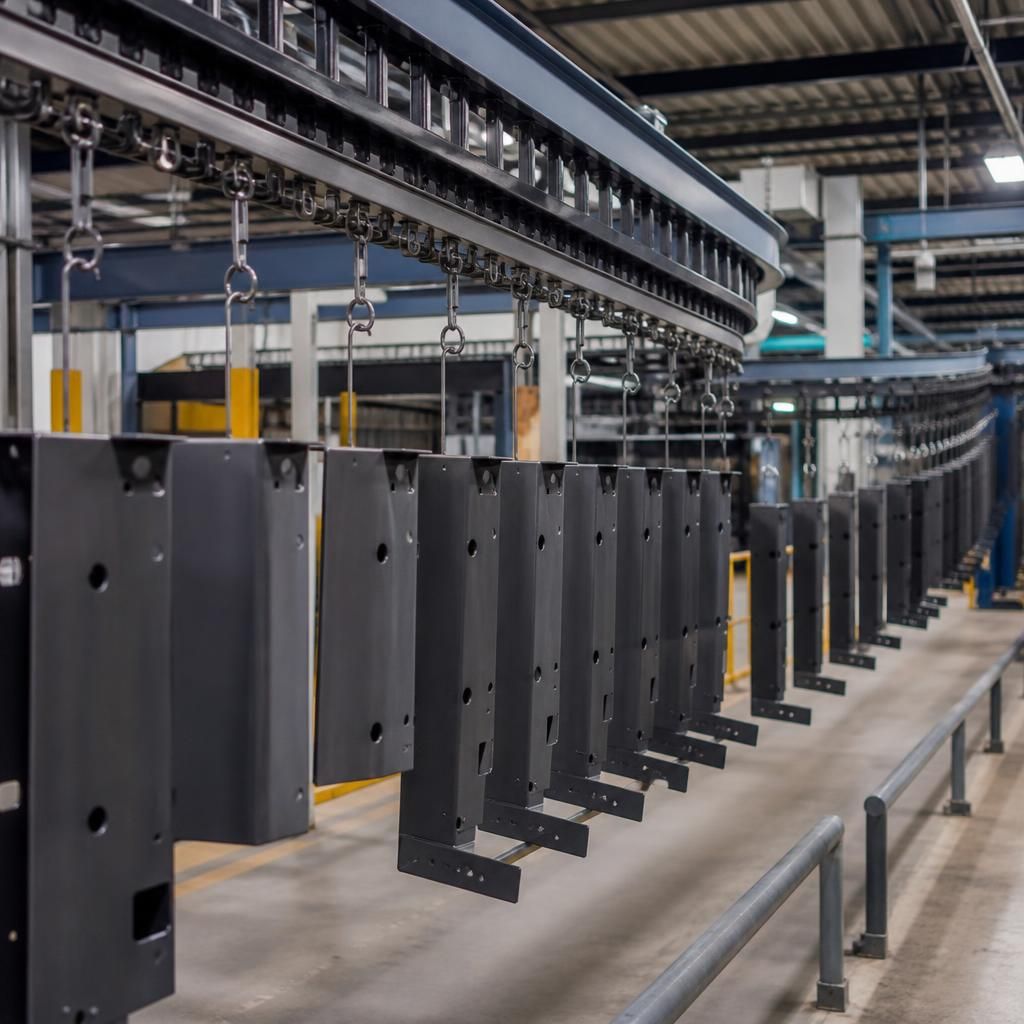
An automated conveyor system can improve production resilience by allowing controlled accumulation between key stages. If loading, preparation, coating or inspection briefly operates at a different rate, correctly designed buffer sections can prevent the entire line from stopping immediately. This helps protect the continuity of the coating and curing process while the cause of the imbalance is addressed.
Buffer capacity and conveyor layout must be matched to the component mix, line speed and available floor space. Parts should remain correctly identified and positioned during any pause, with controls that prevent overcrowding, contact damage or unsuitable items entering the next stage. When these safeguards are included, the conveyor provides more than transport: it helps manage the different operating rates within an integrated powder coating process.
Discuss your automated conveyor integration requirements
If you are assessing whether an automated conveyor system is suitable for your existing powder coating operation, discuss your component range, process stages and integration constraints with the team. This can help identify the practical requirements for a suitable conveyor layout and control approach.