

What are the key advantages of integrating a conveyor system into our existing powder coating process?
Integrating a conveyor system into an existing powder coating process provides controlled, repeatable movement of components between preparation, coating and curing stages. It can improve process consistency, reduce manual handling and help maintain a more orderly production flow without requiring every stage to be operated independently.
Integrating a conveyor system into an existing powder coating process can increase production capacity, improve coordination between stages and make process performance easier to monitor. Its main advantage is that it connects preparation, masking, coating, inspection and curing into one planned material flow, rather than treating each operation as a separate work area.
Better use of production capacity
A conveyor allows components to move through the line at a planned rate, helping the operation make better use of available spray booths, ovens and inspection space. When the conveyor speed and loading pattern are matched to the slowest important stage, work can be presented to that stage more consistently. This can reduce avoidable gaps between batches and make existing equipment more productive without necessarily replacing it.
The benefit depends on identifying the actual constraint in the process. If curing is the limiting stage, for example, increasing the conveyor speed alone will not increase useful output. Integration works best when the conveyor, oven capacity, booth dimensions, loading method and unloading arrangements are assessed as one system.
Less work-in-progress between operations
Separate coating stages often require components to be placed on stillages, pallets or temporary storage areas while they wait for the next operation. A suitable conveyor can reduce this accumulation by moving parts directly between defined points. This frees floor space and makes it easier for supervisors to see which work is in process, awaiting inspection or ready for dispatch.
A planned route also helps distinguish completed work from parts that still require preparation, coating or curing. This is particularly useful where several finishes, component sizes or customer orders are being processed through the same facility.
More reliable handling of coated parts
After powder has been applied, the finish must remain undisturbed until it has passed through the curing stage and cooled sufficiently for the next handling step. A conveyor supports a defined route through this vulnerable part of the process. Correct hanger selection, spacing and support reduce the need to reposition components before the coating has fully hardened, helping to limit contact marks, impact damage and contamination.
Integration also makes it easier to establish standard loading and unloading points. Parts can be presented in a known orientation, which supports repeatable masking, spraying and inspection arrangements. The conveyor design still needs to account for component weight, centre of gravity, dimensions and areas that must remain uncoated.
Improved production planning and traceability
A conveyor can provide a visible reference for where an order is within the process. When combined with job identification, batch records or line controls, it can help link a component to its preparation requirements, powder specification, curing conditions and inspection result. This is valuable for B2B work where records may be needed to investigate a finish issue or confirm that different parts of an order followed the intended route.
The system can also support more structured scheduling. Jobs may be grouped according to colour, coating type, component size or curing requirements, reducing unnecessary changes between runs. Scheduling must be planned carefully, however, because an unsuitable sequence can create cleaning requirements, introduce contamination risks or leave incompatible parts waiting in the line.
More effective use of staff
Automation of part movement allows operators to spend more time on tasks that require judgement, including surface preparation checks, masking, gun adjustment, visual inspection and quality decisions. It does not remove the need for skilled oversight. Operators still need to verify loading, coating coverage, hanger contact, oven conditions and the condition of the conveyor itself.
Clear loading and unloading positions can also help define responsibilities between process stages. This makes it easier to identify where a delay or defect has occurred and supports consistent working methods across different batches.
Potential for controlled expansion
An existing powder coating process can often be improved in stages. A conveyor may initially connect selected operations, with additional loading points, inspection stations or automated controls added later if the layout and control system allow for expansion. This can be more practical than attempting to automate every stage at once, particularly where component sizes and production volumes vary.
Before installation, the business should review:
- the dimensions, weights and shapes of the parts to be carried;
- hanger design, spacing and electrical contact requirements;
- the relationship between conveyor speed, spray application and curing conditions;
- available floor space, access routes and maintenance clearance;
- compatibility with existing booths, ovens, extraction and control equipment;
- job identification and records required for inspection or customer traceability; and
- safe access for loading, unloading, cleaning and maintenance.
A conveyor is therefore most valuable when it is designed around the existing process rather than added as an isolated transport device. Proper integration can provide a clearer production route, better equipment utilisation, more controlled part handling and a stronger basis for planning and quality records, while retaining the flexibility needed for different industrial components and coating requirements.
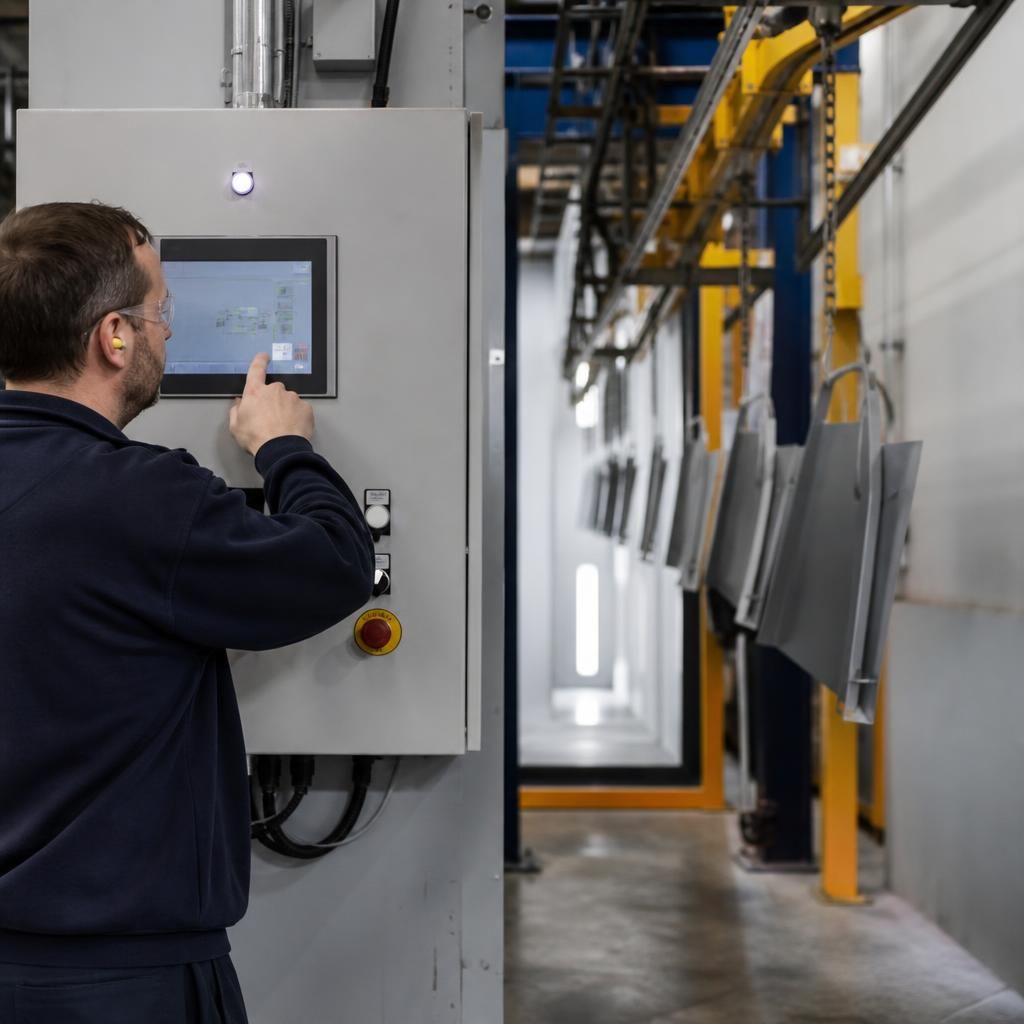
A further advantage of integrating a conveyor is coordinated control between connected equipment. When the conveyor is linked to booth, oven and extraction controls, the system can use defined operating conditions and interlocks to prevent unsuitable movement through the line. For example, a part should not enter a curing stage before coating has been applied, and the line can be stopped if a fault affects safe operation or process control.
This gives operators a clearer way to manage interruptions than moving components between independent work areas. A fault can be assessed at the relevant stage, while the remaining parts are protected from being sent into an unsuitable process condition. The control arrangement should be specified around the existing equipment, with attention to emergency stops, guarding, access points and safe isolation for maintenance.
Assess Conveyor Integration for Your Powder Coating Process
Discuss your existing powder coating process with Powder-coatings.co.uk, providing details of your component range, equipment and production requirements. This allows the suitability and practical scope of conveyor integration to be assessed before any changes are planned.