

What are the essential maintenance and operational practices to ensure the longevity and efficiency of automated powder coating lines?
Automated powder coating lines remain efficient and produce consistent finishes when planned maintenance, regular inspections, accurate process controls and thorough cleaning are built into daily operations. Monitoring conveyor movement, pretreatment, booth conditions, curing performance and powder application, supported by documented checks and trained operators, helps identify wear or drift before it affects production.
The longevity and efficiency of an automated powder coating line depend on controlling the complete production system, not just repairing faults when they occur. Effective operation combines condition-based maintenance, correct handling of powder and coated components, stable utilities, disciplined changeovers, safe access and accurate production records.
Use a structured maintenance system
Separate maintenance tasks by frequency and importance. Operators can complete basic tasks such as checking visible damage, clearing build-up from accessible areas and reporting unusual noise or movement. Skilled maintenance personnel should handle work on drives, electrical systems, burners, extraction equipment, sensors and safety circuits. Each task should identify the equipment concerned, the required method, acceptable condition and action to take if a defect is found.
Prioritise equipment that can stop the whole line or create a quality defect. Conveyor drives, load-bearing components, booth equipment, curing equipment, compressed-air systems and interlocked guards generally require particular attention because a failure in one area can affect every subsequent stage. Maintenance records should distinguish between a temporary corrective action and the permanent repair needed to prevent recurrence.
Manage lubrication and mechanical wear correctly
Lubrication should follow the equipment manufacturer’s specification rather than a general assumption that more lubricant is better. Excess lubricant can migrate onto components or product, while unsuitable lubricant may damage seals or attract powder. Check for looseness, abnormal vibration, chain elongation, worn bearings, damaged hangers and misaligned sections of the conveyor. Replacing a worn part before it fails can prevent dropped workpieces, line stoppages and damage to adjacent equipment.
Inspect loading and unloading points particularly carefully. These areas experience repeated contact and handling, so hooks, jigs, racks and supports can become distorted or contaminated. Any fixture that does not hold a component securely or consistently should be removed from use and either cleaned, repaired or replaced.
Control powder and colour changes
Powder should be stored in clean, dry conditions and kept in its original, clearly identified container until required. Stock rotation helps prevent old material being overlooked, while lot and colour records provide traceability if a finish later requires investigation. Do not combine powders unless the coating supplier’s technical instructions specifically permit it.
Changeovers require a defined sequence. Remove residual powder from the relevant equipment, confirm that the next powder is correctly identified and record the change before production resumes. Where several colours or coating types are processed, plan the sequence to reduce cross-contamination and avoid unnecessary reclaim. Reclaimed powder should only be used where its collection, identification, storage and permitted blend ratio are controlled.
Protect compressed air and electrical supplies
Powder application equipment is sensitive to contamination in compressed air. The air supply should be checked for moisture, oil and pressure stability, with filters, drains and dryers serviced in accordance with their specified requirements. A utility problem may appear as poor powder transfer or inconsistent application even when the guns themselves are functioning correctly.
Electrical cabinets, cables, sensors and control panels should be kept free from powder deposits and inspected for heat damage, loose connections and signs of moisture. Work on electrical equipment must be carried out by suitably competent personnel with the line isolated under the site’s safety procedure. Safety circuits, emergency stops, guards and access interlocks need functional checks after relevant maintenance work and before the equipment is returned to production.
Standardise loading, racking and line setup
Automated equipment can only repeat the conditions presented to it. Components should therefore be loaded in a consistent orientation, with sufficient spacing for the required coverage and with contact points selected to minimise visible marks. Fixtures must be matched to the component’s size, weight and geometry; overloading a hanger or allowing parts to swing can affect coating uniformity and place extra strain on the conveyor.
Keep approved setup information for recurring work, including fixture selection, loading orientation, coating requirements and curing instructions. Operators should verify the job identity before loading the line, particularly where similar parts are processed with different coating specifications. A controlled setup reduces adjustment by trial and limits the risk of producing a full batch with the wrong configuration.
Use planned change control
Alterations to conveyor speed, booth settings, gun positions, powder delivery, curing conditions or fixture design should be recorded against the relevant job or process. Change one significant variable at a time where practical, then assess the result using the agreed quality checks. Unrecorded adjustments make it difficult to identify the cause of defects and can leave the line operating with settings that are unsuitable for a later batch.
When a new component, powder or fixture is introduced, assess its effect on line capacity, access, grounding, overspray, curing and safe operation before full production. A short validation run can identify clearance issues and handling problems without committing an entire batch to an unproven setup.
Monitor performance through useful records
Records should be concise enough to be completed consistently but detailed enough to support decisions. Useful information includes:
- equipment faults, symptoms and confirmed causes;
- parts replaced and the reason for replacement;
- powder type, colour, batch identification and reclaim status;
- job setup and approved process changes;
- utility or alarm events that affected production;
- quality findings linked to a particular line condition or batch; and
- actions still awaiting completion.
Review these records for recurring failures rather than treating each stoppage as an isolated event. Repeated conveyor misalignment, frequent filter loading, recurring gun blockage or repeated fixture damage may indicate an underlying design, loading or housekeeping problem. Trend information can also help determine whether a maintenance interval should be adjusted, provided any change is supported by the equipment’s technical requirements and observed condition.
Provide competent operation and safe access
Operators should understand the purpose of each stage, the normal signs of correct operation and the symptoms that require the line to be stopped or escalated. Training should cover job identification, loading limits, powder handling, alarm response, isolation arrangements and the limits of operator adjustments. Maintenance personnel need appropriate instruction for working at height, entering restricted areas and isolating mechanical, electrical, thermal and pneumatic energy.
Access panels, extraction points and service areas should remain unobstructed. Do not bypass an interlock or continue operating with a damaged guard to maintain output. After intervention, confirm that tools, temporary supports and cleaning materials have been removed, guards are secure and the line is safe to restart.
Finally, assign clear ownership for each check and review the maintenance system when the line, product range or coating specification changes. A documented, risk-based approach allows automated equipment to operate consistently while reducing avoidable wear, contamination, unplanned stoppages and repeat defects.
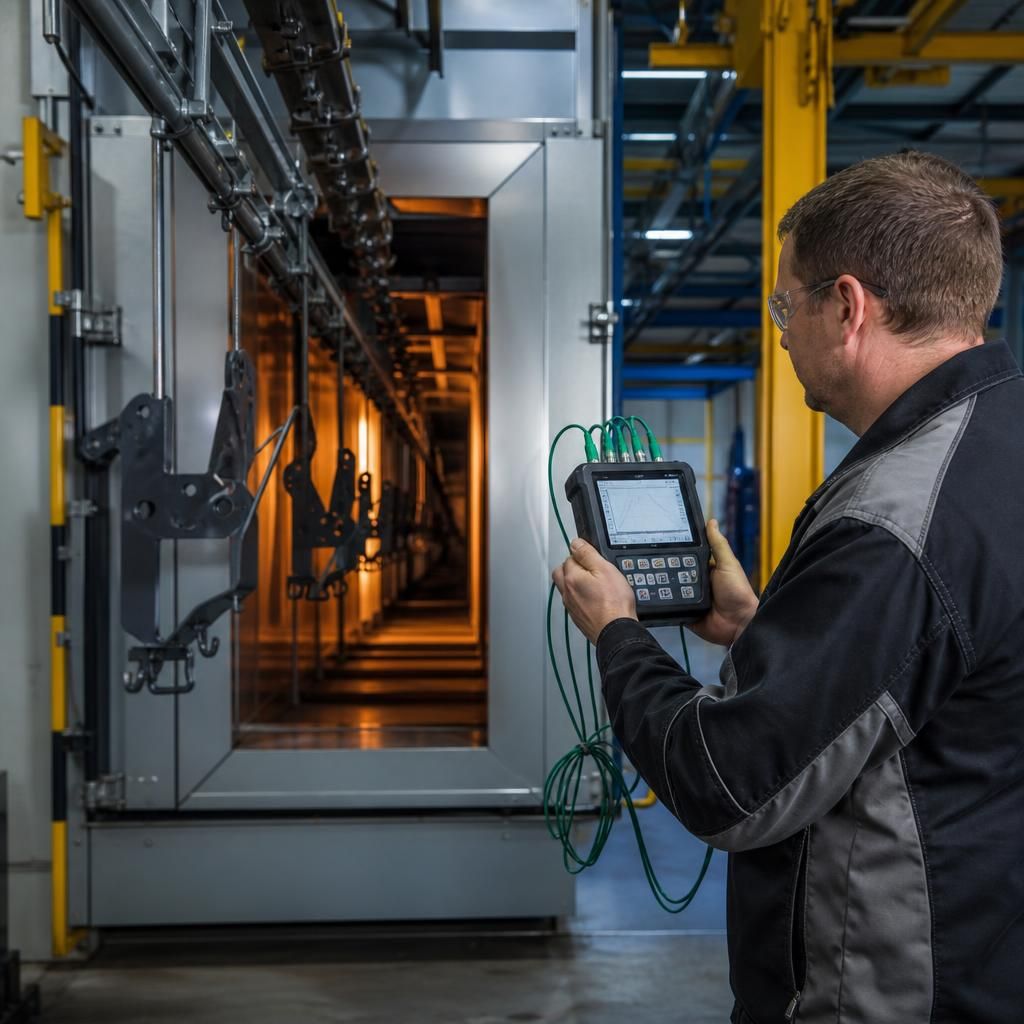
Thermal verification is a key operational practice for maintaining an efficient automated powder coating line. The oven must deliver the coating manufacturer’s specified part-metal temperature and cure conditions, rather than relying only on the displayed air temperature.
Use periodic temperature profiling on representative components to identify cold spots, excessive heat, slow heat-up or uneven airflow. Compare results with the approved curing requirements and investigate changes caused by blocked air paths, damaged seals, failing heating elements, inaccurate sensors or altered conveyor loading. Keeping oven doors, inspection points and airflow routes in suitable condition reduces heat loss and helps the line maintain consistent curing without unnecessary energy use.
Discuss your automated powder coating line maintenance requirements
Discuss your automated powder coating line repair requirements with Powder-coatings.co.uk, providing details of the line configuration, recurring issues and coating processes involved. This helps establish the most appropriate next step for maintaining consistent, efficient operation.