

What considerations should be taken into account when deciding between powder coating and traditional paint for metal surfaces?
The choice between powder coating and traditional paint depends on the metal substrate, component size and geometry, expected exposure, required finish, production process and future maintenance needs. Powder coating is often suitable for durable, consistent factory-applied finishes, while traditional paint may be more practical for on-site application, heat-sensitive components, complex repairs or situations requiring solvent-based coating systems.
The decision between powder coating and traditional paint should be based on the required performance, coating specification, application controls and future use of the metal component. Powder coating is a dry process that applies electrically charged particles before heat fuses and cures them into a continuous film, whereas traditional paint is a liquid coating that dries or chemically cures after application. Neither option is automatically suitable for every project; the correct choice depends on how the coating will be specified, applied, handled and maintained.
Required resistance and coating system
Assess the types of wear the finished component will encounter. Abrasion, impact, cleaning chemicals, oils, moisture and corrosion place different demands on a coating. Powder coating can provide a tough, uniform surface, but the result depends on selecting a compatible powder chemistry, primer or pre-treatment and film thickness. Traditional paint can also offer high performance when applied as a correctly specified primer-and-topcoat system, particularly where a specialist liquid formulation is needed.
It is therefore better to compare complete coating systems than to compare powder and paint as broad categories. A coating specification should identify the intended environment, preparation standard, number of coats, target film build, colour, gloss level and relevant testing requirements.
Application and curing requirements
Powder coating requires the component to be clean, electrically suitable for the application process and capable of passing through the curing stage. This makes preparation and process control important. Traditional paint may be applied by spray, brush or roller, and some systems use air drying while others require a controlled cure. The chosen method affects the consistency of the film, the amount of masking required and the level of inspection needed.
Consider whether the component can be safely supported, moved and cured without damaging its surface. Small contact marks, trapped contamination or inadequate curing can affect adhesion and appearance. For repeat manufacture, a controlled powder-coating process can provide consistent coverage across batches. For isolated repairs or work that cannot be removed from its location, a liquid paint system may be more practical.
Surface preparation and existing coatings
Preparation is a major factor in the service life of either finish. Oil, grease, mill scale, rust, dirt and previous coatings must be assessed before a new coating is selected. Powder coating generally requires a clean, suitably prepared surface because defects or contamination can remain visible beneath the cured film. Traditional paint may offer more flexibility when a compatible primer is needed over a prepared existing coating, but it is not a substitute for removing unstable or contaminated material.
Where corrosion protection is important, ask whether the system includes pre-treatment or a primer layer rather than relying only on the decorative topcoat. The condition of welds, sharp edges, joints, drilled holes and recessed areas should also be reviewed because these features can influence coverage and coating continuity.
Dimensional tolerances and masking
Coating adds a measurable film to the component, so tolerances should be checked around threads, bearing seats, sliding faces, hinges, electrical contact points and close-fitting assemblies. Areas that must remain uncoated need suitable masking, and the masking method should be agreed before work starts. Powder overspray can affect edges and apertures if the component is not designed or prepared with coating in mind.
Traditional paint also adds film thickness, but its application may be easier to control locally during repair or assembly work. The important consideration is not simply which finish looks better; it is whether the completed coating allows the part to function correctly after coating.
Appearance and repeatability
Both methods can produce decorative finishes, but the visual result is influenced by application technique, film thickness, surface preparation and curing or drying conditions. Specify the required colour reference, gloss, texture and acceptable visual tolerance in advance. Powder is often selected where a repeatable factory finish is required across a batch, while liquid paint may be preferred where several coats, detailed blending or local colour matching are involved.
Inspect samples or an agreed reference panel when appearance is critical. This helps establish expectations for colour, texture, edge coverage and acceptable minor variation before production work begins.
Environmental and workplace considerations
Traditional solvent-based paint can release volatile organic compounds during application and drying, creating requirements for ventilation, handling and waste control. Water-based and low-solvent paints can reduce some of these issues, although their environmental profile still depends on the full product and application system.
Powder coating does not use a liquid solvent carrier and overspray may be recoverable in some controlled processes. However, powder still needs to be stored, handled and disposed of correctly, and the curing stage consumes energy. Environmental assessment should therefore consider preparation chemicals, energy use, waste, packaging and the expected service life rather than focusing on one stage alone.
Repairs, alterations and future maintenance
Think about how the component may be repaired or modified after coating. A damaged powder-coated area can often be touched up with a compatible liquid repair product, but the repaired area may differ in texture, gloss or colour from the original finish. Traditional paint is generally easier to blend or recoat locally, which can be useful for equipment that is regularly altered or maintained in the field.
Where a component is likely to be welded, drilled or machined later, decide whether coating should take place before or after those operations. Unplanned modifications can expose bare metal and create a requirement for local corrosion protection.
Cost and production planning
Compare the full cost rather than only the quoted coating price. Relevant factors include preparation, masking, primers, curing or drying, handling, inspection, packaging, transport, rework and future repair. Powder coating can be economically attractive for repeat work because the process is suited to controlled batch production, while traditional paint may avoid some setup or process constraints for one-off items and local work.
Colour changes, cleaning between coating systems and the number of separate coats can affect production planning for either method. A clear specification and an agreed inspection standard help prevent costly disagreements caused by different interpretations of colour, finish or acceptable defects.
How to make the final choice
- Define the exposure, wear and chemical demands placed on the component.
- Confirm the required colour, gloss, texture, film thickness and appearance tolerance.
- Check curing, drying, masking and dimensional requirements against the component design.
- Assess whether the part will need local repair, repainting, welding or modification later.
- Compare environmental controls, preparation work, handling and whole-life cost.
- Agree the coating system and inspection criteria before production begins.
For manufactured metal parts, the most reliable decision comes from matching the coating system to the component’s actual duty rather than choosing solely on initial appearance or price. A powder-coating specialist can review the metalwork, preparation requirements, finish specification and batch arrangements so that the selected process is technically suitable for the finished application.
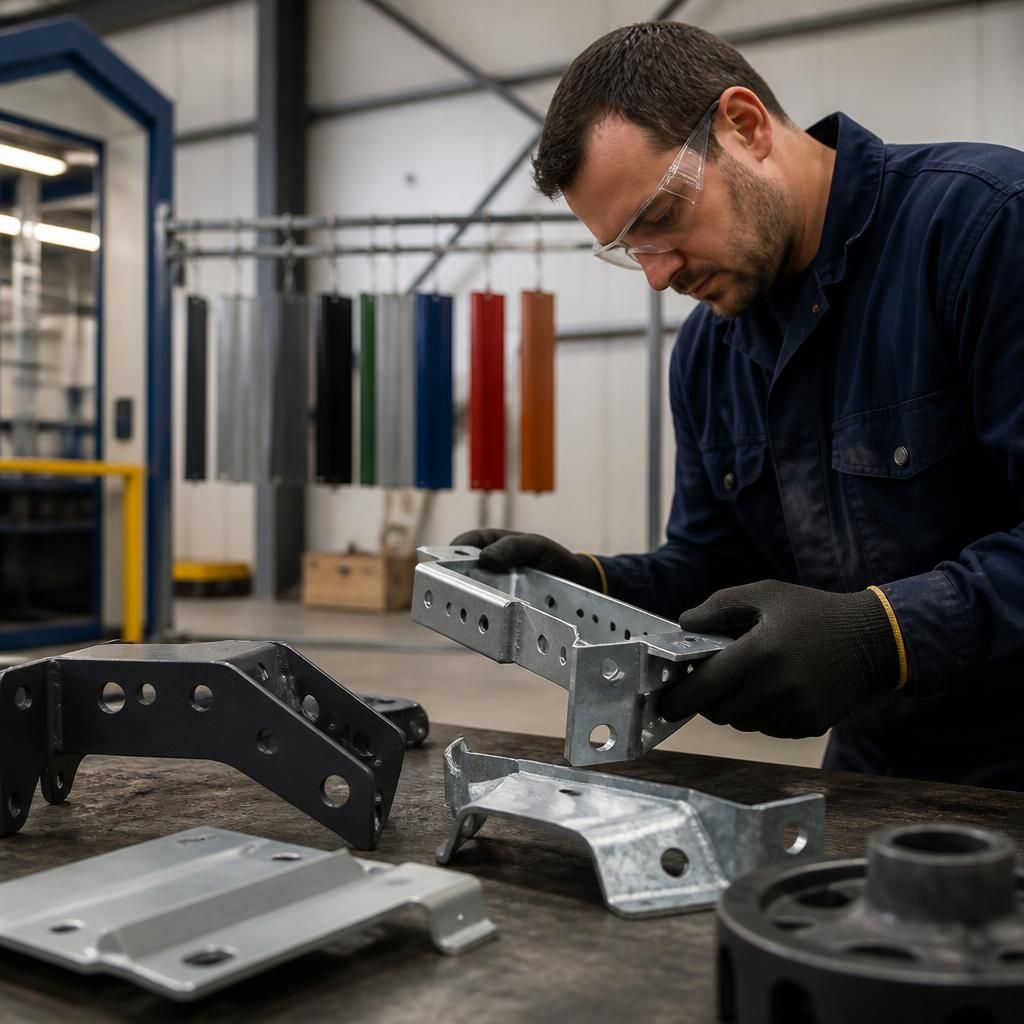
The metal substrate can influence the choice as much as the coating’s intended appearance. Steel, aluminium, galvanised steel and cast components each require compatible preparation and, in some cases, a suitable primer or pre-treatment. Powder coating is effective when the substrate can be cleaned, electrically grounded and cured without causing distortion or trapped-gas defects. Traditional paint may be more adaptable for unusual substrates, mixed-material assemblies or components that cannot safely undergo the required powder-curing cycle. Confirming the metal type, surface condition and preparation method before specifying the finish helps avoid adhesion problems and premature coating failure.
Discuss the Right Coating for Your Metal Parts
Discuss your metal components and coating requirements with a powder-coating specialist to help determine whether powder coating or traditional paint is the more suitable option. Provide details of the substrate, component dimensions, intended environment and required finish for an informed assessment.