

What are the key differences between polyester, epoxy, and polyurethane powder coatings?
Polyester powder coatings provide strong outdoor durability and colour retention, epoxy coatings offer excellent adhesion and corrosion resistance for indoor use, and polyurethane coatings combine weather resistance with a smooth, high-quality finish. The right choice depends on the component’s environment, required appearance, exposure to chemicals or sunlight, and performance requirements.
The main difference between polyester, epoxy and polyurethane powder coatings is the resin system used to form the cured film. That resin determines how the coating responds to sunlight, moisture, chemicals, abrasion, heat and cleaning, as well as the appearance that can be achieved. All three are generally thermoset powders: they melt during curing, flow across the prepared metal and chemically cross-link into a permanent coating.
Polyester powder coating is usually selected for components that will be exposed to the external environment. Its formulation is designed to retain colour and gloss more effectively under sunlight than standard epoxy systems, while providing a practical balance between appearance and general durability. It is widely used for fabricated metalwork, architectural components, equipment housings, brackets, frames and other parts that may experience rain, condensation and changing temperatures.
Polyester is not a single performance level. Standard formulations may be suitable for general-purpose applications, while enhanced systems can be specified where longer-term resistance to weathering, colour change or surface degradation is important. The specification should therefore identify the expected exposure rather than simply stating “polyester”. A part installed outdoors, for example, may need a different polyester grade from a part used inside a protected industrial area.
Epoxy powder coating forms a strongly adherent film and is valued for its resistance to moisture, corrosion-related environments and many chemicals. It is often appropriate for internal metal components, machinery parts, electrical enclosures, shelving, fixtures and items where sunlight is limited. Epoxy can provide a hard, protective barrier when the steel or other metal has been correctly prepared and the coating is fully cured.
Its principal limitation is external exposure. Direct ultraviolet light can cause an epoxy surface to lose appearance and develop a chalky finish over time. This does not necessarily mean that the underlying metal loses all protection immediately, but the visible surface may no longer meet the required standard. For that reason, epoxy is normally chosen for its protective properties in suitable environments rather than for long-term exposed decorative performance.
Polyurethane powder coating uses a polyurethane-based chemistry to produce a smooth, refined film with a strong balance of appearance and environmental resistance. It can be considered where surface quality, colour retention and resistance to handling or cleaning are all important. Polyurethane is used on components that need a more polished finish than a basic industrial coating may provide, including some equipment, fittings and visible fabricated parts.
The practical differences can be summarised as follows:
- Polyester: commonly preferred for external or mixed-exposure components where weathering and retained appearance are important.
- Epoxy: commonly preferred for internal components requiring adhesion, chemical resistance and a protective barrier against corrosion.
- Polyurethane: commonly preferred where a smooth, high-quality appearance must be combined with resistance to environmental exposure and routine handling.
These categories overlap, so resin type should not be selected in isolation. The component’s location, expected service life, contact with chemicals, cleaning method, handling frequency and required visual standard all affect the decision. A part kept indoors but exposed to solvents may favour a different system from an outdoor part that is rarely handled. Similarly, a concealed bracket may need a primarily protective specification, whereas a visible panel may require close control of gloss, colour and surface texture.
Epoxy-polyester hybrids are another option for some applications. These combine epoxy and polyester resins to balance protective properties and appearance. They are often used for general internal metalwork where a pure epoxy system is not necessary, but where a straightforward polyester system is not the preferred specification. A hybrid should not automatically be treated as an external coating; its suitability depends on the formulation and the exposure conditions.
The metal substrate and preparation also influence the result. Oil, grease, mill scale, rust, welding residues and other contaminants can interfere with adhesion regardless of which resin is selected. Abrasive preparation, chemical cleaning, suitable pretreatment and correct handling before coating help establish a consistent base. Sharp edges, recesses, welds and differing metal types may require particular attention because they can affect coverage and the risk of premature corrosion.
Curing is equally important. Powder must be heated sufficiently for the specified system to flow and cross-link throughout the coating, not merely reach the required temperature at the oven air. Component thickness, geometry, metal mass and loading arrangement can all influence the heat absorbed by the part. Under-cured powder may have reduced performance, while excessive heat can affect colour, gloss or the substrate. The coating specification should therefore be matched to the component and the curing process rather than chosen solely by colour or price.
Finish requirements can further narrow the choice. Gloss level, matt appearance, texture, colour stability and visual uniformity are separate considerations from resin chemistry. A coating may meet the required chemical or weathering performance but still be unsuitable if the finish highlights surface imperfections or does not match adjacent components. Trial panels or sample pieces can be useful where colour, texture or appearance must be assessed before a production batch is processed.
For a sound specification, provide the coater with the component material, dimensions, intended environment, exposure to sunlight and chemicals, cleaning requirements, desired colour and finish, and any performance standard that must be met. Polyester, epoxy and polyurethane are not interchangeable labels: the correct choice is the system whose tested properties match the component’s actual service conditions. For Midlands manufacturers, fabricators and other businesses preparing a coating requirement, these details allow the coating material and application method to be considered together rather than selecting a resin by name alone.
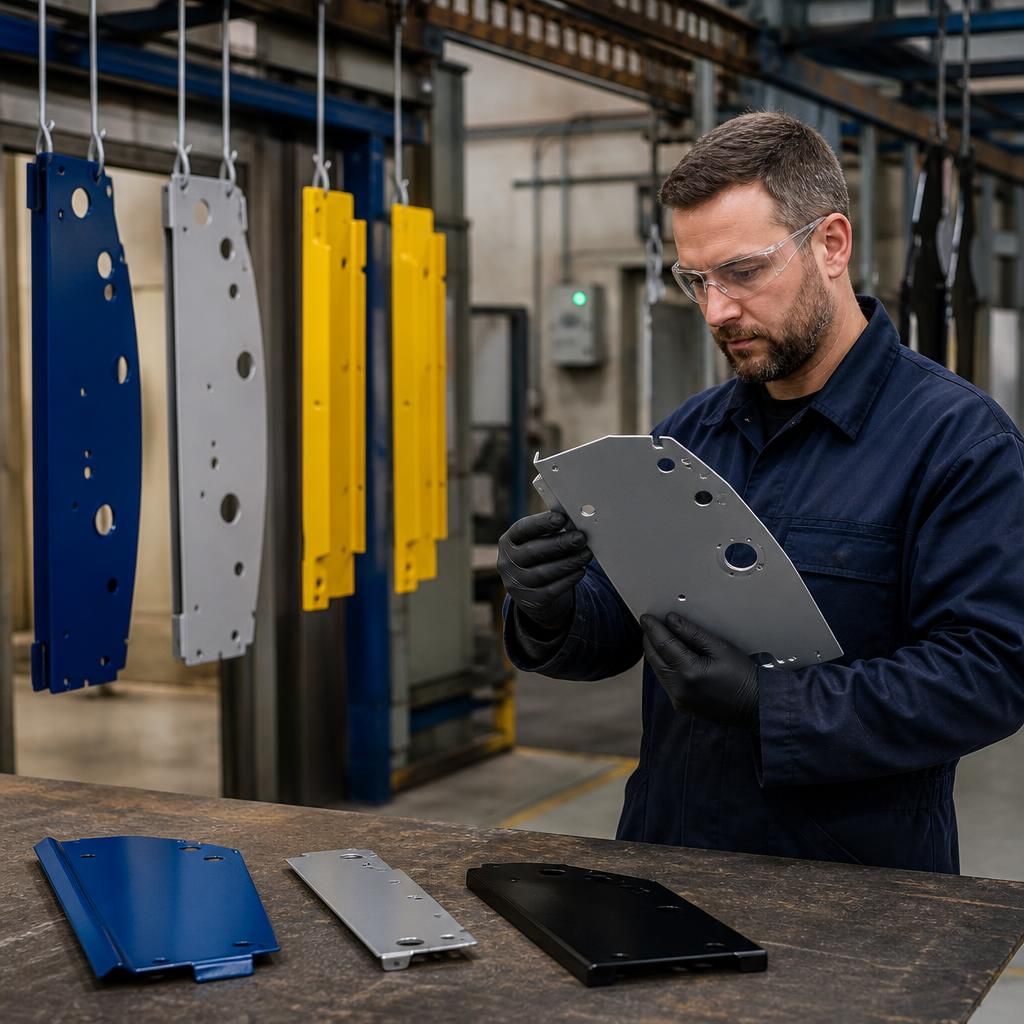
A practical difference between polyester, epoxy and polyurethane powder coatings is how they affect future repair or recoating work. Once a thermoset powder has cured, it cannot simply be melted and reshaped like a thermoplastic coating. Any later coating work normally depends on removing or abrading the existing surface sufficiently, checking adhesion and confirming that the new system is compatible.
This matters when components may be refurbished, modified or supplied in stages. A replacement part finished with a different resin may not match the original surface behaviour, even if the colour and gloss appear similar. The coating specification should therefore record the resin system as well as the colour, gloss and texture. Keeping that information with the component or production records helps avoid treating polyester, epoxy and polyurethane as interchangeable during future maintenance or repeat manufacture.