

What makes UV and high-performance powder coatings more durable than standard coatings?
UV and high-performance powder coatings are more durable because they use formulations designed to withstand ultraviolet radiation, moisture, temperature changes and chemical exposure more effectively than standard coatings. Their specialised resins, pigments and protective additives help the finish retain its colour, gloss, adhesion and protective barrier for longer in demanding environments.
UV and high-performance powder coatings last longer than standard coatings because their complete coating system is engineered to control the main causes of premature failure: degradation of the binder, loss of adhesion, surface attack and mechanical damage. Durability therefore depends on more than the powder itself; substrate preparation, film build, curing and the suitability of the specification for the environment all affect the finished result.
The resin system is a primary difference. A powder coating’s resin forms the continuous film that binds the pigments and protects the metal. High-performance formulations use resin chemistry selected for stronger resistance to ultraviolet exposure, hydrolysis, temperature cycling and chemical attack. Once correctly cured, the cross-linked film is less likely to soften, embrittle, chalk or lose cohesion when exposed to demanding conditions.
Standard coatings can be suitable for many internal or moderately exposed applications, but their performance may decline sooner where components receive sustained sunlight, rain, condensation, industrial contaminants or repeated temperature changes. A high-performance specification is intended to retain its physical and protective properties for longer in those conditions, rather than simply providing an attractive initial finish.
UV resistance protects the coating film itself. Ultraviolet radiation can break down chemical bonds in a coating, causing fading, chalking, gloss loss and gradual embrittlement. UV-resistant formulations use more stable binders and carefully selected pigments, together with additives that reduce the effect of radiation on the film. This slows visible weathering and helps the coating remain continuous, which is important because a weakened or porous film offers less protection to the metal beneath it.
Pigment selection also matters. Some colours and finishes are inherently more vulnerable to fading than others, particularly where the coating is exposed to direct sunlight for long periods. The required colour, gloss level and expected exposure should therefore be considered together when specifying a durable finish.
Resistance to moisture and temperature cycling reduces failure at the metal interface. Outdoor components repeatedly expand and contract as their temperature changes. They may also encounter rain, condensation, freeze-thaw conditions or trapped moisture within joints and recesses. A well-formulated coating with good adhesion and flexibility is better able to accommodate these movements without cracking or separating from the substrate.
However, even a high-performance coating cannot compensate for contamination beneath the film. Oil, grease, mill scale, corrosion products, dust and moisture can interrupt adhesion and create points where water penetrates. Proper preparation and appropriate pretreatment are essential because the coating’s durability begins at the interface with the metal.
Higher resistance to chemicals and contaminants helps preserve the barrier. Components used in manufacturing, transport, construction and automotive settings may be exposed to cleaning agents, fuels, oils, salts, pollutants or process chemicals. A suitable high-performance powder coating limits swelling, softening, staining and surface attack more effectively than a general-purpose coating. The exact resistance depends on the chemical, its concentration, contact time, temperature and the coating specification, so these conditions should be identified before selection.
Mechanical durability is another part of the comparison. Powder coatings form a continuous cured film that can be specified for resistance to abrasion, impact and handling damage. High-performance systems may be selected where coated parts are assembled, transported, cleaned or used in areas subject to repeated contact. A coating that resists scuffing and impact is less likely to expose bare metal through everyday service damage.
Film thickness must still be controlled. Insufficient coverage can leave weak areas, while excessive build may affect appearance, curing and flexibility. Edges, corners, welds, holes and recessed sections also require attention because they can receive less consistent coverage and are often the first locations to show failure.
Correct curing converts the applied powder into its intended protective film. The component must reach the specified metal temperature for the required cure cycle. If it is under-cured, the film may have reduced hardness, adhesion and chemical resistance. Over-curing or unsuitable heat exposure can also affect colour, gloss and coating performance. For this reason, process control is as important as choosing a high-performance powder.
A useful specification should consider:
- the amount and direction of UV exposure;
- rain, humidity, condensation, salt and temperature variation;
- contact with chemicals, cleaning products or industrial contaminants;
- the expected level of abrasion, impact and handling;
- the base metal, preparation method and pretreatment;
- required colour, gloss, texture and acceptable weathering; and
- the target film thickness and curing requirements.
It is also important to distinguish between appearance retention and corrosion protection. A coating may retain its colour and gloss while damage at an edge or poorly prepared area allows corrosion to begin. Conversely, a finish may show some visual weathering without immediately losing all protective function. The correct assessment should therefore consider adhesion, film integrity, chemical resistance and corrosion performance as well as appearance.
High-performance powder coating is not a universal guarantee of longer service life. Its advantage is realised when the formulation is matched to the exposure and applied to a suitably prepared component under controlled conditions. For manufacturers and fabricators, discussing the component’s operating environment before coating helps determine whether a standard system is adequate or whether enhanced UV, weather and chemical resistance is justified.
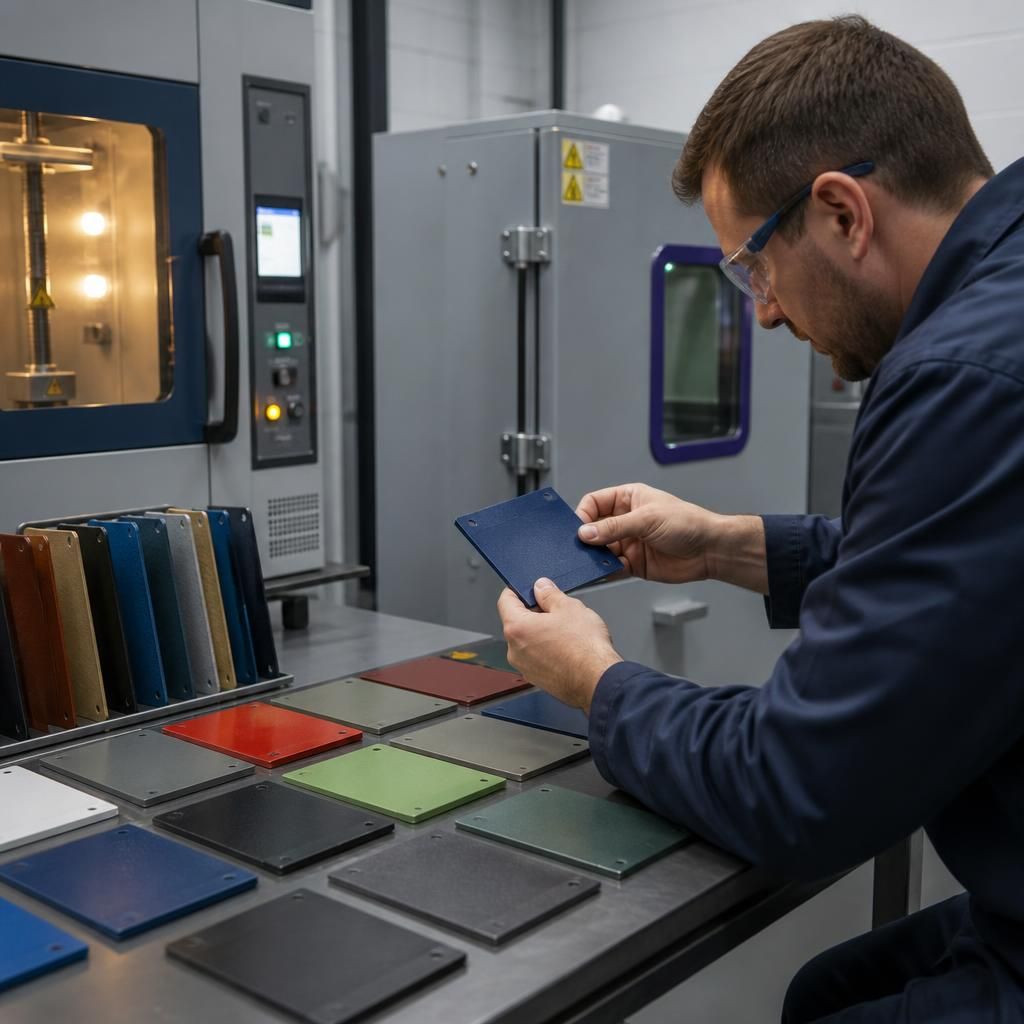
The durability advantage of a high-performance powder coating should be judged against relevant test data, not the product description alone. Manufacturers may assess properties such as colour and gloss retention, adhesion, impact resistance, abrasion resistance and chemical exposure. These tests help compare formulations under controlled conditions, although accelerated testing is an indicator of performance rather than a guaranteed service-life prediction.
For a meaningful comparison with a standard coating, the test conditions must reflect the component’s intended use. A finish exposed to strong sunlight requires evidence of suitable UV and weathering resistance, while an industrial component may need stronger chemical or abrasion performance. Reviewing the coating classification, test method and exposure assumptions helps ensure that its claimed durability relates to the actual application.