

What specific performance characteristics should you prioritise for your project's success when selecting a thermoset powder coating?
Prioritise the characteristics that match the component’s service conditions: adhesion, corrosion resistance, chemical resistance, abrasion and impact resistance, UV stability, and the required finish quality. Also confirm that the coating’s curing requirements, film thickness and substrate compatibility suit your production process and the component’s intended use.
The most important thermoset powder coating characteristics are those that control the component’s likely failure modes throughout its service life. Selection should therefore prioritise the required balance of mechanical behaviour, thermal stability, electrical performance, appearance retention and process consistency, rather than choosing a coating solely by colour or general-purpose classification.
Start with the component’s load profile. A coating for a rigid enclosure may need high surface hardness and dimensional stability, while one applied to a part that flexes during assembly needs sufficient elasticity to avoid cracking or delamination. Hardness, flexibility and elongation should be considered together: increasing one property can affect the others. For parts exposed to repeated handling, look for resistance to chipping and deformation, not just a high hardness value.
Consider thermal behaviour separately from the surrounding environment. If a coated component experiences heating and cooling cycles, the coating must tolerate expansion and contraction without developing microcracks or losing bond strength. Relevant characteristics can include continuous-use temperature, short-term heat resistance, thermal ageing and resistance to thermal shock. The difference in expansion between the substrate and coating is particularly important for large panels, thin metal sections and assemblies exposed to fluctuating temperatures.
Specify electrical properties where the coating forms part of the design. Thermoset powders can be selected for insulating behaviour, but the required property depends on the application. Important criteria may include dielectric strength, insulation resistance, surface resistivity, tracking resistance or controlled conductivity. State whether the finish must insulate the part or permit reliable earthing, and identify any areas that must remain electrically conductive before coating is applied.
Assess coverage and appearance on the actual component geometry. Corners, recesses, welds, folded edges and boxed sections can behave differently from broad, accessible faces. A suitable coating specification should account for the ability to produce a consistent finish across those features without excessive build-up, thin spots or visual defects. For visible components, define acceptable limits for colour variation, gloss variation, orange peel, pinholes and surface contamination rather than relying on a general description such as “high quality finish”.
Check resistance to manufacturing and assembly operations. The finished coating may need to withstand masking removal, handling, stacking, bolting, pressing, bending or contact with seals. If the part will be assembled after coating, assess whether the coating’s hardness and flexibility suit those operations. Where a second coating or repair layer may be applied, confirm intercoat compatibility and adhesion requirements in advance.
Give attention to coating-system consistency. A thermoset powder is not assessed in isolation: substrate condition, pretreatment, application equipment and the coating schedule all influence the final result. Ask for technical information covering:
- the resin and crosslinker system;
- recommended and acceptable processing conditions;
- mechanical, thermal and electrical test data where relevant;
- expected appearance tolerances and colour-control arrangements;
- compatibility with the substrate and any pretreatment;
- storage, handling and recoat requirements; and
- known limitations such as outgassing from castings or porous substrates.
Prioritise characteristics by consequence. A useful approach is to classify each requirement as critical, important or preferred. A failure that compromises electrical safety, structural function or statutory compliance should take precedence over a minor appearance preference. For a decorative component, visual uniformity and long-term colour consistency may carry greater weight. For a fabricated industrial part, mechanical integrity, thermal cycling and resistance to assembly damage may be more significant.
Use representative testing rather than relying only on data sheets. Supplier figures provide a basis for comparison, but test results may not reproduce the substrate, geometry or preparation used in production. Trial panels or representative components can reveal problems such as edge effects, outgassing, poor coverage or incompatibility with adjacent materials. Testing should use agreed methods and acceptance criteria, with the same criteria applied when approving later batches.
In practice, the strongest specification links each performance characteristic to a measurable risk: cracking during flexure, loss of insulation, degradation during heat cycling, visual variation or damage during assembly. This produces a coating choice that is technically justified for the component and production process, rather than one selected from a generic list of properties.
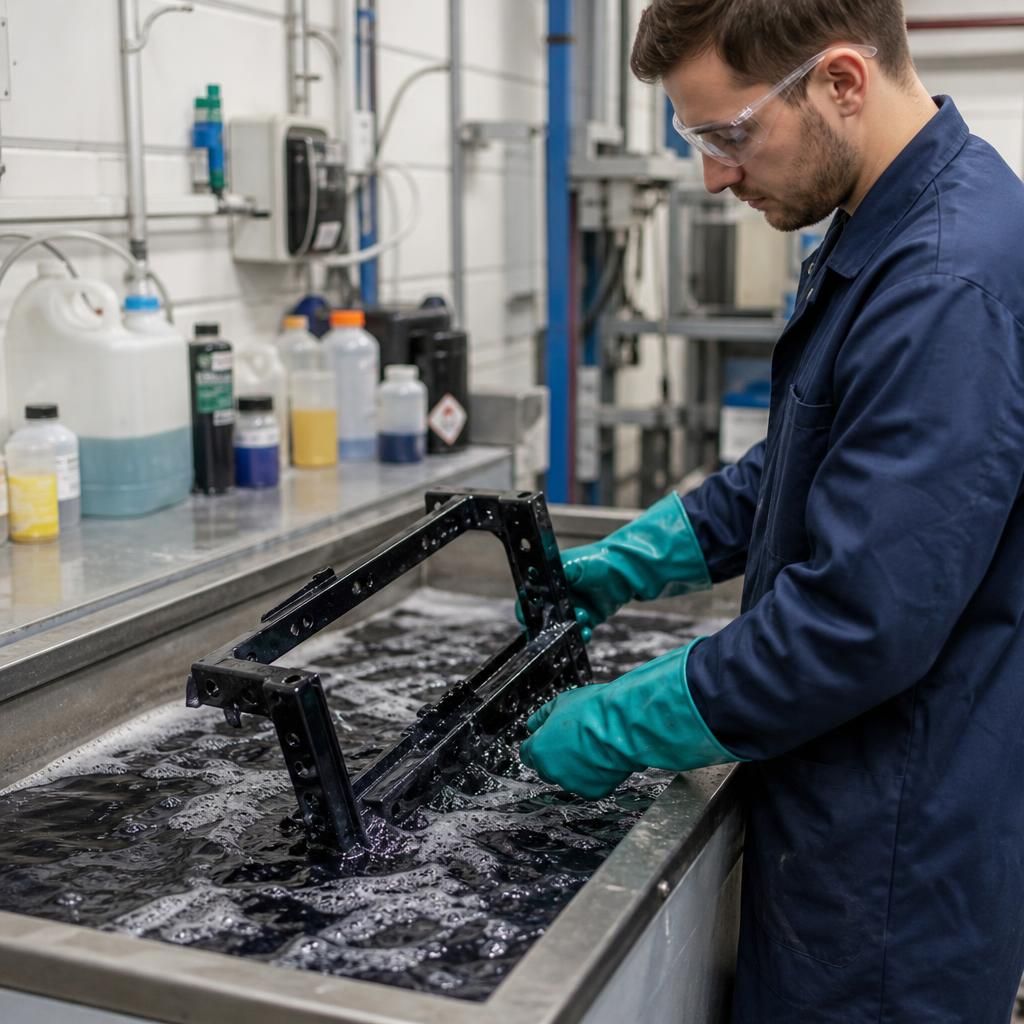
Chemical resistance should be matched to the substances the coated part will actually encounter. Identify the chemicals, their concentration, contact duration and operating temperature rather than relying on a general claim that a thermoset powder is “chemical resistant”. Oils, fuels, detergents, acids, alkalis and solvents can affect a coating in different ways, and occasional splashing presents a different requirement from continuous immersion.
Check whether exposure could cause softening, swelling, blistering, loss of adhesion, staining or loss of gloss. Cleaning agents deserve particular attention because repeated contact, elevated wash temperatures and mechanical cleaning can be more demanding than the original operating environment. Where the consequence of coating failure is significant, assess the proposed powder on representative metal, using the intended pretreatment and film build, before approving it for production.
Discuss Your Thermoset Powder Coating Requirements
Discuss your thermoset powder coating requirements with our team to identify the performance characteristics most relevant to your component and application. Provide details of the substrate, service conditions, required finish and production process so suitable options can be considered.