

What specific applications are ideal for using fusion bonded epoxy coatings?
Fusion bonded epoxy coatings are ideal for steel pipelines, pipe fittings, valves, tanks and other components exposed to corrosion, chemicals, moisture or buried and immersed conditions. They are particularly suited to infrastructure, oil and gas, water, construction and industrial applications where strong adhesion and durable protective coverage are required.
Fusion bonded epoxy (FBE) coatings are best suited to prepared steel components that need a strongly bonded, electrically insulating barrier against corrosion, moisture, chemicals and abrasion. They are particularly effective where the finished part will be buried, immersed, exposed to soil, or placed in a process environment rather than used primarily for decorative appearance.
Applications involving buried or immersed steel
- Underground steelwork exposed to damp soil, salts and naturally occurring contaminants.
- Submerged metalwork in water-treatment and marine-related environments, subject to the specified water chemistry and coating system.
- Steel reinforcement and foundation-related components where corrosion protection is needed before the material is enclosed in concrete or soil.
- Coated piles, supports and similar structural elements that experience continuous contact with ground or water.
FBE is a practical choice for these uses because the coating forms a continuous film that adheres directly to the prepared steel. Its resistance to cathodic disbondment can also make it suitable for systems where cathodic protection is part of the wider corrosion-control strategy. The coating specification should still be checked against the intended current levels, immersion conditions and repair requirements.
Applications exposed to chemicals and process fluids
FBE can suit steelwork handling or containing fluids when the resin formulation has been selected for the particular chemical exposure. Relevant examples include process pipework, fluid-handling equipment, storage vessels and components used in treatment systems. Suitability depends on the chemical concentration, operating temperature, exposure duration and whether the contact is continuous or intermittent. A coating that performs well against water may not be appropriate for solvents, strong acids or alkaline fluids, so chemical-resistance data should be reviewed rather than relying on the generic term “epoxy”.
Applications requiring mechanical protection
FBE is also appropriate where coated steel may encounter handling damage, soil movement, aggregate or moderate abrasion. This makes it useful for fabricated sections, structural supports and heavy-duty components that need more than a purely decorative finish. Edge preparation, film thickness and the avoidance of sharp discontinuities are important because impact resistance depends on the complete coating system and the condition of the steel beneath it.
When the application method matters
FBE is applied as a dry powder to a heated metal surface, allowing the particles to melt, flow and cure into a bonded thermoset layer. The process is therefore well suited to components that can be suitably cleaned, heated and handled during coating. It is less straightforward for very large assemblies, heat-sensitive attachments or items that cannot be processed without distorting dimensions. Masking may be needed on threads, machined faces, earth points and other areas where coating thickness would affect assembly or electrical contact.
For fabricated parts, the design should allow access for blast cleaning and coating, minimise crevices and provide suitable lifting or hanging points. Welds should be continuous where required, spatter removed, and sharp edges treated appropriately. These preparation details often have as much influence on service performance as the epoxy formulation itself.
Applications where FBE may need an additional system
FBE is not normally selected solely for colour retention or high-gloss architectural appearance. Extended exposure to direct sunlight can cause epoxy surfaces to chalk or lose their original appearance, even where the underlying corrosion protection remains effective. If the component is both heavily exposed to ultraviolet light and required to retain a particular finish, a compatible overcoat or alternative topcoat system may be considered.
It may also be unsuitable where the operating temperature exceeds the coating’s specified limit, where repeated severe thermal cycling is expected, or where flexibility is more important than hardness. The correct decision should consider the substrate, preparation standard, service temperature, exposure medium, mechanical loading, inspection requirements and the consequences of coating damage.
Practical suitability check
- Identify whether the exposure is atmospheric, buried, immersed or chemical.
- Define the fluid, soil or process contaminants and their expected temperature.
- Confirm that the steel can be blast cleaned and heated without affecting its dimensions or attached parts.
- Specify the required film thickness, edge treatment, holiday detection and repair procedure.
- Decide whether ultraviolet exposure, appearance requirements or additional mechanical protection call for a compatible topcoat.
In summary, FBE is most appropriate for engineered steel applications where adhesion, corrosion resistance and long-term barrier protection are more important than decorative appearance. It should be selected as part of a complete coating specification, with the resin grade, preparation, curing conditions and inspection method matched to the actual service environment.
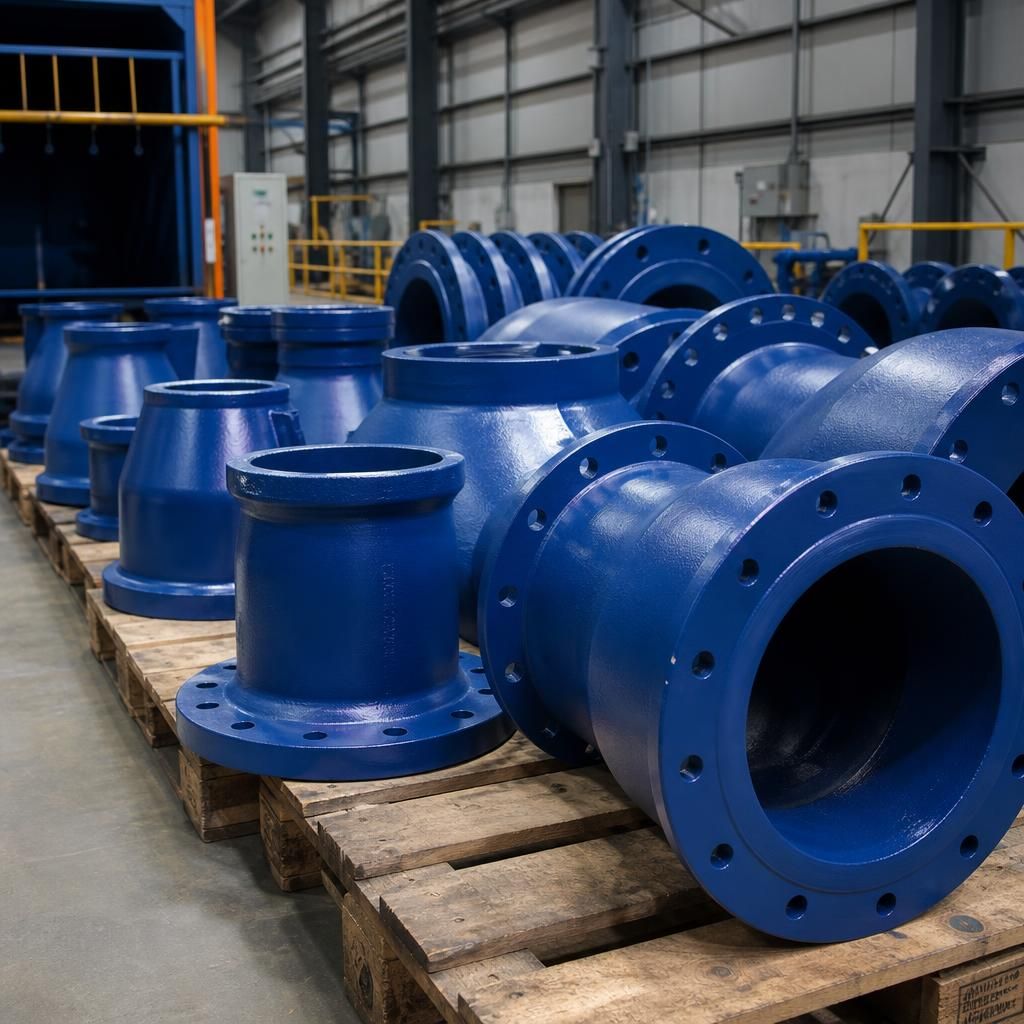
Fusion bonded epoxy coatings are particularly well suited to repeat batches of steel components that can be processed under controlled preparation, heating and curing conditions. This makes them practical for standardised parts such as fittings, supports, fabricated sections and other industrial components manufactured to consistent dimensions.
Batch processing allows the coating specification to be applied consistently across similar items, while inspection can focus on film continuity, coverage and any areas requiring repair. The approach is most effective when the component design provides access for cleaning and coating, with threads, machined faces and connection points identified for masking where necessary.
For manufacturers and fabricators, FBE is therefore a strong option when corrosion protection must be repeated across a series of steel parts rather than applied as a purely decorative finish. The final suitability still depends on the component’s service environment, geometry, required thickness and ability to withstand the coating process without dimensional change.
Discuss Whether Fusion Bonded Epoxy Suits Your Application
Discuss your component specification with Powder-coatings.co.uk to assess whether fusion bonded epoxy is suitable for its service environment, geometry and required finish. Provide details of the substrate, operating conditions and intended use so the appropriate coating approach can be considered.