

What is the difference between thermoset and thermoplastic powder coatings?
Thermoset powder coatings cure through a chemical reaction that permanently hardens the finish, while thermoplastic powder coatings melt and flow onto the surface without chemically cross-linking. This means thermosets generally provide a hard, durable finish for many metal components, whereas thermoplastics can be remelted and are often selected where flexibility, impact resistance or greater film thickness is required.
The main practical difference between thermoset and thermoplastic powder coatings is how each finish behaves during service and when exposed to heat. Thermosets are generally chosen for hard, durable protection on metal components, while thermoplastics are considered where flexibility, impact resistance, abrasion resistance or a heavier coating build is more important. The right option depends on the component’s operating temperature, exposure conditions, required film thickness and performance priorities.
Thermoset powder coatings are commonly used for architectural, industrial, fabricated and automotive components. Once processed, the coating forms a stable network that does not flow again when reheated. This gives the finish good dimensional stability and helps it retain its hardness during normal service. Typical thermoset chemistries include epoxy, polyester, hybrid and polyurethane systems, each offering a different balance of corrosion protection, weathering, chemical resistance, appearance and cure requirements.
Thermoplastic powder coatings remain capable of softening when heated. They are often selected for parts that may receive impact, flexing, abrasion or a comparatively thick protective layer. Common thermoplastic coating families include nylon, polyethylene and PVC-based systems, although suitability depends on the specific formulation and application method. Their ability to soften under heat can be useful in some applications, but it also places greater importance on the component’s maximum service temperature.
The main differences can be summarised as follows:
- Hardness and flexibility: Thermosets generally provide a harder, more rigid surface. Thermoplastics are typically more flexible and less likely to fracture when a coated part is subject to impact or movement.
- Impact and abrasion: Thermoplastics can be advantageous for components exposed to repeated knocks, rubbing or sliding contact. Certain thermoset formulations also provide strong abrasion resistance, so the coating specification should be assessed rather than relying only on the coating category.
- Film thickness: Thermoplastic processes can produce a relatively heavy protective layer, which may be useful where edge coverage, electrical insulation or substantial barrier protection is required. Thermoset powder coatings are often selected where a controlled, uniform decorative and protective film is appropriate.
- Heat resistance: Thermosets commonly retain their shape and hardness more effectively at elevated temperatures. Thermoplastics can soften as temperature increases, so the expected operating and cleaning temperatures must be checked against the product’s technical data.
- Repair and reprocessing: A thermoset cannot normally be melted back into a flowable coating after it has been fully cured. A thermoplastic may soften again when reheated, but this does not automatically make a damaged coating simple to repair; contamination, surface preparation, adhesion and the condition of the underlying metal still matter.
- Weather and chemical exposure: Neither category is automatically best in every environment. Thermoset polyester systems are often considered for exterior weathering, while epoxy systems may be selected for chemical or corrosion-related protection where ultraviolet exposure is limited. Thermoplastic options can offer useful chemical, moisture or abrasion resistance, but the precise chemistry and exposure must be matched.
Processing is also different. Thermoset powder is normally applied to a prepared metal surface and heated so that the particles melt, flow and complete their cure. The required metal temperature and time at temperature depend on the formulation, component mass and oven conditions. Thermoplastic powder may be applied using methods such as electrostatic spray, fluidised-bed coating or other specialist processes. The method affects coverage, thickness, adhesion and the finish obtainable on complex shapes.
Component design can influence the decision as much as the coating chemistry. Holes, recesses, sharp edges, welds and closely assembled parts can affect powder deposition and heat transfer. Thermoplastic coatings may be useful where a thicker, resilient barrier is required, but that thickness can affect tolerances, threads, mating surfaces and drainage points. Thermoset coatings can offer a more controlled finish for parts where dimensional accuracy and appearance are important.
Surface preparation is essential for both types. Degreasing, removal of rust, appropriate blasting or chemical preparation, and the use of a compatible primer or pre-treatment all influence adhesion and corrosion performance. A thermoplastic coating is not inherently able to compensate for poorly prepared steel, and a thermoset coating will not deliver its intended properties if oil, scale, moisture or incompatible residues remain on the substrate.
For a component exposed to high temperatures, a thermoset is often the more suitable starting point, provided its specific resin and pigment system match the operating conditions. For flexible parts, impact-prone equipment, heavy-duty abrasion or applications needing a thicker protective layer, a thermoplastic may be more appropriate. Where both flexibility and high-temperature stability are important, the available options may involve a compromise, making technical data and application trials particularly relevant.
Selection should therefore consider the complete service environment: base metal, part geometry, coating thickness, cure or processing temperature, continuous and peak operating temperatures, ultraviolet exposure, chemicals, moisture, impact, abrasion, colour and required appearance. For industrial batches or specialist metal components, providing these details before coating helps determine whether a thermoset or thermoplastic system is technically suitable and whether the proposed process is compatible with the part.
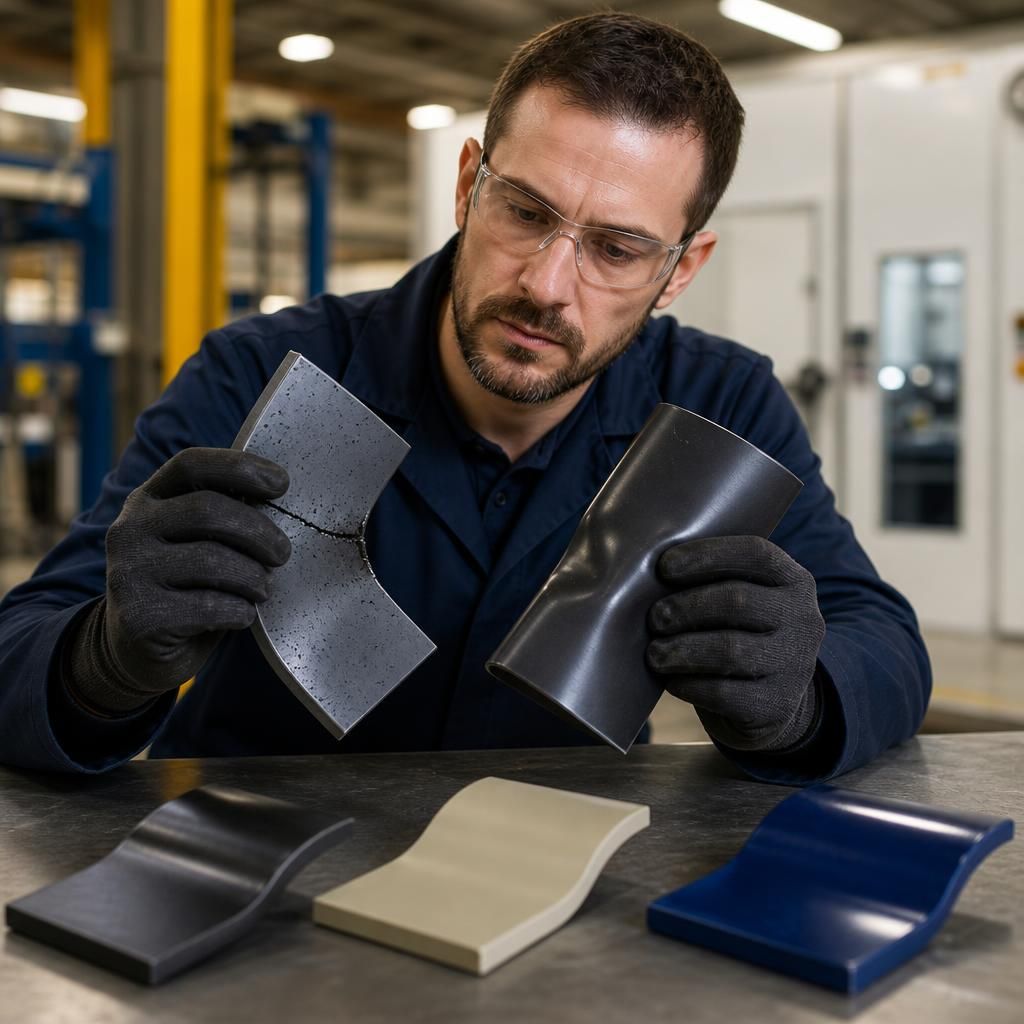
A useful way to compare thermoset and thermoplastic coatings is to consider how each may fail when the component is mechanically stressed. A thermoset finish may crack or chip if the underlying metal is sharply bent or repeatedly flexed, whereas a thermoplastic finish can accommodate some movement but may deform, indent or creep under sustained load, particularly at raised temperatures.
This distinction is important for parts such as guards, brackets, housings and handling equipment. The coating should be matched to the likely failure mode: resistance to cracking during movement, or retention of shape under pressure and heat. Product-specific technical data and a review of the component’s loading conditions are needed because performance varies between individual formulations within each coating family.
Discuss Thermoset and Thermoplastic Options for Your Project
Discuss your component’s operating conditions, geometry and required finish with our team to help identify whether a thermoset or thermoplastic powder coating is the more suitable option. We can consider your project requirements for metal components and specialist coating applications.