

What role does the thermoplastic powder coating process play in determining the final finish quality and long-term reliability of industrial applications?
The thermoplastic powder coating process directly affects finish quality and long-term reliability through surface preparation, powder application, heating and controlled cooling. Correct control of each stage promotes an even, well-adhered coating with the intended appearance and resistance to wear, impact, moisture and environmental exposure.
The thermoplastic powder coating process determines final performance by controlling how consistently the coating forms a continuous, correctly bonded film over the component. Finish quality depends not only on the powder itself, but also on component design, coating distribution, film build, melt behaviour and verification. Small variations in any of these areas can produce visible defects or create weak points that reduce service reliability.
Component geometry is an important influence. Recesses, internal corners, sharp edges, holes and overlapping sections do not receive powder in the same way as broad, exposed faces. Complex shapes can therefore show thinner coverage in some areas and excessive build-up in others. A suitable process accounts for these differences through part orientation, powder delivery and controlled movement. Edge coverage is particularly significant because edges are exposed to impact and can become early sites of coating damage if the film is discontinuous or too thin.
Powder characteristics affect both appearance and consistency. Particle-size distribution, flow behaviour, colour, gloss and the formulation’s melting characteristics influence how the material spreads and levels. Powder that does not flow evenly can leave a rough texture, pinholes, cratering, uneven gloss or visible variation between batches. Consistent storage and handling are also important because contamination, moisture or agglomeration can affect transfer and surface appearance.
Application control governs film uniformity. Stable powder delivery, effective electrical grounding where electrostatic application is used, and appropriate gun settings help produce an even deposit. Inadequate control may lead to thin areas, heavy build, poor penetration into recesses or excessive back-ionisation. These problems are not always obvious from a quick visual inspection, so thickness measurements at representative locations are useful, particularly on parts with irregular geometry.
Film build must match the intended service conditions. An under-thick coating may provide incomplete coverage and reduced resistance to abrasion, moisture or chemicals. Excessive thickness can cause runs, sagging, cracking, poor flexibility or dimensional problems around mating surfaces. The correct build is therefore a balance between protection, appearance and the tolerances of the finished component rather than an attempt to apply as much material as possible.
Thermoplastic coatings form their working film when the powder softens and flows. The degree of flow affects levelling, edge coverage and the closing of small surface irregularities. Insufficient flow can leave a textured or porous finish, while excessive or uneven flow can produce runs, sags and differences in gloss. Parts must be exposed to the required thermal conditions consistently, including areas that heat differently because of their mass, shape or position. Monitoring the component rather than relying only on equipment settings helps identify these differences.
The nature of thermoplastic material also affects long-term reliability. Unlike a thermoset coating, a thermoplastic coating does not form its final properties through an irreversible chemical cross-linking reaction. It can soften when exposed to sufficiently high temperatures and may be more sensitive to permanent deformation under sustained heat or load. Selection must therefore consider the application’s operating temperature, contact pressure, chemical exposure, impact risk and required flexibility. A process that produces an attractive finish may still be unsuitable if the coating’s service limits do not match the working environment.
Reliability is also influenced by continuity across joints, fastener areas and contact points. Damage can begin where coated components rub together, where hardware is installed or where edges are cut after coating. These areas may require design allowances, masking or a defined repair procedure. Post-coating drilling, machining or handling should be controlled so that exposed substrate and local damage do not undermine the wider protective system.
Quality assessment should combine appearance checks with tests appropriate to the application. Typical controls include:
- visual inspection for colour consistency, gloss, texture, runs, pinholes, craters and uncovered areas;
- coating-thickness checks across faces, edges and difficult-to-reach features;
- adhesion assessment where the substrate and coating specification make it appropriate;
- impact, flexibility, abrasion or chemical-resistance testing when those properties are critical to service;
- dimensional checks where coating build could affect assembly, clearances or moving interfaces.
These checks are most useful when linked to agreed acceptance criteria and recorded against the component or batch. Comparing results across production runs can identify drift in powder handling, equipment settings or thermal control before it becomes a recurring defect. Traceability of powder, part configuration and inspection results is particularly valuable for safety-critical, high-value or repeat-manufactured components.
In practice, the process should be designed around the component’s complete duty rather than appearance alone. A durable result requires suitable thermoplastic chemistry, controlled film formation, coverage at vulnerable features and verification that the finished coating meets the relevant functional requirements. For industrial parts, this connection between process control and service conditions is what turns a visually uniform finish into a reliable protective surface.
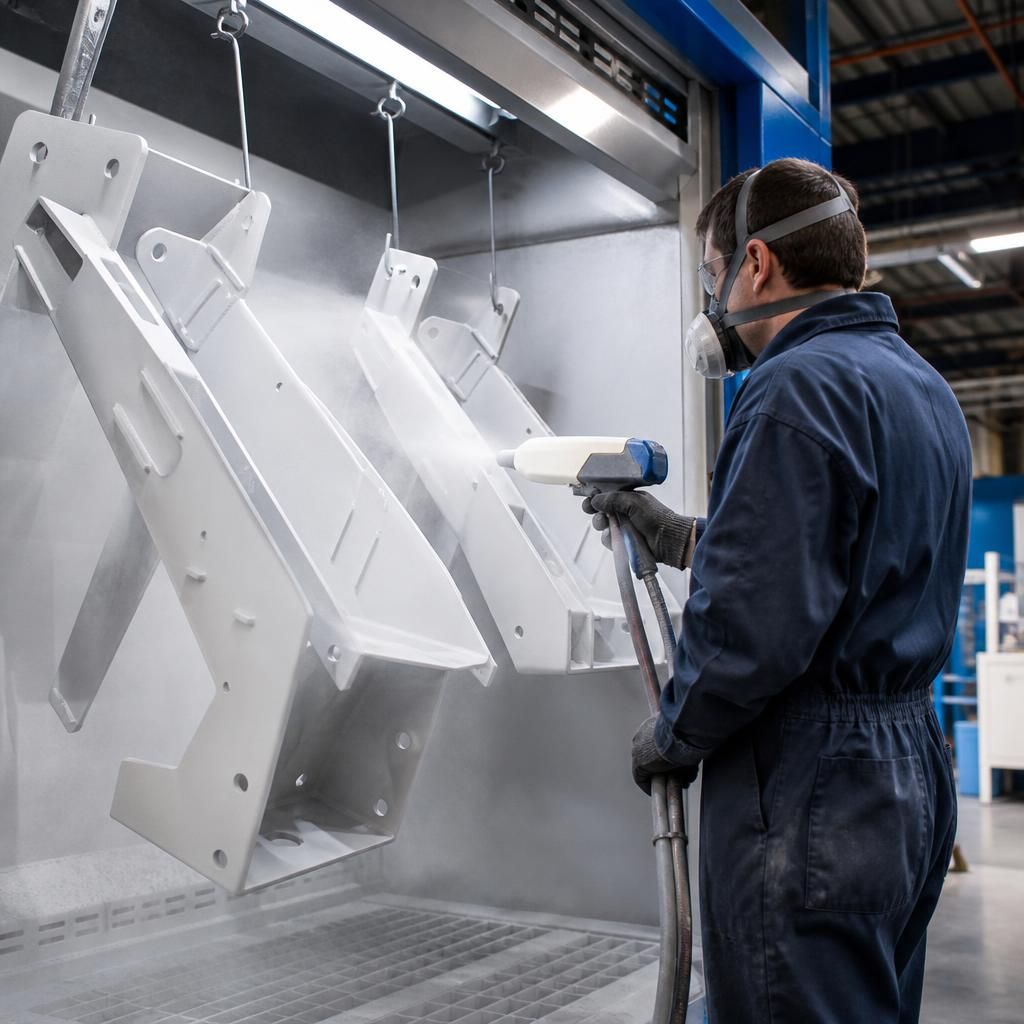
The application method can materially affect the final finish. In fluidised-bed coating, a preheated component is passed through suspended thermoplastic powder, allowing the particles to melt onto the surface and form a comparatively substantial, continuous film. This can provide effective coverage on suitably shaped parts, but the result depends on consistent component temperature and controlled immersion. If the part is too cool, the powder may not fuse properly; if it is too hot or remains in the powder for too long, excessive build, sagging or uneven edges may occur.
Electrostatic spray application offers more targeted control for components with varied surfaces or areas requiring selective coating. However, recessed features and Faraday areas can receive less powder than exposed faces. The process route should therefore be selected according to the component’s geometry, required film build and appearance specification. Matching the method to the part helps avoid correcting preventable finish defects after coating.