

What factors should be considered when choosing between thermoplastic and thermoset powder coatings for projects involving extreme temperature variations?
Choosing between thermoplastic and thermoset powder coatings for extreme temperature variations requires assessing the full operating temperature range, the frequency and speed of thermal cycling, substrate movement, and the coating’s resistance to impact, chemicals and heat. Thermoplastics can soften when reheated, whereas cured thermosets retain their cross-linked structure until excessive heat causes degradation, so the coating’s service-temperature limits and the application process must be matched to the project.
The choice between thermoplastic and thermoset powder coating for an extreme-temperature project should be based on the complete design and operating specification, not on maximum temperature alone. Important factors include the substrate, coating thickness, heat-transfer conditions, thermal gradients, required finish, exposure duration, mechanical loading, chemical contact and the consequences of coating failure.
Define the thermal exposure precisely. Record the lowest and highest temperatures at the coating surface, how long the component remains at each condition, and whether heat is applied from an oven, hot fluid, exhaust gas, sunlight or another source. The temperature of the metal may differ substantially from the surrounding air, particularly where the component is insulated, enclosed or in contact with a heat-conductive medium. Short excursions and continuous exposure place different demands on a coating, even when the peak temperature is identical.
Also identify whether the component experiences a steep temperature gradient. One area may be close to a heat source while another remains relatively cool, creating uneven expansion across the part. This can place additional stress on the coating and on the bond between the coating and substrate. Large panels, welded assemblies and parts with different metal thicknesses are especially likely to develop temperature differences during service.
Consider the substrate and its movement. Aluminium, steel, galvanised steel and other metals do not expand at exactly the same rate. A coating must accommodate the movement of its substrate without losing adhesion or developing cracks. The design should therefore account for the metal type, section thickness, welded joints, sharp edges, apertures and any areas where the coating bridges a joint or follows a curved profile. A coating that performs well on a rigid, uniform part may be less suitable for a thin or intricately fabricated component.
Thermal expansion is also affected by the way the component is supported. Fixings, brackets and adjacent materials can restrain movement, concentrating stress at holes, corners and connection points. Where the finished part is assembled with materials having different expansion characteristics, assess the complete assembly rather than considering the coated item in isolation.
Match the coating to the mechanical conditions at temperature. Heat can alter hardness, flexibility and resistance to indentation. Ask whether the surface will be exposed to vibration, rubbing, impact, abrasion, clamping pressure or repeated handling while hot or immediately after heating. For parts that must absorb movement or impact, flexibility and adhesion may be more important than a very hard surface. For parts subject to sliding contact or particle wear, abrasion resistance may take priority.
Thermoplastic systems can be useful where toughness and flexibility are required, but their response to heat and load must be checked at the actual operating condition. Thermoset systems may provide a more dimensionally stable cross-linked film within their specified range, but excessive exposure can cause irreversible loss of performance. The correct choice depends on which failure mode is acceptable for the application and whether the coating needs to tolerate handling while warm.
Assess chemical and environmental exposure alongside temperature. Heat can accelerate chemical reactions and increase the rate at which oils, fuels, solvents, cleaning agents or process chemicals affect a coating. Identify the exact substances, their concentration, contact time and temperature. Vapour, splash, immersion and repeated cleaning should be treated as separate exposure conditions. Outdoor components may also face moisture, salt, ultraviolet radiation and contamination, which can interact with thermal stress.
Pay particular attention to areas where chemicals can penetrate through a scratch, cut edge or poorly protected joint. The coating specification should consider corrosion protection for the substrate as well as the appearance of the exposed surface. If a part is frequently washed, the cleaning method, detergent chemistry, water temperature and pressure may be as important as the normal service temperature.
Check application and curing requirements. Thermoset powder requires a controlled curing cycle so that the film develops its intended cross-linked structure. The relevant measurement is the temperature reached by the metal, rather than simply the air temperature inside the oven. Thick sections, light fabrications and assembled parts may heat at different rates, so the coating process must be suitable for the component’s mass and geometry.
Thermoplastic powder is applied and fused through a different process, and the achievable film build, edge coverage and surface profile may vary according to the material and application method. Excessive or uneven thickness can affect appearance, flexibility and heat transfer. Confirm the required film thickness and acceptable tolerances before production, especially where the coating forms part of a close-fitting assembly.
Review the consequences of failure. A decorative defect may be tolerable on one component but unacceptable where the coating provides electrical insulation, corrosion protection, hygiene control or a barrier against a process material. Determine whether failure would involve colour change, gloss loss, softening, blistering, cracking, delamination, loss of insulation or exposure of the substrate. This helps establish the appropriate safety margin and whether the coating should be specified for continuous service, intermittent service or a defined number of thermal exposures.
Where the coating is used on safety-critical or difficult-to-access equipment, specify inspection points and acceptance criteria in advance. These may include visual appearance, adhesion, film thickness, edge coverage and resistance to the relevant chemicals or temperature cycle. The criteria should relate to the coating’s function rather than appearance alone.
Use representative testing before final selection. A test panel made from the same substrate and prepared in the same way as the production part can reveal problems that a product data sheet cannot. Ideally, testing should reproduce the complete sequence: heating, cooling, mechanical loading, chemical contact and cleaning. Inspect the panel for cracking, blistering, loss of adhesion, colour change and changes in hardness or flexibility.
For a project involving unusual temperatures or severe cycling, provide the coater with the full operating profile, substrate details, expected film build, chemical exposure and performance priorities. The final specification should identify the coating type, colour and finish, preparation method, application requirements, curing or fusion conditions, inspection checks and service limitations. This structured comparison gives a more reliable basis for choosing thermoplastic or thermoset powder than a general claim about one category being more heat resistant than the other.
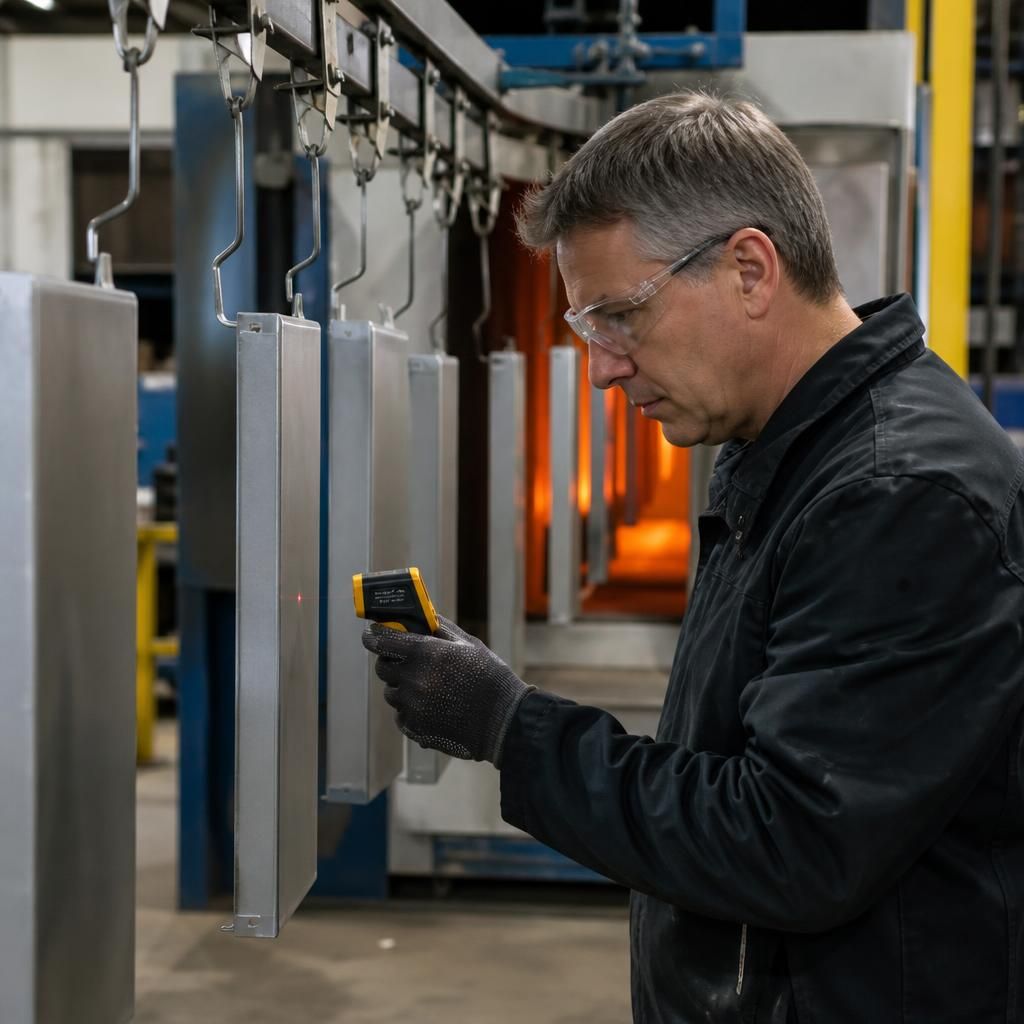
Thermal-performance data for powder coatings must be interpreted as application limits rather than universal temperature guarantees. A product’s stated continuous, intermittent and peak-temperature ratings may refer to different test conditions, film thicknesses and exposure durations, so the relevant rating is the one that matches the project’s actual thermal profile.
When comparing thermoplastic and thermoset systems, review how the coating behaves as it approaches its rated limit. A thermoplastic may show changes in hardness, surface feel or dimensional stability before it loses adhesion, while a thermoset may retain its shape but undergo irreversible chemical degradation after excessive exposure. These are different failure mechanisms and should be assessed against the component’s function.
Ask the coater or material supplier for data covering the intended coating thickness, substrate and exposure conditions. Where the operating temperature is close to a stated limit, specify an appropriate margin and verify performance using representative coated samples. This helps distinguish a coating that merely survives a short temperature excursion from one suitable for repeated or sustained service.
Discuss your extreme-temperature powder coating requirements
Discuss your extreme-temperature powder coating requirements with our Midlands team, providing the operating profile, substrate details and performance priorities for review. We can help you identify the information needed to compare a suitable thermoplastic or thermoset specification.