

How is each type of thermoplastic powder coating applied in industrial settings?
Thermoplastic powder coatings are applied mainly by preheating the metal and immersing it in a fluidised powder bed, or by electrostatic spraying powder onto the component before heating it to form a continuous film. The suitable method depends on the coating type, component size and geometry, required thickness, and the finish and performance specified for the application.
Thermoplastic powder coatings are applied by depositing dry polymer powder onto a prepared metal surface and then heating it until the particles melt, flow together and form a continuous protective layer. Unlike thermoset powders, the material does not chemically cross-link during heating, so the application stage must provide sufficient heat and dwell time for complete fusion without degrading the polymer.
The application method is selected according to the powder chemistry, component dimensions, substrate thickness, required film build and geometry. Industrial coaters commonly use fluidised-bed dipping, electrostatic spraying, hot flocking or, for particular heavy-duty linings, flame-spray systems. Each method controls how the powder reaches the part and how the finished film develops.
Fluidised-bed application
In a fluidised-bed process, powder is held in a tank through which clean, controlled air is passed. The airflow suspends the particles so that the bed behaves in a similar way to a liquid. A metal component is heated to the required temperature and immersed in the suspended powder. Contact with the hot surface melts the particles, allowing them to coalesce into a coating. The component may be immersed once or repositioned to improve coverage around its surfaces.
This method is well suited to robust components, tube sections, wire forms and parts that need a relatively substantial protective layer. It can provide excellent coverage on external surfaces and is particularly useful where impact resistance, corrosion protection or electrical insulation is more important than a very thin decorative finish. The component must be able to tolerate preheating and immersion without distortion, and its shape must allow powder to contact the areas that need coating.
Film thickness is influenced by the component temperature, immersion time, powder characteristics and the number of dips. If the part is too cool, the particles may not fuse fully. Excessive temperature or dwell time can cause sagging, uneven build or polymer degradation. Drainage, sharp corners, recesses and enclosed sections therefore need to be considered during both component design and process setup.
Electrostatic powder spraying
Electrostatic spraying charges the powder particles as they pass through a spray gun. The grounded metal component attracts the charged particles, which adhere to its surface before the part enters a heating stage. Heat then melts the deposited powder into a continuous film. This approach allows the operator to control powder delivery and to build coverage progressively, making it suitable for larger components, panels, fabrications and parts with more detailed geometry.
Spray application can offer more controlled coverage than immersion where the required coating is comparatively thin or where only selected surfaces need treatment. It is also useful when a component cannot be heated and dipped safely because of its size, mass or construction. However, electrostatic attraction is affected by recesses, internal corners and enclosed sections. The Faraday-cage effect can prevent powder from reaching these areas, so gun position, voltage, air settings and application sequence require careful adjustment.
Thermoplastic powders may require different spray equipment and heating conditions from conventional thermoset powders. Their particle size, melt behaviour and electrical properties influence transfer efficiency and surface appearance. The applicator must use a compatible gun, hoses and recovery arrangement, while avoiding contamination between different powder chemistries or colours.
Hot flocking
Hot flocking combines a heated component with a controlled powder application, usually by directing or distributing powder onto the hot surface rather than immersing the entire part in a fluidised bed. The heat melts the particles on contact. It can be useful for localised areas, awkward sections or components where a full dip would be impractical. The process depends heavily on maintaining an even substrate temperature; cooler areas may produce incomplete fusion, while hotter areas may receive excessive build or an irregular texture.
Flame spraying and specialised lining methods
Flame spraying conveys thermoplastic powder through a heated air or gas stream so that it softens or melts before reaching the substrate. The molten particles impact the prepared surface and build up a fused layer. This technique is used where a component is too large for a conventional oven or where a thick, highly protective lining is required. It demands close control of flame temperature, spray distance, traverse speed and substrate heating to prevent porosity, poor adhesion or thermal damage.
Some industrial applications use rotational or slush-lining techniques for hollow components. Powder is introduced into a heated mould or component and distributed while the part rotates. The polymer melts against the internal surface to create a lining. This is a specialist approach rather than a general solution for open metal fabrications, and it depends on the part being suitable for controlled heating and movement.
How different thermoplastic types behave during application
- Polyamide powders: These are commonly selected for abrasion resistance, impact performance and chemical protection. They can be applied by fluidised bed or spray, depending on the required thickness and component geometry. Surface preparation is particularly important because the coating must form a reliable bond with the substrate.
- Polyethylene and polypropylene powders: These are used for chemically resistant, flexible and relatively thick protective layers. Fluidised-bed and specialised spray methods are common, although the exact process depends on the grade and its melting behaviour. Care is needed to achieve adhesion because some polyolefin surfaces have low surface energy.
- Thermoplastic polyurethane powders: These are chosen where flexibility, abrasion resistance and a resilient finish are required. Spray application can be appropriate for controlled coverage, while other grades may be applied using heated-part techniques. Excessive heat must be avoided because it can affect colour, gloss and film integrity.
- PVDF powders: These are used where strong resistance to weathering and chemicals is required. Application normally involves controlled electrostatic spraying followed by a carefully specified bake or fusion stage. Equipment cleanliness, substrate preparation and temperature uniformity are important because surface defects can be difficult to correct after fusion.
- PVC powders: These can provide flexible, insulating or corrosion-resistant coatings, depending on the formulation. Dip or spray processes may be used, but the temperature profile must remain within the product supplier’s limits to prevent degradation and unwanted surface changes.
Preparation before powder application
Application quality is determined partly before the powder reaches the component. Steel and other metal substrates are normally cleaned to remove oil, grease, rust, mill scale and other contaminants. Mechanical preparation, chemical cleaning or conversion treatment may be used according to the substrate and the performance required. Weld spatter, sharp edges and trapped residues should be addressed because they can cause thin coverage, pinholes, blistering or premature failure.
Parts also need suitable racking or handling points. The contact arrangement must provide electrical grounding for electrostatic spraying and must not obstruct areas requiring coating. For heated-part methods, the rack should support the component without creating cold spots or damaging the newly fused film.
Fusion, cooling and inspection
After deposition, the coating is heated by an oven, infrared system, induction process or the heat retained by the component, depending on the application method. The relevant control is the temperature reached by the metal and the time the coating remains at the required fusion condition, not simply the air temperature shown on an oven display. Large or heavy parts heat more slowly than thin sections, so temperature monitoring may be needed to confirm that all areas have fused adequately.
Once the coating has flowed, the component is cooled in a controlled manner. Handling it too soon can mark the surface or distort a soft film. Inspection may include visual checks for pinholes, runs, missed areas, inclusions, uneven texture and colour variation. Where specified, the finished coating can also be assessed for film thickness, adhesion, flexibility, impact resistance, porosity or electrical insulation.
For batch production, consistent results depend on recording the powder grade, substrate preparation, part temperature, application settings, fusion conditions and cooling method. A trial component or test panel can help establish the correct settings before a full production run, especially where the part contains deep recesses, mixed material thicknesses or a requirement for an unusually heavy or thin film.
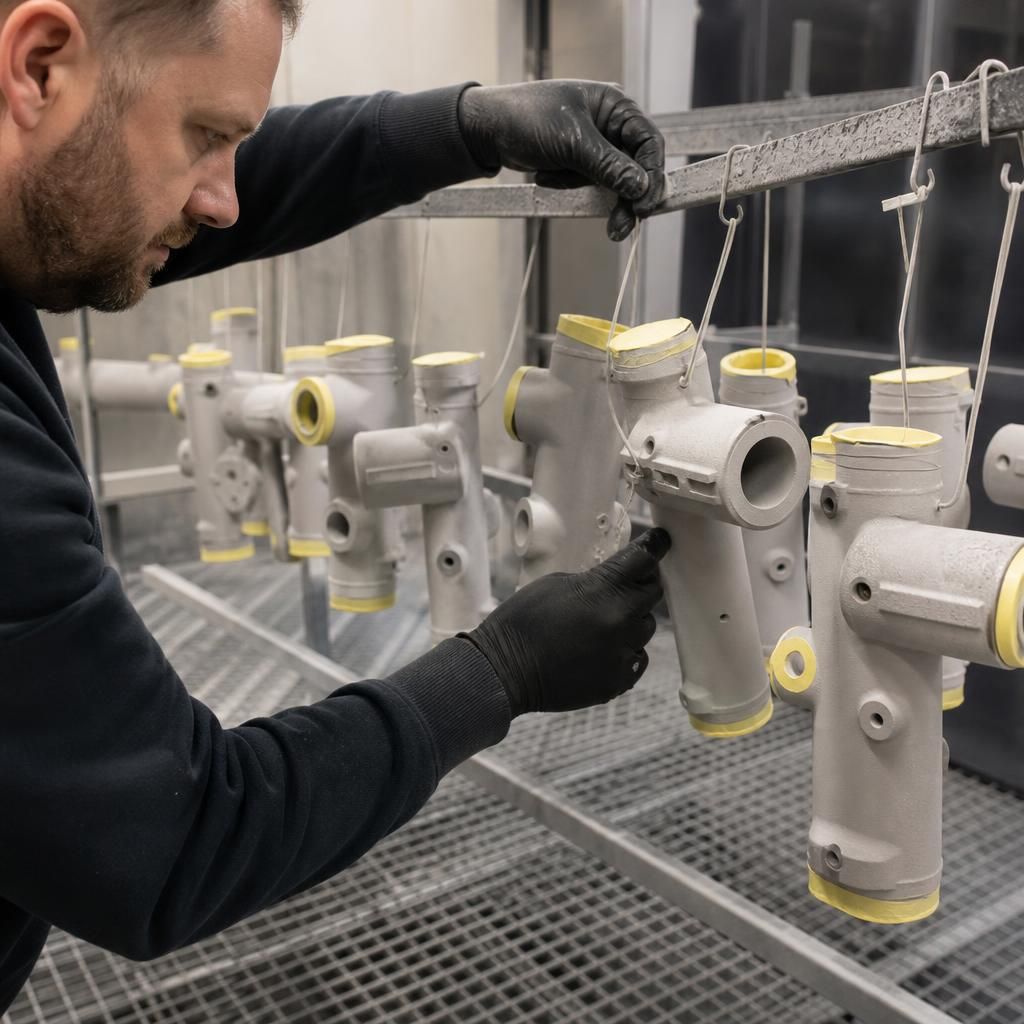
Masking is an important part of thermoplastic powder coating application where components contain threads, bearing seats, bores, mating faces or close-tolerance holes. These areas may need heat-resistant plugs, caps or masking materials before powder is deposited, because the fused coating adds thickness and can affect assembly or fit. Masking must also be compatible with the chosen heating cycle and removed without damaging the surrounding film.
The coating specification should therefore identify both the surfaces to be coated and any areas that must remain free from powder. This allows the applicator to plan racking, masking and powder application as one process rather than correcting interference after the component has been finished.
Discuss Your Thermoplastic Powder Coating Application
Discuss your component drawings, coating specification and production requirements with the powder-coating team to identify a suitable thermoplastic application method. This can help clarify preparation, masking and process considerations before coating begins.