

What should be considered when selecting a matt or gloss finish for outdoor applications?
When selecting a matt or gloss finish for outdoor applications, assess the metal component’s exposure to UV light, moisture, pollutants, abrasion and handling, alongside the required appearance. Gloss finishes generally provide stronger visual depth and are easier to clean, while matt finishes reduce reflection and can give a more understated appearance; the choice should also account for the coating specification, substrate preparation and expected maintenance.
The most suitable matt or gloss finish for an outdoor metal component depends on the required visual effect, the consistency of the finished surface, the component’s design and use, and the powder coating system selected. Sheen should therefore be specified alongside the substrate, pretreatment, powder chemistry, colour and service conditions rather than treated as an isolated appearance choice.
Define the required sheen precisely. “Matt” and “gloss” can describe a range of finishes, so a project should state the required gloss level or refer to an approved physical sample where possible. This is particularly important when components are manufactured in separate batches or coated by different suppliers. A finish that appears acceptable in isolation may look noticeably different when installed next to existing panels, frames or equipment.
Light conditions also affect how the finish is perceived. Gloss surfaces produce stronger highlights and can make colour appear more saturated, while matt surfaces give a softer, more diffuse visual effect. The surrounding materials, viewing distance and installation angle should be considered. A highly reflective finish may be unsuitable where reflected light could distract users or affect visibility, whereas a matt finish may be preferred for a more discreet architectural or industrial appearance.
Consider the condition and shape of the metal. Gloss finishes can make variations in the underlying surface more noticeable because reflected light emphasises waviness, grinding marks, dents and uneven welds. A lower-sheen coating can produce a visually calmer result, but it will not correct inadequate preparation or conceal significant defects. Sharp edges, recesses, folded sections, perforations and welded areas should be reviewed before coating because they can affect film coverage and the final uniformity of the finish.
Component design can also influence how practical a finish is in service. Areas that are frequently touched, handled or subject to rubbing may show changes in appearance more readily if the surface is marked or polished through use. On assemblies with mating faces, hinges, sliding sections or close tolerances, the coating thickness and finish texture must be compatible with the fit and movement of the parts. This is a specification issue rather than a reason to choose matt or gloss automatically.
Give greater weight to the coating system than to sheen alone. Outdoor performance is influenced by the powder formulation, resin type, pigment selection, film thickness and pretreatment process. Two coatings with a similar gloss level may have different suitability for external use. The required level of colour retention, gloss retention and corrosion protection should be established with the coating supplier, particularly for components expected to remain exposed for extended periods.
Colour can also affect the practical choice. Dark shades often show surface marks, dust or uneven visual ageing more readily than lighter colours, regardless of whether the finish is matt or gloss. A textured or very low-sheen surface may alter how a RAL colour is perceived compared with a smooth version of the same colour. If colour matching matters across several components, approve the colour and sheen together rather than approving the RAL reference alone.
Check compatibility with the substrate and pretreatment. Mild steel, galvanised steel, aluminium and previously coated components can require different preparation methods. Galvanised or zinc-coated surfaces may need specific preparation to reduce defects such as pinholing or poor adhesion, while aluminium requires a suitable pretreatment for the intended coating system. Weld contamination, oils, oxides and residues should be removed before coating. These requirements apply to both matt and gloss finishes, but any visible variation can be more apparent on a smooth, reflective coating.
A sample panel or representative trial part is useful where the finish is important. The sample should use the same substrate, preparation, powder system and application method as the production parts. Review it in the intended environment and compare it with adjacent materials, rather than relying only on a small colour card. For larger projects, record the approved colour, sheen, texture, substrate preparation and acceptable visual tolerances in the coating specification.
- Specify the desired matt, satin or gloss level, preferably with an agreed sample or measurable requirement.
- Confirm that the powder system is intended for the component’s external service conditions.
- Check whether the substrate, welds, edges and recesses need special preparation.
- Assess whether reflected light, surface visibility or the installed setting favours a lower- or higher-sheen appearance.
- Approve colour and sheen together, especially where several batches or component types must match.
- Consider contact areas, movement, tolerances and handling when selecting the coating finish.
- Use a representative test piece where appearance, colour consistency or substrate complexity creates uncertainty.
In practice, the sheen is only one part of the outdoor specification. A well-prepared substrate, compatible pretreatment and suitable exterior-grade powder system have greater influence on coating integrity than whether the final surface is matt or gloss. The most reliable selection is the one that combines the required appearance with the component’s geometry, handling demands, colour-matching requirements and environmental performance criteria.
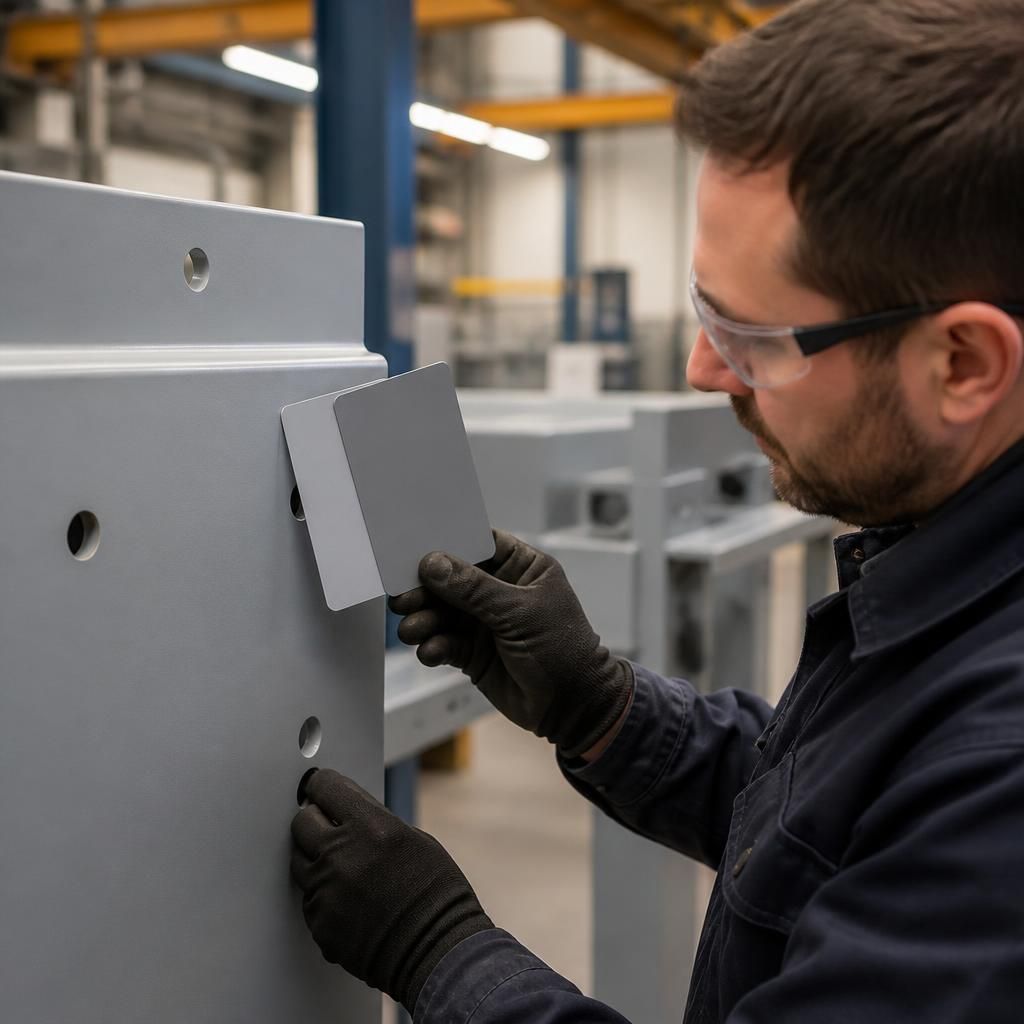
Plan for repairs and replacement parts when selecting an outdoor matt or gloss finish. Local repairs, recoated sections or components produced in a later batch can show a visible difference in sheen, even when the colour reference is the same. This is particularly noticeable on adjoining panels or large, uninterrupted surfaces.
The coating specification should therefore identify the approved finish and the method for dealing with installation damage or future replacement parts. Where appearance is critical, retain an approved sample and confirm whether a damaged component should be repaired locally or recoated as a complete part. This helps prevent an isolated repair from creating an obvious matt-to-gloss or gloss-level mismatch.