

What application methods are best suited for effectively applying nylon and speciality powder coatings to ensure optimal adhesion and durability?
Electrostatic spray is generally best for controlled, consistent coverage on complex metal components, while fluidised-bed application is well suited to nylon coatings where a thicker, robust and uniform film is required. In both cases, thorough surface preparation, correct part temperature and an accurately controlled curing or fusion cycle are essential for strong adhesion and durable performance.
The most suitable application method depends on the coating chemistry, required film thickness, component geometry and production volume. For nylon and other speciality powder coatings, electrostatic spray and fluidised-bed coating are the principal methods, while hot-dip, electrostatic fluidised-bed and specialised spray techniques can be appropriate for particular parts. The method must be selected alongside the powder supplier’s processing requirements, because nylon powders do not all behave identically.
Electrostatic spray is generally the most flexible option for batches containing different component sizes or geometries. A spray gun charges the powder particles, which are attracted to an earthed metal workpiece. This enables operators to build an even coating on accessible faces while adjusting gun settings, movement and pass sequence around edges, recesses and apertures. It is particularly useful where the specification calls for a controlled coating rather than the heavy, enveloping layer typically associated with dip processes.
For nylon, electrostatic spraying requires careful control of powder delivery and charging. Particle size distribution, humidity, gun voltage, air flow and the electrical characteristics of the workpiece can all affect transfer and coverage. Excessive charge may contribute to back-ionisation or uneven deposition, while insufficient charge can reduce transfer efficiency. Operators should therefore validate the setting on representative components instead of relying on a standard setting used for conventional polyester powder.
Spray application also suits components that cannot be fully immersed or that contain areas requiring masking. Fixtures should hold the workpiece securely without obstructing the coating zones, and contact points should be positioned where small uncoated marks will not affect assembly or service. Grounding must remain reliable throughout the application cycle. Particular attention is needed around Faraday areas, narrow slots and internal corners, where the electrical field may prevent powder from reaching the surface evenly. Gun angle, distance, traverse speed and the order in which surfaces are coated can be adjusted to reduce these effects.
Fluidised-bed coating is well suited to nylon when a substantial, continuous layer is required on relatively simple shapes. The workpiece is brought to the appropriate processing condition and immersed in a tank in which air suspends the powder, allowing particles to melt and fuse onto the surface. This method can coat external faces in a single operation and is often considered for protective coverings on items such as formed metalwork, handles, guards and components requiring impact or abrasion resistance.
The main limitation of fluidised-bed application is control over local thickness and detail. Deep recesses, enclosed sections, sharp changes in profile and areas that must remain uncoated can make immersion more difficult. It is also less convenient where a product contains several coating zones or where frequent colour and material changes are required. A trial using the actual component is useful for checking drainage, coverage, edge build-up and the definition of masked areas.
Electrostatic fluidised-bed application combines a charged powder cloud with a fluidised tank. It can provide more controlled deposition than a conventional fluidised bed, although its suitability still depends on the powder’s charging behaviour and the component’s shape. This method may be considered where the production process benefits from immersion-style coating but requires improved control of deposited material. It is not automatically suitable for every nylon formulation, so process trials and the coating manufacturer’s technical guidance remain important.
Hot-dip or preheated dip coating is another option for selected nylon applications. A heated metal component is immersed in powder so that the material melts onto contact, producing a relatively thick and continuous film. This approach can be effective for robust protective coverings, but it demands close control of part handling, immersion time and withdrawal. Excess material may collect at lower edges or in cavities, and the process is less suitable for delicate assemblies, tight tolerances or parts with heat-sensitive inserts.
Whichever method is chosen, application should be treated as a complete process rather than a spray or immersion step in isolation. The coating specification should define the required appearance, functional film build, coverage limits, masking points and inspection criteria. Components should be arranged to avoid contact between coated faces, and fixtures should allow the powder to reach all specified areas without creating excessive rack marks.
- Choose electrostatic spray for varied batches, complex but accessible profiles, defined coating zones and situations requiring adjustable local coverage.
- Choose fluidised-bed coating for durable, enveloping layers on parts with shapes that can be immersed and withdrawn cleanly.
- Consider electrostatic fluidised bed where a fluidised process is preferred but additional deposition control is needed.
- Consider hot-dip application for suitable robust components where a thick nylon layer is required and dimensional tolerances permit the process.
Inspection should cover more than visual appearance. Depending on the specification, checks may include coating continuity, film thickness at representative locations, adhesion, coverage of edges and recesses, masking accuracy and the absence of pinholes, contamination or excessive runs. For repeat production, retaining approved process parameters and sample panels can help identify changes in powder behaviour or application conditions before they affect a larger batch.
For Midlands manufacturers and fabricators, the practical choice is usually made after reviewing component drawings, batch quantities, dimensional tolerances and the intended service environment. A coating specialist can then determine whether spray, fluidised-bed or another application route provides the most consistent balance of coverage, thickness control and production efficiency for the specific metal component.
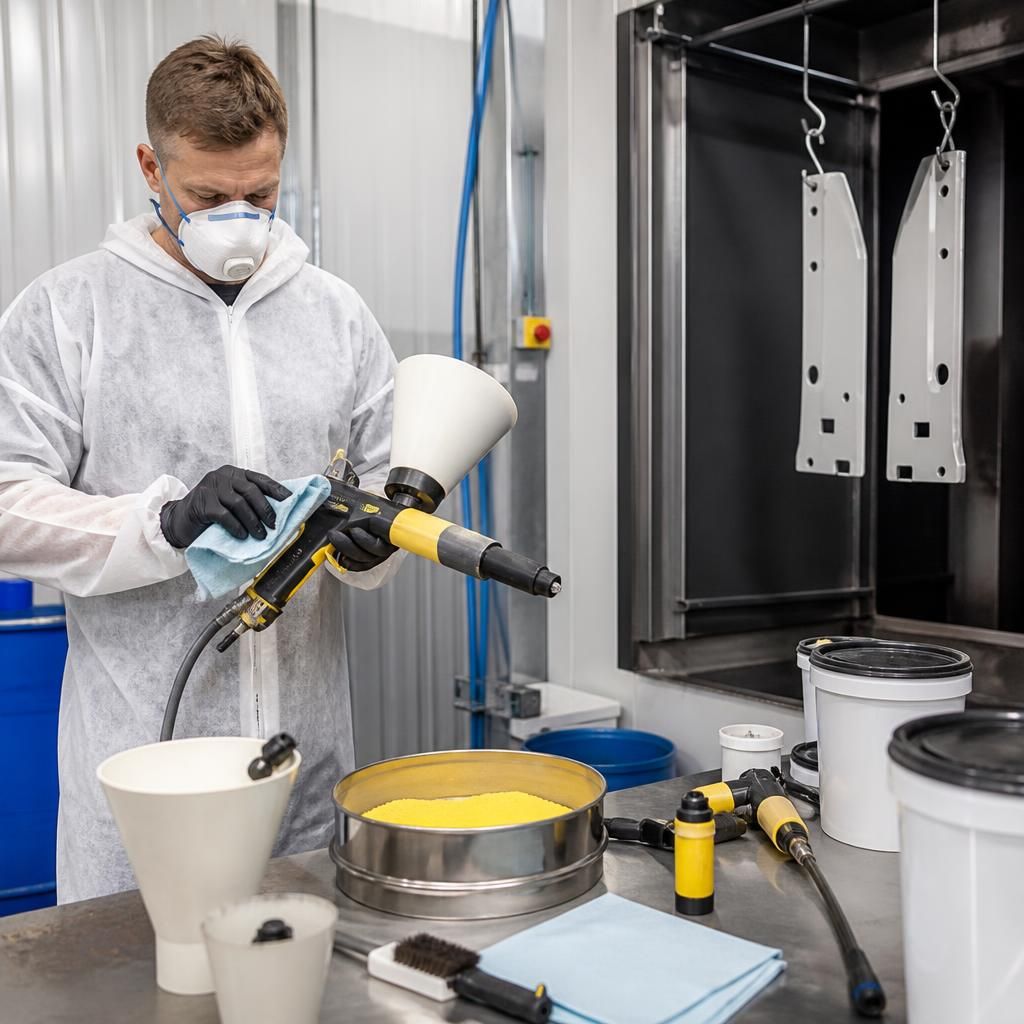
Equipment cleanliness and powder segregation are important when applying nylon and speciality coatings, because contamination can affect fusion, appearance and adhesion. Application equipment, recovery systems, storage containers and fixtures should be cleaned thoroughly when changing between coating materials or colours. Powder should also be kept dry and protected from foreign particles before use.
Where reclaimed powder is considered, its use should follow the coating supplier’s technical guidance and the agreed quality specification. Some speciality formulations require tighter control of reclaim than standard powders, particularly where surface appearance, electrical performance or a consistent film build is critical. Controlling these factors helps ensure that the selected application method produces a repeatable, durable coating rather than simply achieving initial coverage.
Discuss the Best Application Method for Your Nylon or Speciality Powder Coating
Discuss your component drawings, coating specification and production requirements with our team to identify the most suitable nylon or speciality powder coating application method. We can help assess the practical requirements for achieving consistent coverage, adhesion and durability.