

How can nylon powder coatings improve the longevity and performance of industrial metal components?
Nylon powder coatings can extend the service life of industrial metal components by forming a tough, resilient surface that resists abrasion, impact, friction and exposure to many chemicals. This protection helps components retain their functional performance in demanding applications, provided the coating is correctly selected, applied and cured for the operating conditions.
Nylon powder coatings improve the longevity and performance of industrial metal components by adding a resilient, low-friction polymer surface that protects the substrate while changing how the component interacts with other parts. The result can be longer service intervals, more consistent movement and reduced damage to mating surfaces, provided the nylon grade, coating thickness and application process match the component’s operating conditions.
Reduced wear at contact points
One of the main advantages of nylon is its suitability for components that slide, rotate or repeatedly contact other surfaces. The coating provides a smoother working interface than bare metal and can reduce scuffing, galling and surface marking. This is particularly useful for guides, rollers, chutes, brackets, handling equipment, machine guards and other parts where metal-to-metal contact would gradually affect fit or movement.
Maintaining the original surface profile is important. Excessive coating build-up can alter clearances, interfere with assembly or affect the movement of close-fitting parts. A suitable specification therefore considers the required film thickness, masking of critical faces and any machining or finishing needed after coating.
Protection against corrosion and contamination
A continuous nylon layer separates the metal from moisture, salts, dirt and other contaminants. This can slow the initiation of corrosion, especially on components used in humid, wash-down or chemically exposed environments. The benefit depends on complete coverage and sound adhesion: sharp edges, recesses, threaded areas and damaged sections require particular attention because discontinuities can allow contaminants to reach the substrate.
Nylon is not a universal replacement for every corrosion-control system. The coating specification should account for the metal type, surface preparation, exposure conditions and whether the component will be immersed, cleaned aggressively or exposed to outdoor weather. In some applications, a compatible pre-treatment or primer system may be required to support long-term adhesion.
More reliable movement and lower operating noise
The relatively low-friction surface of nylon can support smoother movement in mechanisms and reduce the tendency for parts to stick or judder. Its cushioning properties can also reduce the noise created when components contact, strike or convey materials. These characteristics are valuable in material-handling systems, manufacturing equipment, transport-related components and assemblies where vibration or impact noise affects the working environment.
Performance should be assessed under actual load and speed conditions rather than by considering the coating in isolation. Pressure, heat, mating-material hardness, lubrication and the presence of abrasive particles all influence wear. A coating that performs well on a lightly loaded guide may not be suitable for a heavily loaded bearing surface.
Electrical and surface-performance benefits
Nylon is electrically insulating, so it can help isolate a metal component from adjacent conductive parts. This may be useful for covers, supports, clips, housings and fixtures, although the required electrical properties should be confirmed for the finished coating and the application. Nylon can also provide a uniform, cleanable surface with a choice of finish and colour, helping components remain identifiable and easier to inspect.
These aesthetic and housekeeping benefits are secondary to the engineering specification, but they can contribute to practical serviceability. A consistent surface makes scratches, chips or contamination easier to identify during inspection, while colour coding can assist with component recognition where it forms part of a documented system.
Temperature, moisture and chemical limitations
Nylon coatings are durable, but their properties vary with temperature, humidity and the specific nylon formulation. At elevated temperatures, the coating may soften or lose mechanical strength. Nylon can also absorb moisture, which may affect dimensions, hardness and electrical behaviour. For components operating in hot, wet or thermally cycling conditions, these effects should be considered during material selection.
Compatibility with cleaning agents, oils, fuels, solvents and process chemicals must also be checked. A coating may resist occasional contact but perform differently under prolonged immersion, repeated washing or exposure to concentrated chemicals. The correct assessment uses the actual substance, concentration, temperature and contact duration rather than relying on a general claim of chemical resistance.
How correct application affects service life
Longevity depends as much on preparation and curing control as on the nylon material itself. Oil, rust, scale and other contaminants must be removed, and the surface profile must be suitable for the chosen coating system. Parts should be designed or prepared to avoid areas where powder cannot reach, and edges, holes and internal faces should be reviewed before production.
During application, consistent coverage and controlled heating help the powder melt and form a coherent film. Insufficient curing can leave weak adhesion or an inconsistent surface, while excessive heat may affect the substrate, dimensions or coating properties. Inspection should include visual coverage, thickness where relevant, adhesion and the condition of functional faces.
Choosing nylon for a specific component
Nylon powder coating is most effective when the specification begins with the component’s real duty cycle. Consider load, movement, mating materials, operating temperature, moisture, chemical exposure, required tolerances, electrical requirements and likely damage during handling or maintenance. These factors determine whether nylon is appropriate and which grade and application method should be used.
For manufacturers and fabricators, discussing drawings, sample parts and operating conditions with a specialist coater can help identify masking requirements, coating build limits and suitable testing before a batch enters production. This approach reduces the risk of solving one problem, such as corrosion, while creating another, such as interference with assembly or reduced performance at temperature.
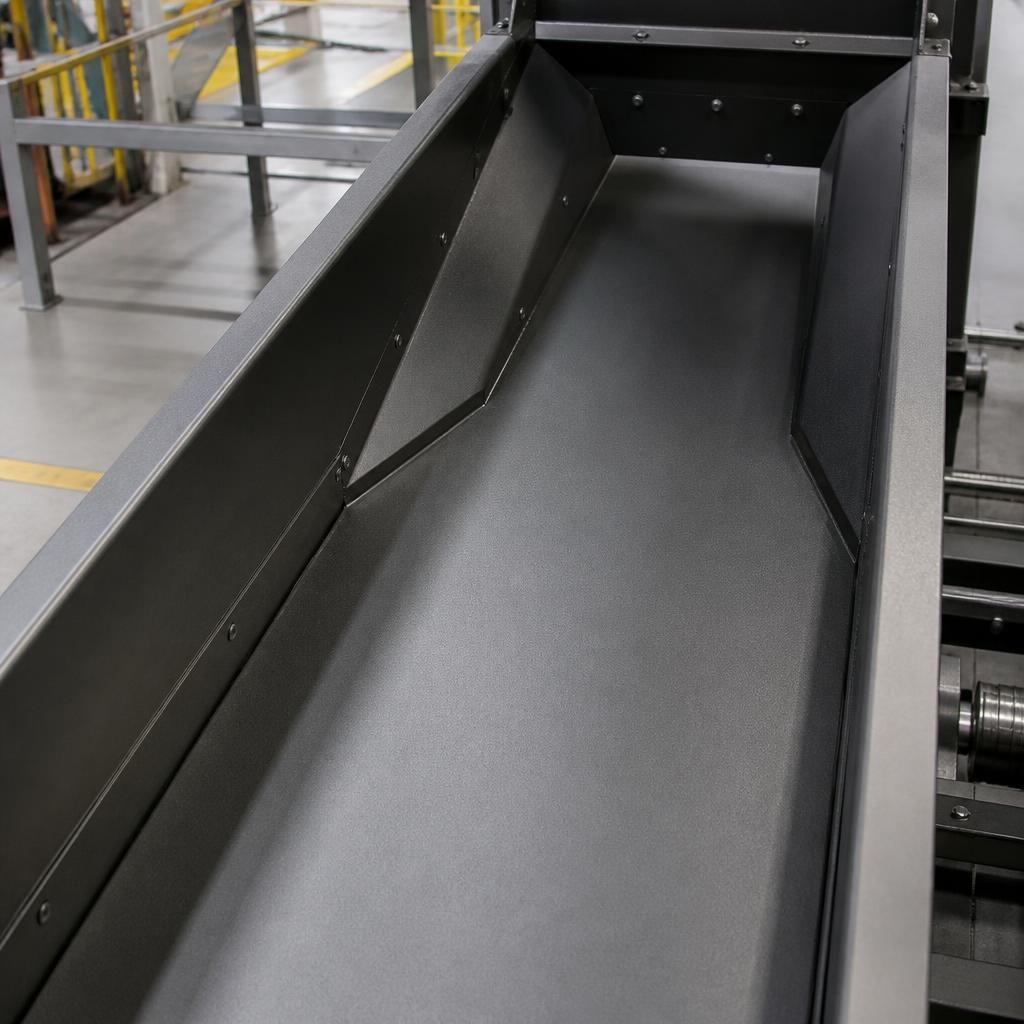
Reduced material build-up can improve component performance. Nylon powder coatings provide a smooth polymer surface that may reduce the adhesion of certain powders, fibres, aggregates and processed materials compared with untreated metal. This can help chutes, guides, hoppers and handling parts maintain a more consistent working surface, particularly where residue changes clearances or interrupts material flow.
The result depends on the nylon formulation, surface finish and substance being handled. Before specification, the coating should be assessed against the material’s moisture content, temperature, particle size and tendency to stick. Cleaning methods should also be considered, as aggressive scraping or unsuitable chemicals can damage the coating and reduce the protection it provides.