

What are the main differences in application and performance between epoxy and polyester powder coatings?
Epoxy powder coatings generally provide stronger chemical resistance and adhesion, making them suited to components used indoors or exposed to demanding industrial conditions, while polyester coatings offer better resistance to sunlight and weathering for outdoor applications. In practice, both require correctly prepared metal and controlled spray and curing processes, but the choice depends on the component’s environment, required finish and likely exposure to chemicals, abrasion and UV light.
Epoxy and polyester powder coatings differ mainly in how their resin systems respond to service conditions, mechanical stress and finishing requirements. Epoxy is typically selected for demanding internal or chemically exposed components, whereas polyester is formulated to retain its appearance and flexibility when used on items exposed to sunlight and changing weather. The practical difference is not limited to the powder itself: part design, preparation, application method and the specified cure all affect the final result.
Application differences
Both coating types are commonly applied as dry powder using an electrostatic spray process. The powder is charged as it leaves the spray gun and attracted to the earthed metal component, before being heated so that the particles melt, flow and chemically cure into a continuous film. Consistent grounding, suitable spray settings and even powder distribution are therefore important for either resin system.
Epoxy powders often provide good wetting and flow over correctly prepared steel, helping them form a continuous coating around the component. Polyester powders can also produce smooth, decorative finishes, but the chosen formulation must match the intended exterior exposure and appearance requirements. Complex shapes, recesses, sharp edges and Faraday cage areas can affect deposition regardless of whether the powder is epoxy or polyester. These areas may require careful spray-gun adjustment and experienced application rather than simply applying more powder.
Surface preparation is a major part of the application process. Oil, mill scale, rust, weld residue and other contaminants can interfere with adhesion and create defects such as pinholes, blistering or premature corrosion. Cleaning and, where appropriate, abrasive or chemical pretreatment provide the surface condition needed for either coating. The component must also be dry before spraying, and the coating system should be compatible with the substrate and any pretreatment already used.
The cure schedule is determined by the specific powder formulation and the metal component’s actual temperature, not just the oven air temperature. A large or heavy part may heat more slowly than a small section, so the process needs to achieve the specified metal temperature for the required period. Under-curing can leave the film softer or less chemically resistant than intended; excessive heat or time can affect colour, gloss and film performance. Epoxy and polyester powders should therefore be processed according to their technical specification rather than treated as interchangeable materials.
Differences in physical performance
- Hardness and toughness: Epoxy films are often hard and tightly bonded, which can be useful where resistance to oils, solvents and industrial chemicals is important. Hardness does not automatically mean immunity from impact damage: a rigid film may be less tolerant of repeated bending or distortion. Polyester systems are commonly chosen where a balance of surface hardness and flexibility is needed.
- Flexibility and forming: Polyester coatings are generally better suited to components that experience movement, vibration or minor deformation, provided the chosen grade is designed for that duty. Coating selection still needs to account for forming after coating, because bending a cured film can cause cracking or loss of adhesion in either system.
- Appearance retention: Polyester is normally preferred for exposed decorative surfaces because suitable exterior grades retain colour and gloss more effectively under sunlight. Standard epoxy is more likely to lose its visual finish when exposed to ultraviolet radiation, even if the underlying film remains attached and protective.
- Chemical exposure: Epoxy usually has the advantage where the coating will contact industrial chemicals, oils, fuels or cleaning agents. The actual resistance depends on concentration, temperature, contact duration and the particular formulation. Polyester may be appropriate for less aggressive exposure, but a chemical-resistance requirement should be checked against test data rather than inferred from the resin name alone.
- Corrosion protection: Neither resin provides reliable corrosion protection if moisture can reach poorly prepared steel or uncoated edges. Film continuity, pretreatment, edge coverage and the absence of application defects are as important as the choice between epoxy and polyester. For severe environments, the complete coating system should be specified, including any primer and topcoat.
Choosing the coating for the component
The correct comparison starts with the component’s location and duty. Indoor machinery housings, brackets, electrical enclosures and industrial parts exposed mainly to chemicals may favour epoxy. Outdoor frames, architectural metalwork, vehicle-related components and other items where colour and gloss must be retained generally favour an exterior-grade polyester. These are typical directions rather than absolute rules; temperature, abrasion, impact, cleaning chemicals and expected service life can change the selection.
Finish requirements also influence the decision. Both coating families can be supplied in a range of colours, gloss levels and textures, but a visually consistent result depends on using the same powder specification, film thickness and cure conditions across a batch. Repairs or additions to existing coated metal require particular care, since a colour match alone does not confirm compatibility or equivalent performance.
For a specification, identify the substrate, pretreatment, required film build, colour and gloss, curing conditions, service temperature and likely exposure to chemicals, moisture, sunlight and mechanical damage. Where the part will encounter more than one significant hazard, the coating supplier or applicator should assess the complete requirement rather than selecting a resin solely by whether the component is indoors or outdoors.
For Midlands manufacturers and fabricators, a powder-coating specialist can review the component design and intended environment before processing a batch. Collection and delivery options may also be relevant where parts are being sent for preparation, coating and return, but the technical specification remains the basis for achieving the required application and performance.
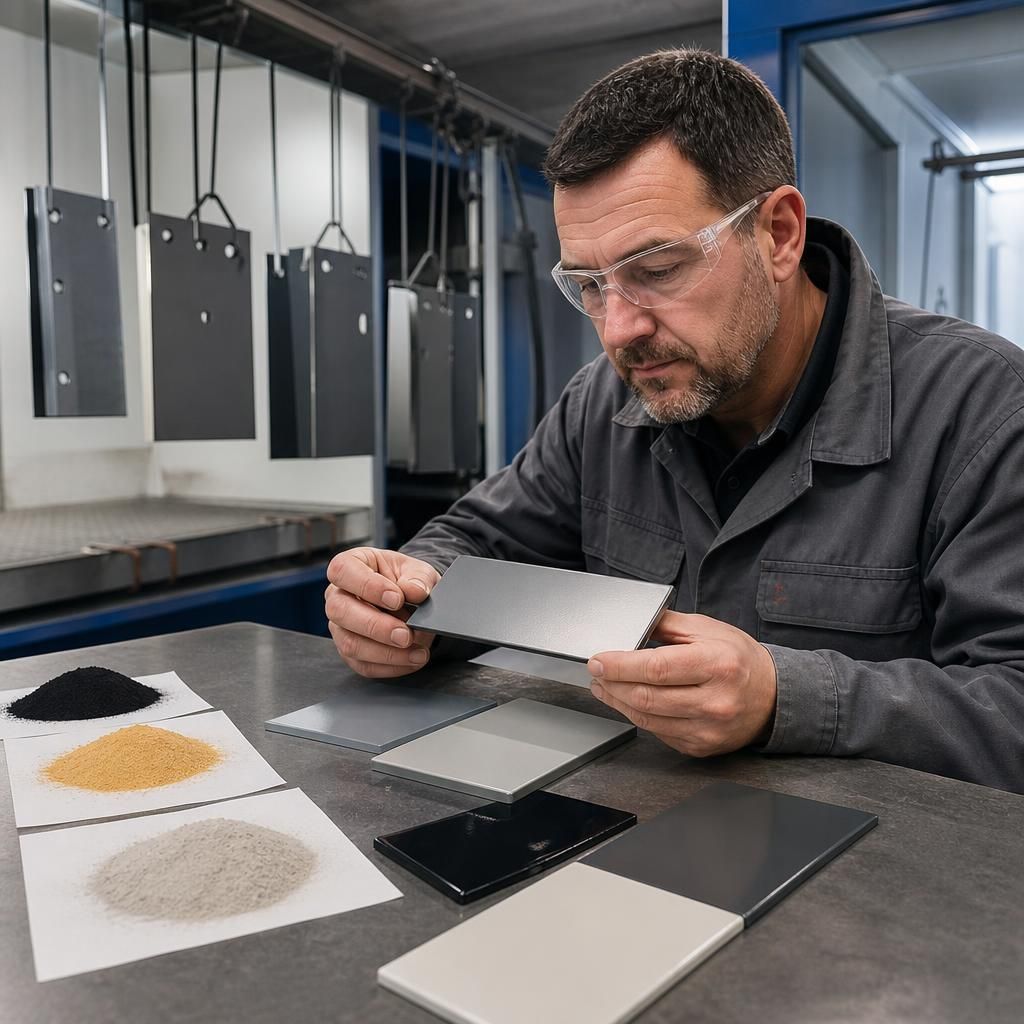
Resin type is only the starting point when comparing powder coatings. Epoxy and polyester products are available in different grades, so the technical data sheet should be checked for the specific coating’s intended environment, chemical resistance, flexibility, appearance retention and curing requirements rather than relying on the resin name alone.
For an important batch, a trial component or sample panel can help confirm that the selected powder produces the required finish on the chosen substrate and pretreatment. The cured sample can then be assessed for colour, gloss, coverage, adhesion and visible defects before full production proceeds. This provides a more reliable comparison of application and performance than treating all epoxy or all polyester powders as equivalent.