

What are the main differences between epoxy and polyester powder coatings?
Epoxy powder coatings generally provide stronger chemical and corrosion resistance, making them suitable for indoor industrial components and parts exposed to harsh substances. Polyester powder coatings offer better resistance to sunlight and weathering, so they are typically preferred for exterior metalwork where colour and gloss retention are important.
Epoxy and polyester powders differ mainly in resin chemistry, functional performance and suitability for the service conditions of the finished component. Both are dry powder materials applied electrostatically and cured into a continuous protective film, but they are formulated to meet different demands. The correct choice depends on the component’s environment, required mechanical performance, appearance and expected maintenance conditions.
Resin chemistry and film behaviour
Epoxy coatings are based on epoxy resin systems that cross-link during curing to form a dense, strongly adherent film. This structure is valued where the coating must resist oils, solvents, chemicals, moisture and corrosion-related attack. Epoxy can also provide useful electrical insulation, which makes it relevant to certain industrial and engineering components.
Polyester coatings use polyester resins designed for a more balanced combination of protection, flexibility and appearance. They are commonly selected for fabricated metalwork and components that may experience handling, vibration, movement or changing outdoor conditions. The formulation can be adjusted to provide different levels of hardness, flexibility, texture and finish.
Mechanical performance
The two coating types can differ in how they respond to impact, bending and abrasion. Epoxy generally forms a hard, strongly bonded film, but a very hard film may be less tolerant of deformation in the underlying metal. If a component is bent, struck or flexed after coating, the finish may be more likely to crack or lose adhesion if the product and application are not matched to that movement.
Polyester systems are often chosen where a degree of flexibility and impact tolerance is important. This does not mean that every polyester powder has the same mechanical properties: the final result depends on the specific formulation, film thickness, curing conditions and preparation of the substrate. For parts that will be handled, assembled or exposed to vibration, these factors should be assessed alongside the basic resin type.
Appearance and finish selection
Epoxy powders can produce smooth, hard and consistent finishes, including a range of colours and textures. They are often appropriate for internal plant, machinery parts, brackets, enclosures and other components where functional protection is more important than long-term decorative appearance.
Polyester powders are available in a wide selection of colours, gloss levels and textures, making them suitable where the finished metalwork forms part of a visible product or installation. Texture can also help disguise minor surface irregularities, although it cannot compensate for poor cleaning, contamination, weld defects or inadequate preparation.
Interior and exterior service conditions
The choice should be based on the actual exposure rather than on the coating name alone. Internal components exposed to chemicals, oils or industrial contaminants may benefit from the resistance of an epoxy system. Exterior components require a polyester formulation designed for the relevant level of environmental exposure, particularly where the appearance must remain stable over time.
Epoxy-polyester hybrids are also available for applications that need a compromise between the properties associated with each resin. These should not be treated as identical to a pure epoxy or a pure polyester coating. Their resistance, appearance and limitations depend on the formulation and the conditions for which the powder was specified.
Application and curing differences
Epoxy and polyester powders are both sensitive to surface preparation, film thickness and cure. The metal normally needs to be clean, dry and free from oil, rust, scale and other contaminants. Pretreatment may be required to improve adhesion and corrosion protection, particularly for components exposed to demanding conditions.
Each powder has its own curing schedule, expressed in terms of the metal temperature and the time required at that temperature. The oven setting alone does not confirm that the coating has cured correctly, because heavier and lighter components heat at different rates. Under-curing can reduce resistance and adhesion, while excessive heat can affect colour, gloss or other finish characteristics. The product specification should therefore be followed rather than applying one general curing rule to every powder.
Application quality also depends on chargeability, earthing, gun settings, recesses, edges and the geometry of the part. Hollow sections, sharp edges and inaccessible areas may require particular attention. These practical variables can have as much influence on the result as the nominal distinction between epoxy and polyester.
How to choose between them
- Choose an epoxy system when chemical resistance, strong adhesion, corrosion protection or electrical insulation is a primary requirement and the component is mainly used indoors.
- Choose a polyester system when the part needs a durable decorative finish, greater tolerance of handling or movement, or a formulation intended for external exposure.
- Consider a hybrid where a balance of properties is required, but check the manufacturer’s technical data for the exact service limitations.
- For components exposed to abrasion, solvents, cleaning chemicals, impact or deformation, specify the individual performance requirement rather than relying on the resin category alone.
- Confirm the required finish, substrate, pretreatment, film thickness and curing schedule before production or batch coating begins.
For industrial metalwork, the most reliable specification identifies the exposure conditions and performance requirements first, then selects the powder system that meets them. A coating specialist can also review the component design, preparation method and curing process so that the chosen epoxy or polyester product is suitable for the complete application rather than selected by resin type alone.
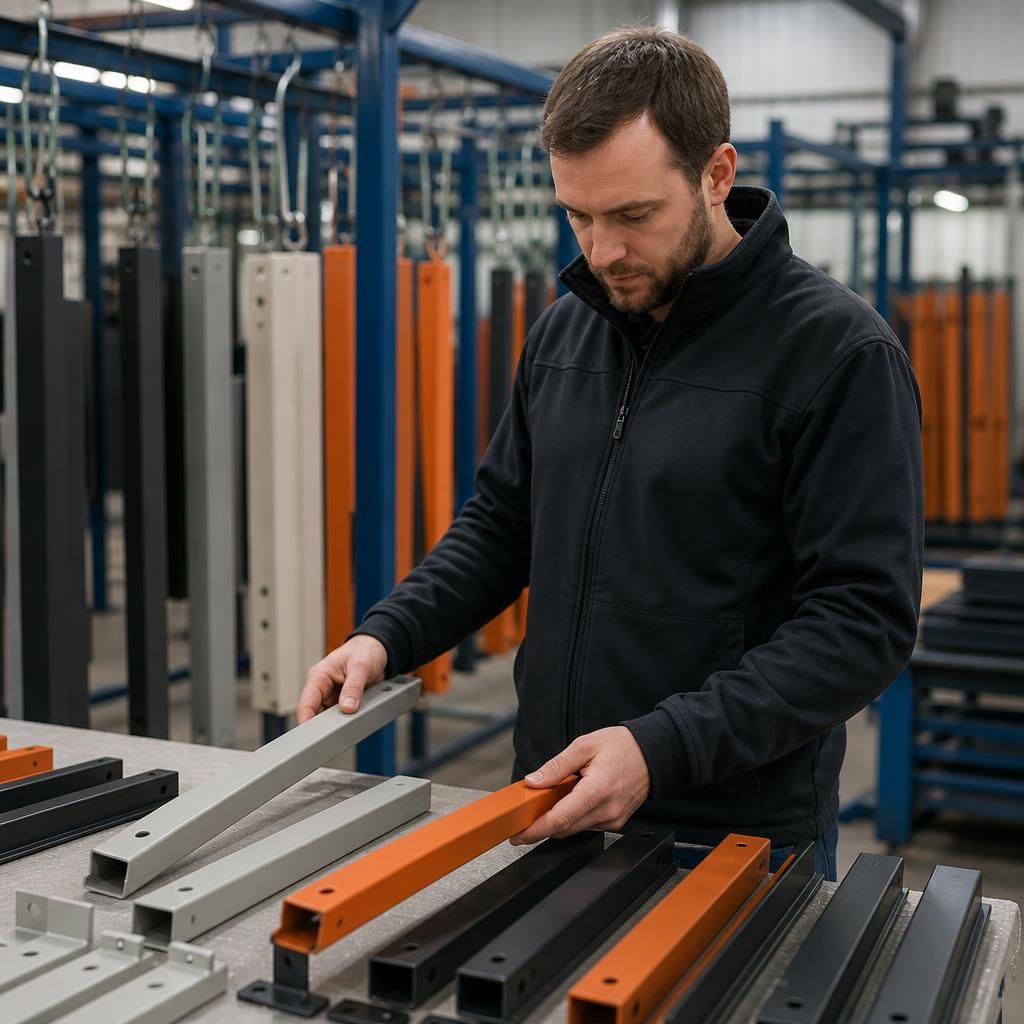
The resin category is only the starting point for comparison. Epoxy and polyester powders are available in different grades, so two products within the same family may have noticeably different hardness, flexibility, chemical resistance, gloss retention and texture. The technical data for the specific powder should therefore be checked before treating one coating type as universally better.
For a project involving several possible finishes, compare products against the conditions the coated part will actually face. Useful criteria include:
- the substances likely to contact the surface, such as oils, solvents or cleaning agents;
- whether the component may be struck, flexed or exposed to vibration;
- the required colour, gloss and texture over the intended service life;
- the acceptable film thickness and curing range; and
- the inspection tests needed to confirm adhesion, appearance and finish consistency.
This approach separates the general differences between epoxy and polyester from the performance of the particular product selected. It also makes the specification easier to verify during production, especially where coated components are supplied in batches.