

What factors should be considered when choosing a powder coating finish for specific environmental conditions?
Choose a powder coating finish by assessing the part’s exposure to moisture, chemicals, UV radiation, temperature changes, abrasion and impact, as well as the substrate and required service life. The coating chemistry, film thickness, gloss level and surface texture should then be specified to provide suitable protection and appearance for those conditions.
The correct powder coating finish is determined by the complete service environment, the component’s design and the required maintenance regime, rather than by colour or appearance alone. A suitable specification considers how the part will be prepared, assembled, handled, cleaned and exposed throughout its working life, then matches those conditions with an appropriate coating system.
Define the exposure category. A component used inside a dry factory has different requirements from one installed outdoors, in a coastal location, in a process plant or in an area subject to frequent washing. It is useful to record the actual location, whether the part is sheltered or fully exposed, and whether contaminants can remain on the surface. A sheltered item may still face demanding conditions if condensation, airborne salts, production residues or cleaning fluids collect around joints and fixings.
Where corrosion protection is important, the environment should be assessed as a combination of factors rather than as a single label such as “external use”. Coastal air, industrial pollution, persistent condensation and deposits trapped against the metal can all increase the duty placed on the coating. The most severe local area often determines the specification: the underside of a frame, a folded return, a bolted joint or a section close to standing water may require more attention than the broad, visible faces.
Consider intermittent contact as well as continuous exposure. Powder coating may be exposed to splashes, wash-down cycles, condensation or accidental spills without being permanently immersed. If a component will be submerged, buried, installed below ground or exposed to retained moisture, the coating must be selected specifically for that duty. A finish suitable for general outdoor exposure should not automatically be assumed to be suitable for permanent immersion.
Assess the cleaning and decontamination method. Detergents, disinfectants, solvents and alkaline or acidic cleaners can affect a finish even when the surrounding atmosphere is relatively mild. The specification should identify the cleaning chemicals, their concentration where known, the contact time, the application temperature and whether pressure washing is involved. Frequent cleaning can also place greater mechanical demand on edges and projections. Compatibility should be confirmed from technical information or by testing rather than inferred from the coating’s colour or gloss.
Review the component’s construction. Coating performance depends partly on whether the design allows the metal to be cleaned, pretreated and coated consistently. Closed sections may need suitable drainage and venting. Crevices, overlapping plates, sharp corners, weld spatter and poorly finished edges can create weak points or retain contaminants. Where practical, design details should allow water to run off and provide access for inspection. Welds and cut edges should be free from residues that could interfere with adhesion or encourage corrosion beneath the coating.
Specify preparation for the substrate. Steel, galvanised steel, aluminium and other metals do not all require the same preparation. Surface cleanliness, oxide removal, keying, conversion treatment and primer selection can influence adhesion and corrosion resistance. Galvanised or repaired surfaces may also present differences in texture and outgassing behaviour. The coating specification should therefore identify the substrate and any previous treatment, not merely state a colour and finish.
Fabricated parts should also be checked for oil, marking materials, silicone contamination, welding residues and moisture before coating. These contaminants can cause craters, pinholes, blistering or local adhesion failure. For multi-part assemblies, decide whether components will be coated separately or after assembly, since inaccessible contact areas and fixing points may not receive equivalent protection.
Match the finish to physical handling. Some parts are damaged before installation through stacking, transport, fitting or repeated contact with tools and adjacent components. In such cases, the specification should address the practical handling sequence, not just the final operating environment. Protective packaging, suitable racking and careful assembly can be as important as the selected finish in preventing early damage.
Where a coating will be exposed to repeated rubbing, sliding contact or particulate contamination, a specialist protective finish may be more appropriate than a standard decorative specification. Nylon coatings are one example of a specialist option that may be considered for particular protective duties, but suitability depends on the substrate, geometry and exact service conditions.
Allow for appearance changes over time. Colour stability, gloss retention and surface texture should be judged against the environment and the importance of visual uniformity. Parts installed together should be specified consistently, including the coating type, gloss level, texture and application requirements. Even where appearance is secondary, an uneven or heavily contaminated surface can make inspection more difficult and may hide early signs of damage.
Set inspection and acceptance criteria before production. The specification can include the required appearance, coverage of edges and recesses, adhesion expectations, allowable surface defects and any agreed film-build range. Test panels or representative trial components can help identify issues caused by unusual geometry, perforations, welds or substrate preparation before a full batch is processed. For safety-critical or highly regulated components, the finish should be documented as part of the wider product quality requirements.
Finally, consider the expected maintenance route. A finish that can be inspected and cleaned without abrasive methods may remain serviceable more easily than one exposed to unsuitable chemicals or aggressive tools. Keep a record of the substrate, preparation method, coating system, colour, gloss and intended environment so that replacement parts and future batches can be specified consistently. For a Midlands manufacturing or fabrication project, providing this information to the powder coating specialist allows the finish to be assessed against the component’s actual duty rather than selected from appearance alone.
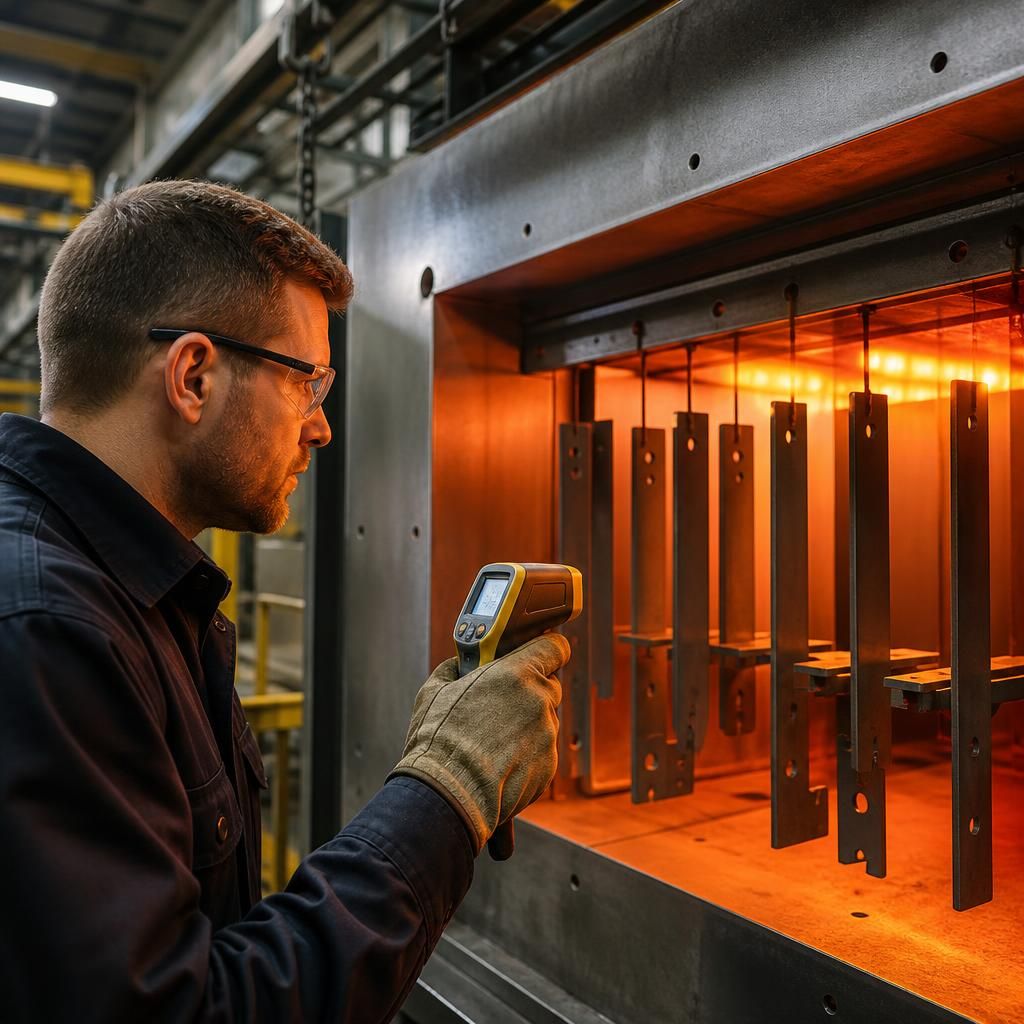
Temperature exposure should be assessed in terms of both the highest and lowest operating temperatures and how often the component cycles between them. Repeated heating and cooling can create movement between the metal substrate and coating, particularly where parts have different thicknesses or materials. Specify the operating range, any rapid temperature changes and whether heat is applied locally, then confirm that the proposed powder coating system is suitable for those conditions.
Discuss Your Environmental Powder Coating Requirements
Discuss your component’s environmental requirements with the powder coating specialist, including the substrate, exposure conditions and intended service life. This information can be used to assess the most suitable coating system and finish for the application.