

How does the powder coating process affect the final colour and finish of RAL and custom options?
The powder coating process affects the final colour and finish through surface preparation, powder application and oven curing, which together influence shade accuracy, gloss level, texture and coverage. RAL and custom colours can therefore appear different if the substrate, coating thickness or curing conditions change, so consistent preparation and process control are essential for repeatable results.
The powder coating process affects the final colour and finish by converting a dry powder into a continuous, bonded film whose appearance depends on the powder formulation, the component geometry and the controls used during application and curing. A RAL reference or approved custom colour identifies the intended appearance, but the finished result must be assessed as a coated component under agreed viewing conditions rather than treated as an exact digital or printed colour.
Colour selection is a starting specification, not a complete process specification. The same colour family may be available in different gloss levels, textures and coating chemistries. For example, a standard RAL shade with a smooth semi-gloss appearance will not look the same as that shade in a matt, fine-textured or coarse-textured formulation. A custom colour therefore needs to be specified alongside its required surface appearance, end use and, where relevant, an approved reference sample.
During application, the powder must be distributed evenly over the component. Complex fabrications can create differences between broad faces, recesses, internal corners and edges. Faraday cage effects may make powder more difficult to deposit in deep recesses, while sharp edges can receive a different film build from adjacent flat areas. The result may be a visual difference in coverage or texture even though the same powder has been used throughout. Component design, racking and the position of the part in relation to the spray equipment can all influence this distribution.
Powder properties also affect how the coating looks after it has flowed. Particle size, formulation and the selected coating system influence the way the film levels, forms texture and reflects light. A smooth coating tends to reveal surface imperfections more readily, whereas a textured finish can disguise minor variations but may require closer agreement about the intended texture. Metallic and special-effect powders require particular care because their appearance can vary with spray direction, film formation and the orientation of particles within the coating.
Custom colour matching is usually controlled by comparing a cured sample against the required reference. This is important because a colour seen on a screen, printed document or painted swatch may not reproduce the appearance of a powder-coated metal surface. The substrate, gloss and texture change how light is reflected, and two surfaces that appear similar in one setting may show a difference under another light source. For critical work, the reference should be a physical sample with the specified coating system and finish, not colour information alone.
Gloss is affected by the coating formulation and the way the cured film develops. A change from gloss to matt changes not only the amount of reflected light but also the perceived depth and strength of the colour. Texture has a similar effect: it scatters light across the surface and can make a colour appear softer, darker or less saturated than a smooth version of the same nominal shade. This is why a RAL number without a finish description may be insufficient for a precise appearance requirement.
Repeatability depends on keeping the coating process aligned with the approved reference. For repeat production, the following details should be recorded and kept consistent:
- the powder manufacturer’s colour and finish identification;
- the substrate and any pre-treatment appropriate to it;
- the specified gloss, texture and special-effect characteristics;
- the application method and powder settings;
- the component orientation, racking arrangement and areas requiring particular attention;
- the agreed curing requirements for the powder and the actual metal temperature achieved; and
- the approved physical sample or other agreed acceptance reference.
Different metal thicknesses can also respond differently in the oven. A thin section may reach the required metal temperature sooner than a heavy section, while a large fabrication may retain heat for longer. If parts do not receive equivalent curing conditions, the resulting appearance or performance can vary across a batch. This is especially relevant where components of markedly different mass are coated together.
Inspection should take place after the coating has cooled and under controlled, agreed lighting. Assessment normally considers colour, gloss, texture, coverage, visible contamination, runs, pinholes and other surface defects. Viewing distance and inspection angle matter particularly for metallic, textured and high-gloss finishes. Where colour tolerance is critical, instrumental measurement can supplement visual assessment, but the measurement method and acceptable tolerance should be agreed before production because readings are influenced by gloss, texture and the instrument itself.
For a project requiring a standard RAL colour, define the finish as fully as possible and approve a representative sample where appearance is important. For a custom option, provide a physical reference, identify the required gloss and texture, and confirm how close a match must be across the relevant components. Powder-coating specialists can then assess whether the requested appearance is suitable for the substrate, component geometry and intended process, helping to prevent a nominally correct colour from producing an unexpected final finish.
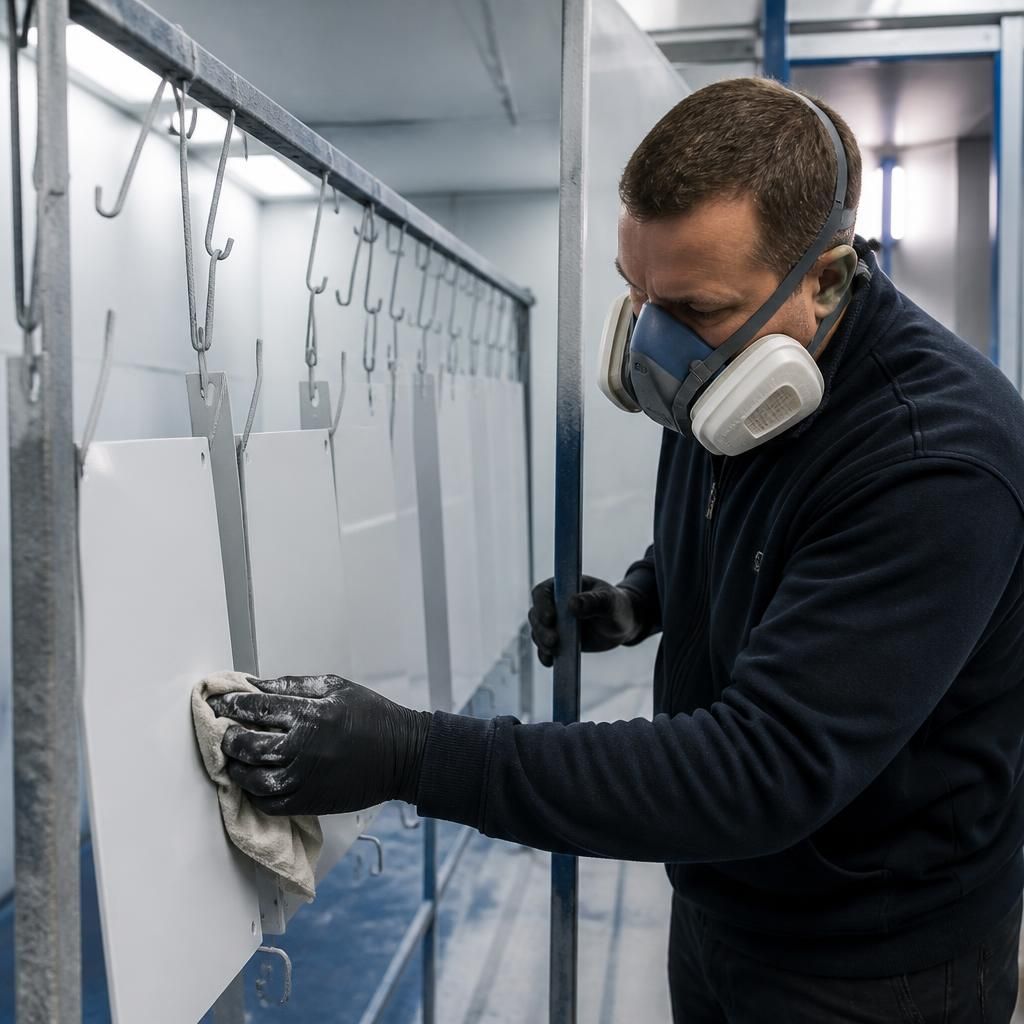
Colour changeovers can affect the final appearance if residual powder from a previous job contaminates the next coating. This is particularly noticeable with light RAL shades, bright colours and special-effect finishes, where small amounts of contrasting powder may create specks, shading or an uneven visual effect.
For consistent results, the coating equipment, booth and associated recovery areas should be cleaned appropriately between incompatible colours or finishes. Powder intended for a critical custom match should also be kept separate from mixed or reclaimed material unless its use has been specifically approved. This process control helps ensure that the specified powder, rather than contamination from an earlier coating, determines the finished colour and surface appearance.