

What unique capabilities should a provider offer to ensure effective application of nylon and speciality coatings?
A capable provider should offer specialist knowledge of substrate preparation, nylon and speciality coating selection, controlled application, curing and finish inspection. It should also be equipped to manage large or batch-produced metal components consistently, with processes suited to the part’s geometry, service conditions and required durability.
Effective application of nylon and speciality coatings requires more than coating equipment. A suitable provider should combine application expertise with engineering control, part-specific fixturing, documented process checks and the ability to verify that the finished coating meets the component’s functional requirements.
Part and specification review. Before processing begins, the provider should establish the coating’s purpose, the substrate material, expected wear, chemical exposure, operating temperature, impact risk and appearance requirements. This assessment helps determine whether a nylon coating, a protective speciality system or a combined coating arrangement is appropriate. It should also identify areas that require masking, additional protection or a different treatment route.
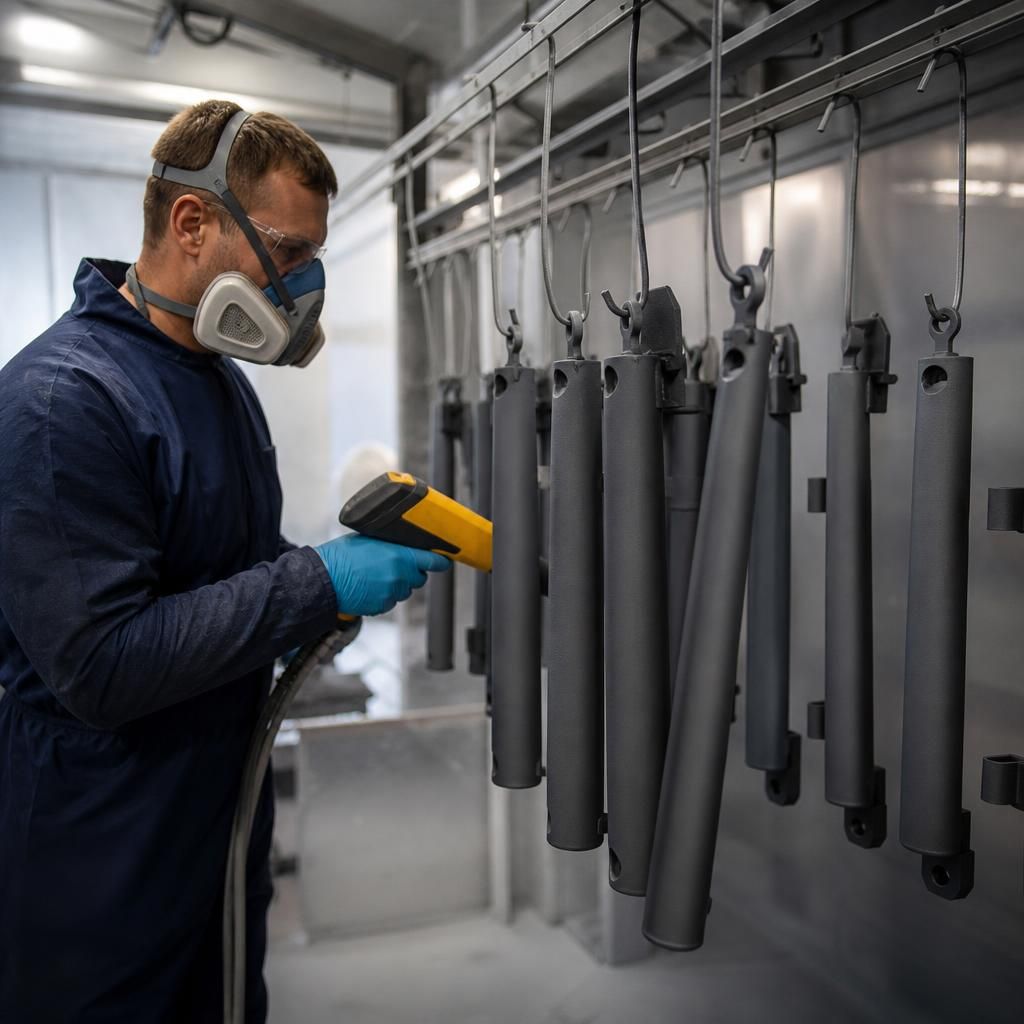
Capability for complex component geometries. Nylon coatings must reach the surfaces that need protection without obstructing holes, threads, mating faces or moving interfaces. A capable applicator should be able to design suitable racking, hooks, plugs, masks and handling methods for each component. This is particularly important for fabrications with enclosed sections, recesses, sharp transitions or irregular profiles, where poor positioning can lead to thin coverage, coating build-up or uncoated areas.
Control of coating thickness. The provider should define acceptable coating build for the application and have a method for checking it across representative areas of the part. Thickness needs to be sufficient for wear and corrosion protection, but excessive build can affect tolerances, fit, thread engagement and dimensional accuracy. Controls should therefore account for edges, corners, internal faces and other areas where the coating may behave differently from broad, accessible surfaces.
Reliable masking and post-coating removal. Masking is a specialist capability rather than a simple preparation step. The provider should understand which faces must remain free of coating and how heat, handling and the chosen application process may affect masking materials. After coating, masks should be removed without damaging the finish or leaving contamination on critical surfaces. A documented masking plan is useful where parts have repeatable interfaces or must meet tight assembly requirements.
Application methods suited to the material and part. Different nylon and speciality systems may require different application techniques, equipment settings and handling sequences. The provider should be able to select a suitable route for the powder characteristics, component size, geometry and required finish, rather than applying one standard process to every job. Equipment should support consistent powder delivery and access to difficult areas while limiting contamination between coating types or colours.
Validated heating and curing control. The relevant requirement is the condition reached by the coating and the metal component, not simply the temperature displayed by an oven. A capable provider should understand the relationship between part mass, geometry, heating rate and dwell time, and should use suitable checks to confirm that the coating has formed correctly. This helps prevent defects associated with under-processing, overheating, incomplete fusion or unwanted changes to the substrate.
Inspection that reflects service requirements. Visual inspection should be supported by checks appropriate to the specification. These may include coating thickness, coverage of difficult features, adhesion, surface continuity, colour or gloss where appearance is important, and freedom from runs, pinholes, blisters or embedded contamination. Inspection criteria should be agreed before production so that acceptance is based on the component’s intended use rather than subjective judgement alone.
Process repeatability and traceability. For repeat work, the provider should retain the approved specification, masking arrangement, application route, coating identification and relevant process records. Traceability allows variations to be investigated and helps reproduce an accepted finish across later batches. It is also valuable when components move through several operations or form part of a larger manufactured assembly.
Understanding of interfaces and assembly. Nylon and speciality coatings can change dimensions at contact points, so application planning should consider bolts, bearings, seals, sliding faces, electrical earth points and other interfaces. A technically capable provider will flag these issues before coating and can advise on masking or post-coating treatment where necessary. This reduces the risk of a visually acceptable finish creating problems during assembly or operation.
Finally, the provider should have suitable procedures for protecting coated components during inspection, storage and transport. Nylon finishes can be durable in service, but careless stacking, abrasive contact or exposure to unsuitable contaminants can damage the surface before installation. Clear packaging, identification and handling instructions complete the application process and help preserve the coating quality delivered to the customer.
Pre-production trials are an important capability when the coating system, substrate or service environment presents uncertainty. A provider should be able to process a representative sample or first-off component so that adhesion, coverage, appearance, dimensional fit and compatibility with the intended use can be assessed before a full batch is released.
This approach is particularly useful for specialist nylon systems, unusual substrates and parts exposed to abrasion, chemicals or repeated handling. Any adjustments to the coating choice, preparation route or application settings can be agreed at this stage, reducing the risk of discovering an unsuitable finish after production has started.