

What are the environmental and safety considerations associated with the application and curing of two-coat and thermoset systems?
Applying and curing two-coat and thermoset systems requires controlled powder handling, suitable ventilation, appropriate personal protective equipment and strict management of dust and ignition risks. Environmental considerations include minimising overspray, recovering powder where the equipment allows, managing waste correctly and controlling curing-oven emissions and energy use in line with applicable workplace and environmental requirements.
Environmental and safety considerations for two-coat and thermoset systems extend beyond the coating booth and curing stage. They include chemical assessment, preparation of the metal, control of the curing equipment, safe movement of coated parts, wastewater management and the eventual treatment or disposal of coating-related materials. The correct controls depend on the powder chemistry, pretreatment process, component size and site conditions, so each system should be assessed against its safety data sheets and relevant UK requirements before work begins.
Safety data and risk assessment
Every powder, primer, topcoat, pretreatment chemical and cleaning product should be identified and assessed before use. Safety data sheets provide information about hazardous ingredients, incompatible materials, storage conditions, first-aid measures and actions to take following a spill. A COSHH assessment should reflect the actual two-coat process rather than relying on a generic assessment for powder coating. This is particularly important where the primer and topcoat have different compositions or where powders containing sensitising, irritant or otherwise hazardous substances are used.
Risk assessments should also cover activities that are sometimes overlooked, including opening containers, cleaning equipment, clearing blockages, changing colours, inspecting the oven, unloading hot workpieces and handling rejected components. Written procedures should define who may carry out these tasks, what isolation is required and how contaminated materials are dealt with.
Pretreatment and chemical handling
Surface preparation can introduce risks that are separate from those associated with the powder itself. Degreasers, acidic or alkaline treatments and conversion processes may cause burns, eye injuries or harmful exposure if incorrectly stored or handled. Chemicals should remain in clearly labelled, compatible containers, with segregation between substances that could react with one another. Dosing, transfer and spill-response arrangements should be documented, and suitable emergency washing facilities should be available where the risk assessment requires them.
Rinse stages also have an environmental significance. Used rinsing solutions can contain oils, suspended solids, dissolved metals or residues from the treatment chemistry. They should not be discharged without checking the applicable sewer, trade-effluent or environmental requirements. Sampling, permitted disposal routes and records of waste transfer help demonstrate that liquid wastes are being managed lawfully.
Thermal and mechanical hazards
A thermoset coating forms its final properties through a controlled chemical crosslinking reaction. Once cured, it cannot simply be melted and reapplied like a thermoplastic material. The curing equipment therefore needs reliable temperature control, guarding and maintenance. Operators should be protected from hot surfaces, heated components and unexpected movement of conveyor or lifting equipment. Access doors, interlocks and isolation arrangements should be checked as part of planned maintenance rather than only after a fault occurs.
Large or awkward components create additional risks during loading, unloading and transfer between coats. Lifting points, trolleys, racks and fixtures should be suitable for the component’s mass and shape. Coated parts can remain hot after leaving the oven, so handling procedures should account for residual heat and allow inspection without requiring unsafe contact. Good rack design also reduces the chance of parts falling, striking workers or damaging the newly applied finish.
Process control and environmental performance
Accurate film-thickness control is an environmental consideration as well as a quality issue. Excess material increases consumption and can create additional rejected work, while insufficient coverage may lead to premature corrosion and replacement of the component. Specifying the required coating thickness, checking the first-off work and monitoring both coats can reduce avoidable rework without compromising protection.
Colour changes and equipment cleaning should be planned to prevent cross-contamination between primer and topcoat materials. Residues from cleaning operations, used wipes, filters, empty containers and contaminated fixtures should be classified before disposal. Their classification depends on the substances involved, so hazardous and non-hazardous waste should not be mixed simply for convenience. Businesses should use authorised waste contractors where required and retain the relevant transfer documentation.
The longer service life provided by a correctly specified two-coat system can reduce the frequency of recoating or component replacement, but this benefit depends on proper preparation, curing and inspection. At end of life, thermoset coatings present recycling challenges because the cured film cannot be remelted into a new coating. Where metal is recycled, coating residues may be handled within the metal recycler’s process; the appropriate route should be confirmed rather than assumed. Product specifications and waste plans should therefore consider both the coated component and any process residues.
Training, records and compliance
Operators should be trained in the particular powders and chemicals used, the meaning of process controls, emergency arrangements and the limits of their authority to intervene in equipment faults. Training should be refreshed when the coating formulation, pretreatment chemistry, equipment or working method changes.
Useful records include safety data sheets, COSHH and general risk assessments, equipment inspections, curing checks, chemical usage, waste transfers, incident reports and corrective actions. In the UK, the relevant duties may involve health and safety, hazardous-substance, workplace-equipment, fire and environmental legislation. A competent person should confirm which requirements apply to the site and process. These controls protect workers and the environment while also providing evidence that the two-coat or thermoset system is being applied and cured under defined, repeatable conditions.
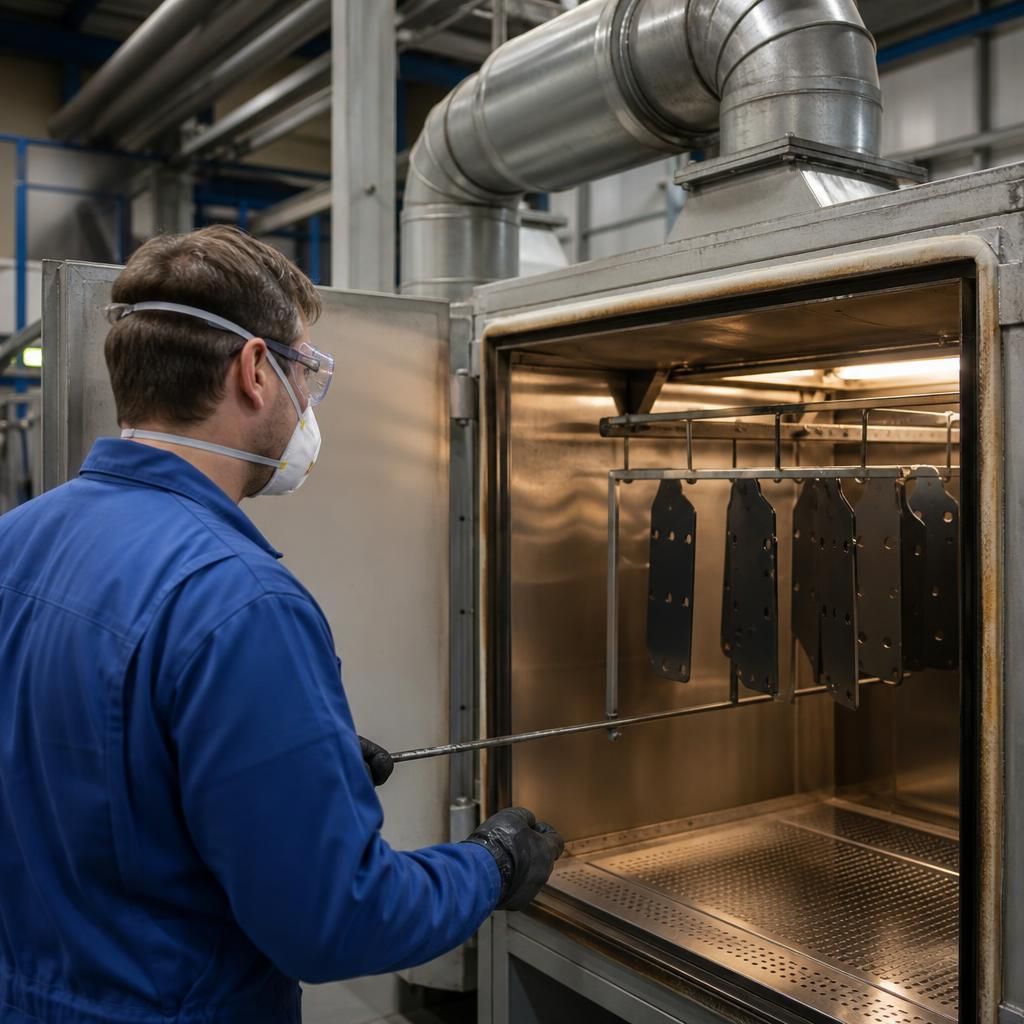
Curing-oven ventilation is an important environmental and safety control because thermoset powders can release vapours and decomposition products if they are heated outside their specified cure conditions. The oven should be operated within the powder manufacturer’s temperature and time range, with airflow and extraction set up to maintain even curing without allowing emissions to accumulate in the work area.
Oven exhaust should be directed and maintained in accordance with the site’s environmental controls, while filters, ducts and extraction points should be inspected for deposits or restricted airflow. Avoiding excessive temperatures also helps prevent coating degradation, reduce unnecessary energy use and limit rework caused by discolouration, brittleness or other cure defects.
Discuss Your Two-Coat and Thermoset System Requirements
Discuss your two-coat or thermoset system requirements with Powder-coatings.co.uk, including the component material, intended service conditions and any existing preparation or coating specification. This allows the appropriate application, curing and compliance considerations to be reviewed before work begins.