

What specific industries benefit most from the corrosion and wear resistance properties of Rilsan Nylon 11 coating?
Rilsan Nylon 11 coating is particularly beneficial in automotive, construction, manufacturing and fabrication applications where metal components face moisture, corrosive substances, abrasion or repeated handling. Its corrosion and wear resistance helps protect components used in demanding environments, especially where a tough, durable insulating layer is required.
The industries that benefit most from Rilsan Nylon 11 coating are those using metal components exposed to moisture, chemicals, abrasive materials or repeated mechanical contact. Its value is greatest where a component needs both corrosion protection and a resilient surface, rather than corrosion resistance alone.
- Chemical processing and process engineering: Tanks, pipework, valves, pumps, fittings and handling equipment may encounter acids, alkalis, salts or other aggressive substances. A correctly specified Nylon 11 coating can form a continuous barrier that limits contact between the metal substrate and the process medium. Chemical compatibility must still be checked against the specific substance, concentration and operating temperature.
- Water and wastewater equipment: Pumps, screens, pipe components, brackets and treatment-plant hardware can face constant moisture, dissolved contaminants and sediment. The coating is useful where corrosion and surface wear occur together, particularly on components exposed to flowing water or suspended particles.
- Oil, gas and fluid-handling applications: Valves, couplings, pipe components and other handling equipment can require protection from moisture, transported fluids and mechanical damage during installation or operation. Nylon 11 is relevant where the coating specification, substrate preparation and service conditions support the required level of protection.
- Agricultural and land-management machinery: Equipment used around soil, fertilisers, slurry and water is exposed to abrasion as well as corrosive contamination. Coating suitable steel components can help protect surfaces that are repeatedly scraped, handled or washed, although moving interfaces and high-impact areas require particular design consideration.
- Material handling and industrial equipment: Chutes, guides, hoppers, rollers, frames and other metal parts may suffer wear from contact with bulk materials or repeated handling. Nylon 11 can be considered where the surface needs to resist rubbing and particle abrasion while also separating the metal from damp or contaminated surroundings.
- Marine and coastal-related equipment: Salt-laden moisture accelerates corrosion on exposed metalwork, while handling, impact and abrasion can damage weaker surface treatments. Nylon 11 coating may be suitable for selected components, provided the design accounts for edges, fasteners, joints and any areas where water could be trapped beneath or behind the coating.
These industries do not benefit equally in every application. Rilsan Nylon 11 is most appropriate when the part has a clearly defined exposure to corrosion and wear and when the coating can be applied consistently across the required surfaces. It is less straightforward for components subject to temperatures, chemicals or loads outside the coating specification, or for parts where tight dimensional tolerances could be affected by the coating thickness.
Selection should therefore consider the metal substrate, surface preparation, operating temperature, chemical exposure, impact and abrasion, electrical requirements, component geometry and expected service conditions. Welds, corners, recesses and edges also need attention because coating performance depends on complete and properly bonded coverage. For a production or repair project, these factors should be reviewed before choosing Nylon 11 over another protective coating system.
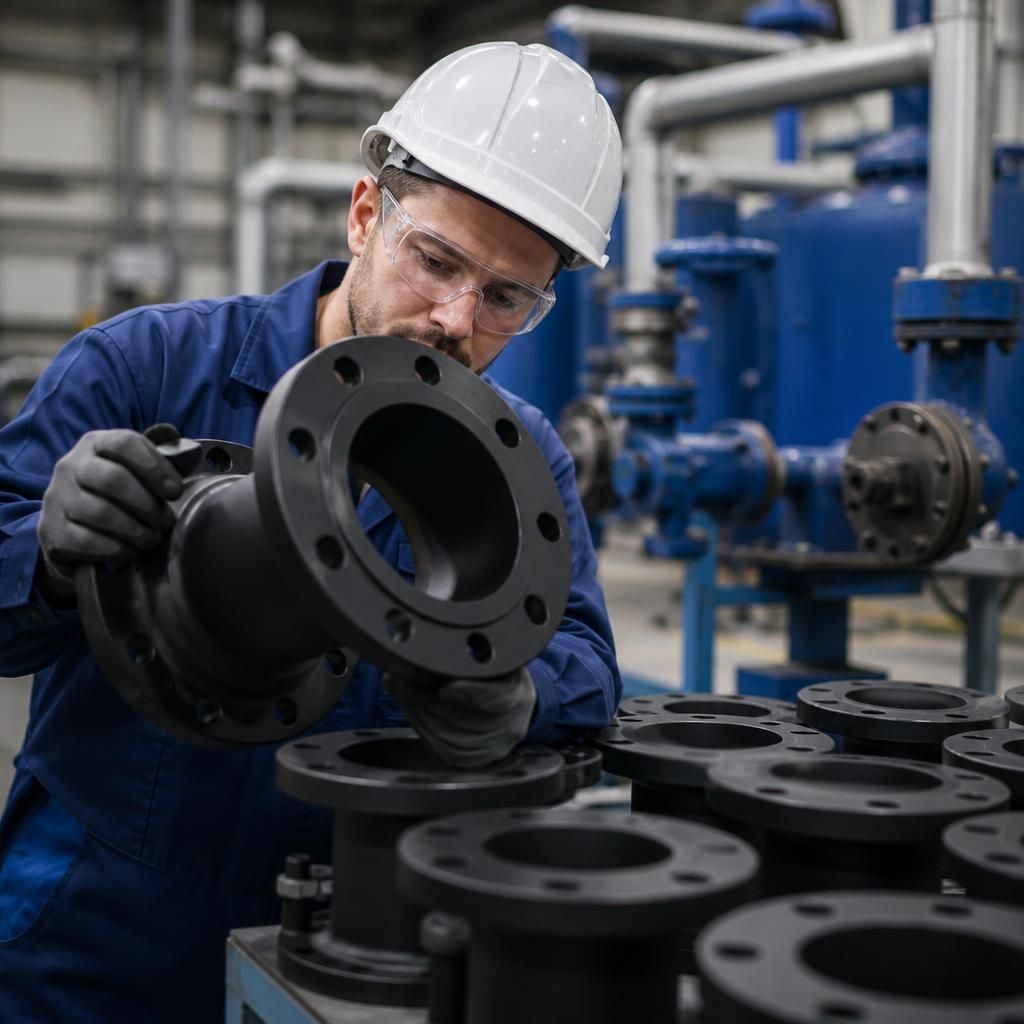
Rilsan Nylon 11 is most valuable where a component must withstand more than one form of service stress at the same time. A metal part exposed only to occasional moisture may need straightforward corrosion protection, whereas a part that also experiences sliding contact, repeated handling or contact with abrasive material requires a coating that protects the surface from both chemical attack and physical damage.
This makes the coating particularly relevant to equipment manufacturers and fabricators supplying components with a defined, demanding duty. The correct choice should be based on the component’s actual exposure and operating conditions, not simply on the industry in which it is used. Reviewing these conditions helps identify where Nylon 11 provides a practical advantage over a coating intended mainly to isolate metal from the atmosphere.