

What specific environmental and operational conditions can Rilsan Nylon 11 coating withstand effectively?
Rilsan Nylon 11 coating can withstand demanding conditions including exposure to many chemicals, moisture, corrosion, impact, abrasion and outdoor weathering. Its tough, resilient finish is suited to metal components exposed to mechanical wear, changing environmental conditions and corrosive surroundings, subject to compatibility with the specific application.
Rilsan Nylon 11 coating is suited to metal components exposed to fluctuating temperatures, damp or saline atmospheres, chemical contact, repeated movement and physical handling. Its performance comes from a combination of toughness, flexibility, adhesion and resistance to environmental ageing, although the coating must be matched to the substances, temperatures and stresses present in the finished application.
Temperature variation and thermal cycling
The coating can accommodate normal changes between hot and cold operating conditions without becoming as brittle as some harder finishes. This makes it suitable for components that experience outdoor temperature changes, warm process areas or intermittent heating and cooling. The design must still allow for the different expansion rates of the metal substrate and the polymer coating. Persistent exposure to temperatures beyond the coating specification can reduce hardness, adhesion or mechanical strength, so the highest continuous and peak temperatures should be checked before specifying it.
Water, condensation and saline atmospheres
Rilsan Nylon 11 is appropriate for components exposed to humidity, condensation, wash-down conditions and general outdoor moisture. It can also be considered for coastal or salt-contaminated environments, provided that the metal is correctly prepared and the coating is continuous at edges, holes and other vulnerable features. The coating acts as a barrier between the substrate and the surrounding environment, but damage, poorly treated edges or uncoated contact points can still create routes for corrosion.
Chemical contact
It offers useful resistance to many oils, fuels, hydrocarbons, salts and commonly encountered industrial chemicals. This can make it appropriate for pipework, tanks, fittings and components where occasional splashing, handling contamination or prolonged contact is expected. Chemical resistance is not universal: concentration, temperature, contact time and whether the substance is static or flowing can all change the result. Strong oxidising agents, aggressive solvents and highly concentrated acids or alkalis require specific compatibility assessment rather than assumption.
Mechanical and operational stress
The flexible polymer layer is suitable where a metal component may be subject to vibration, rubbing, repeated handling or moderate deformation. It can absorb some local loading more effectively than a brittle surface finish and helps protect the substrate from contact damage. Applications involving sharp-edged impacts, severe gouging, continuous high-load sliding or abrasive particles at high velocity need a more detailed assessment, as any coating can eventually be cut or worn through under sufficiently severe conditions.
Outdoor exposure and ultraviolet light
For external equipment, the coating can withstand ordinary weathering, including rain, humidity and sunlight, when the selected formulation and colour are suitable for the environment. Outdoor specification should take account of ultraviolet exposure, temperature cycling, pollution and the possibility of trapped water. Regular inspection is particularly important where coating damage could expose the underlying metal to a more corrosive atmosphere.
Conditions that require closer specification
- Continuous or peak temperatures outside the recommended operating range.
- Direct contact with a chemical whose concentration or temperature varies significantly.
- High-pressure fluid flow, abrasive media or repeated sliding contact.
- Sharp edges, threaded areas, joints and recesses where achieving complete coverage is difficult.
- Substrates that flex substantially or are exposed to rapid thermal cycling.
- Installations where a coating failure would affect safety, hygiene or containment.
Before production, the coating specification should therefore be based on the actual service conditions rather than on the environment alone. The metal type, surface preparation, coating thickness, edge geometry, curing conditions and expected modes of contact all affect performance. For critical applications, compatibility testing using the intended chemical, temperature and mechanical exposure provides a more reliable basis for selection than a general resistance statement.
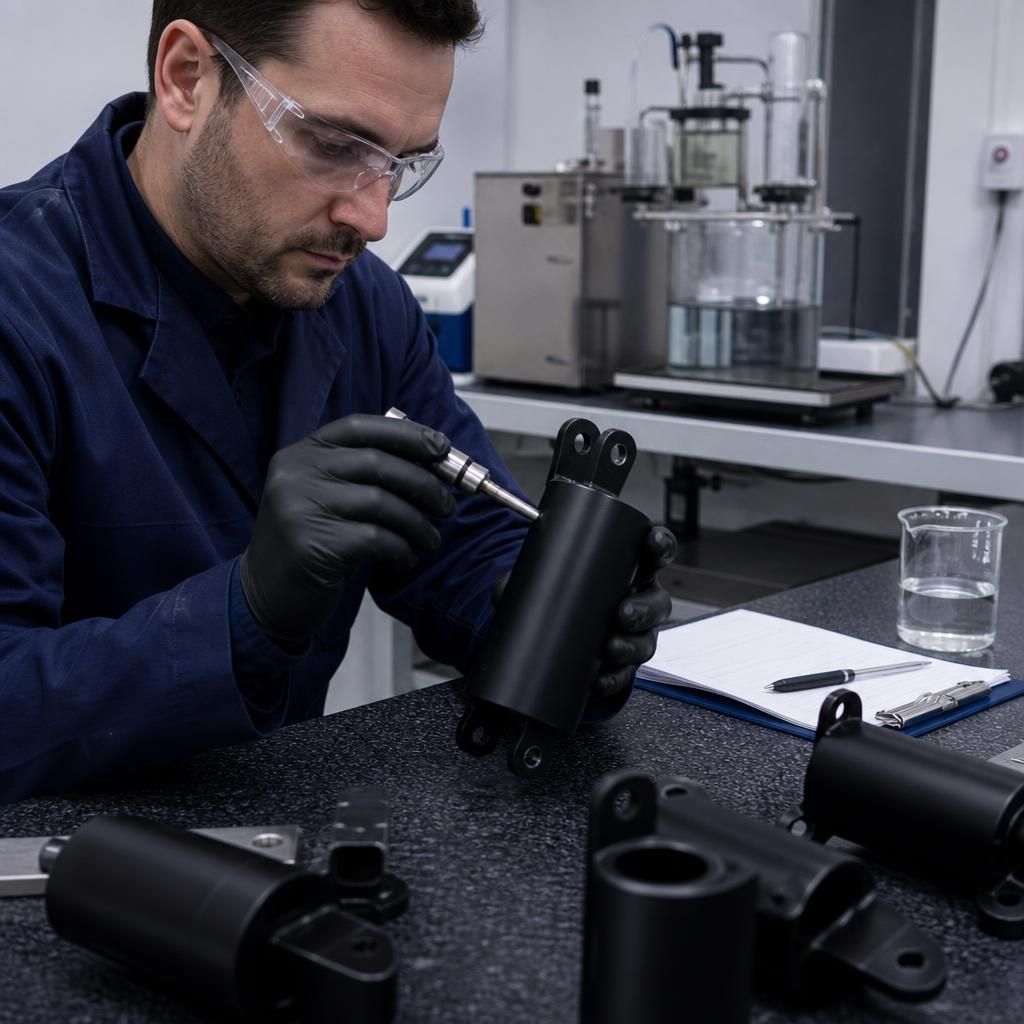
Rilsan Nylon 11 should be assessed against combined conditions rather than a single exposure in isolation. For example, a component may experience chemical contact while warm, vibration while contaminated with oil or grit, followed by cleaning and drying. These sequences can place different demands on adhesion, flexibility and surface durability than any one condition alone.
For demanding applications, a representative test should reproduce the expected order, duration and intensity of exposure as closely as possible. Examining the coated part afterwards for softening, blistering, cracking, loss of adhesion or visible wear gives a more useful indication of service suitability than relying solely on a general chemical or environmental resistance statement.
Assess whether Rilsan Nylon 11 suits your operating conditions
Share your component’s operating conditions with the powder-coating.co.uk team to assess whether Rilsan Nylon 11 is suitable for the application. Include details of the substrate, geometry and expected exposures so the coating specification can be considered accurately.