

What is the typical application process for Rilsan Nylon 11 coating on metal structures?
The typical Rilsan Nylon 11 coating process involves inspecting and preparing the metal structure, removing contaminants and corrosion, applying the nylon powder by a suitable method, then heating it to fuse the coating into a continuous protective layer. The finished coating is inspected for coverage, adhesion and surface defects before the component is handled or returned for use.
The typical Rilsan Nylon 11 application process is a controlled, multi-stage operation tailored to the metal structure, its geometry and the required coating specification. The result depends not only on applying the powder, but also on controlling substrate condition, masking, heat distribution, coating build and cooling throughout the process.
1. Review of the component and coating requirements
Before work begins, the coater assesses the structure’s material, dimensions, shape and intended service conditions. This helps determine the most suitable application method and highlights features that may affect coating quality, including deep recesses, sharp edges, welds, flanges, threaded sections and areas requiring close dimensional control.
The required finish should also be agreed at this stage. Important considerations can include the specified coating thickness, colour, surface appearance, areas that must remain uncoated and any dimensional limits around mating faces or moving parts.
2. Masking and racking
Sections such as threads, bores, electrical contact points, bearing seats and machined faces are masked before coating. Masking materials must tolerate the process temperature and remain secure during handling. Components are then supported or racked in a way that gives the coating equipment access to the required surfaces without creating avoidable contact marks.
Racking also needs to account for how the structure will be heated and cooled. Poor support can affect heat distribution or leave areas difficult to coat consistently, particularly on large, irregular or fabricated assemblies.
3. Substrate preparation and surface profile
The metal surface is prepared to provide a clean, suitable key for the nylon coating. The preparation method is selected according to the substrate and its condition. Weld spatter, sharp projections, burrs and other irregularities may need attention because they can remain visible through the finished coating or create thin areas at edges.
After preparation, the component must be protected from renewed contamination. Oil, moisture, dust or handling residues introduced between preparation and coating can interfere with the bond between the nylon layer and the metal.
4. Preheating and powder deposition
Rilsan Nylon 11 may be deposited using a method suited to the component’s size and geometry, such as electrostatic powder application, hot flocking or a fluidised-bed process. The metal temperature and the powder delivery must be coordinated so that particles melt and join into a continuous layer rather than remaining as loose or incompletely fused material.
Large structures require particular attention to heat balance. Sections with greater mass, enclosed areas or limited access may behave differently from thin projections. The operator therefore controls the sequence and coverage pattern to reduce variations in coating build, runs, sagging or areas of incomplete fusion.
5. Fusion and formation of the coating film
Once deposited, the nylon particles flow together to form the coating film. The process must provide sufficient heat for the material to level and consolidate without damaging the finish or causing excessive build-up. Corners, edges and transitions between different sections are checked during the operation because these areas can attract more or less powder than broad, flat surfaces.
Where multiple applications are required, the timing and condition of each layer are controlled so that the finished coating remains integrated. The exact sequence depends on the component design and the coating specification rather than following one fixed setting for every job.
6. Cooling and removal of masking
After fusion, the coated structure is allowed to cool in a controlled manner before masking is removed or the component is moved. Premature handling can mark the surface, disturb edges or affect areas that have not fully stabilised. Masking is removed carefully to leave clean boundaries without lifting the coating around protected features.
Any temporary supports or contact points are also examined, as these may create small uncoated areas that require treatment in accordance with the agreed specification.
7. Final quality checks
Final checks commonly include confirming coating thickness, continuity, edge coverage, masking lines and the condition of functional surfaces. The operator may also check for pinholes, inclusions, blisters, runs, roughness and other visible defects. Dimensional checks are important where the coating surrounds threads, close-fitting parts or interfaces that must assemble correctly.
For a production batch, inspection records and any agreed test results can be matched to the component or order requirements. If a defect or non-conforming area is identified, the appropriate corrective action depends on its location, extent and the coating specification; local repair is not automatically suitable for every application.
For manufacturers and fabricators, providing accurate drawings, masking details, handling points and service requirements before processing helps the coating process be planned around the structure rather than adapted after application. That is especially relevant for large or complex metal assemblies where access, heat distribution and dimensional tolerances influence the final result.
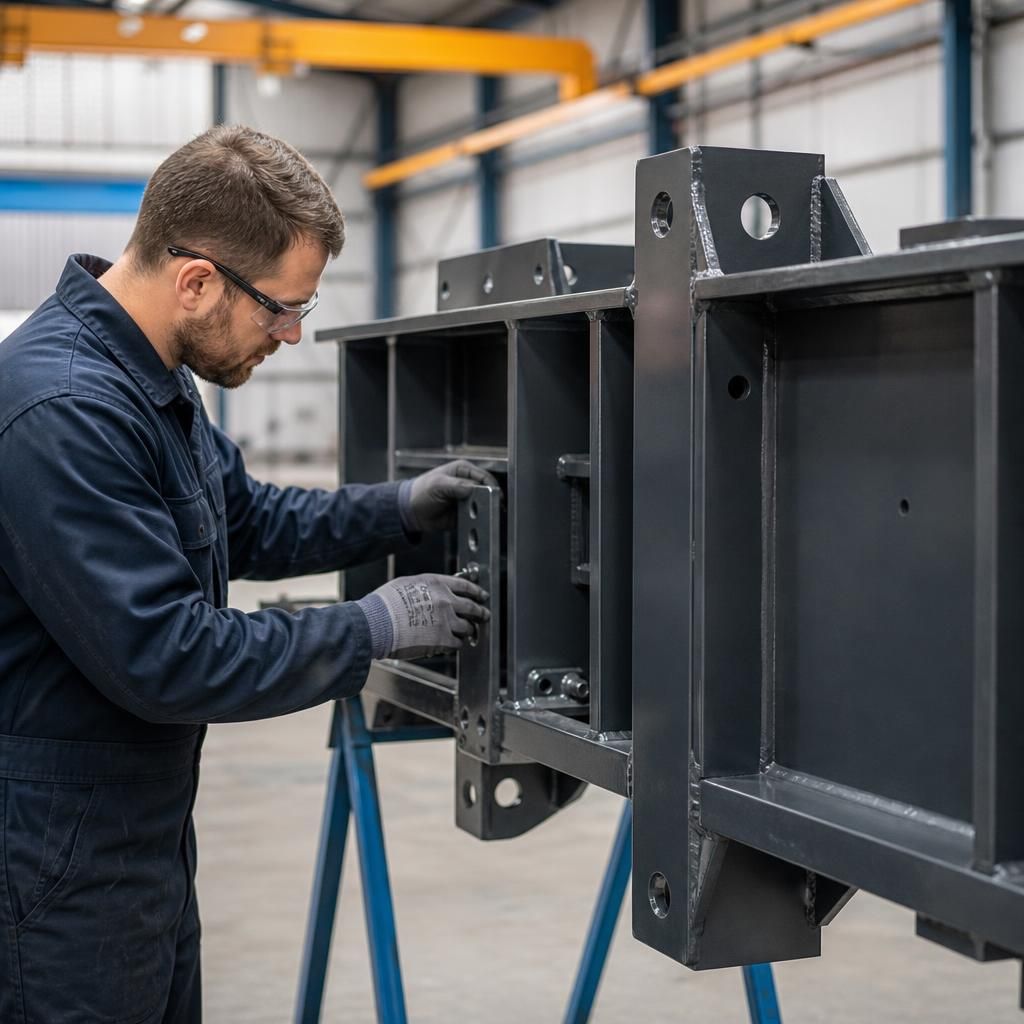
A key part of the Rilsan Nylon 11 application process is reviewing whether the metal structure is suitable for coating as designed. Hollow sections, enclosed cavities and narrow passages may need appropriate venting, drainage or access points so that trapped air, moisture and process residues do not interfere with heating or powder coverage.
- Enclosed areas should be assessed for safe and even heat transfer.
- Drainage routes help prevent moisture or treatment residues remaining inside the structure.
- Access points may be needed where the coating must reach internal surfaces.
- Temporary fixtures should be positioned to avoid obstructing critical coating areas.
Identifying these features before preparation allows the application sequence and racking arrangement to be planned around the structure, rather than relying on corrective work after the nylon coating has been applied.