

What materials and industries can benefit most from powder coating repair services?
Powder coating repair services are most useful for metal components made from steel, aluminium and iron, where damaged or worn finishes can expose the substrate to corrosion and reduce appearance or performance. They are particularly relevant to manufacturers, fabricators, construction firms and automotive businesses managing equipment, frames, panels, brackets and other coated parts, including components with specialist nylon or protective coatings.
Powder coating repair services benefit coated metal components whose finish has localised damage, rather than parts that require complete stripping and recoating. They are most suitable where the underlying material remains structurally sound and the repair can be matched to the existing coating system, colour, texture and level of protection.
Suitable materials. Repair work can be considered for fabricated and cast metal components used in industrial equipment, enclosures, frames, guards, brackets, panels and assemblies. The key issue is not simply the type of metal, but the condition of both the substrate and the surrounding coating. A small area of impact damage, abrasion, edge breakdown or local corrosion may be repairable, provided the affected area can be prepared properly and the remaining coating is firmly bonded.
- Fabricated components: welded assemblies, formed sections and panels can often be assessed for local repairs around edges, joints, fixing points and exposed faces.
- Machined or cast parts: housings, covers and brackets may benefit when wear is limited to accessible surfaces and the component remains dimensionally accurate.
- Pre-treated or plated substrates: galvanised and similarly protected metal requires careful preparation so that the repair does not compromise the underlying corrosion protection.
- Specialist coating systems: nylon and other protective finishes need compatibility checks before repair materials or preparation methods are selected.
Manufacturing. Manufacturers commonly need repairs for production equipment, machine guards, frames, housings and handling components. Repair can be appropriate when damage is confined to areas affected by tooling, assembly, impact or repeated contact. It is also useful where a component has already been coated but has been marked during transport, installation or subsequent modification.
Metal fabrication. Fabricators may require remedial work on gates, frames, brackets, cabinets, structural sections and bespoke assemblies. Welded areas and cut edges deserve particular attention because incomplete preparation or coating breakdown in these locations can allow corrosion to develop beneath the finish. A repair assessment should establish whether the damage is local or whether it extends along welds, seams or concealed faces.
Construction and building-related applications. Coated metal used in building components can be exposed to handling damage, site abrasion, drilling, fasteners and weather. Repair may help preserve the protective and visual finish of items such as architectural sections, access components, screens, supports and metalwork. The suitability of a repair depends on the extent of exposure, the accessibility of the damaged area and whether the existing coating has deteriorated beyond the visible defect.
Automotive and transport-related work. Vehicle and transport components can develop chips, scuffs, friction wear and damage around mounting points or fasteners. Powder coating repair is most practical where the affected region is clearly defined and the component is not suffering from widespread chemical attack, heat damage or repeated structural abrasion. Parts exposed to high temperatures, fuels, oils or road contaminants need a coating system selected for those conditions rather than a generic touch-up.
Specialist and protective applications. Nylon-coated components and parts requiring additional resistance to impact, abrasion, chemicals or electrical contact should not be repaired solely by matching appearance. The replacement material must be compatible with the original coating and suitable for the component’s working environment. Preparation, masking and curing controls are especially important where excessive heat could affect the existing finish or the dimensions of the part.
When repair is not the best option. A complete strip and recoat may be more appropriate where corrosion is extensive, adhesion has failed across a broad area, the coating is contaminated, or the substrate has been distorted or weakened. It may also be preferable when the original coating cannot be identified or when a consistent finish across the whole component is essential. A sound assessment therefore considers the defect, the substrate, the original coating, the component’s service conditions and the finish required after repair.
For B2B users, the strongest candidates are components with valuable or difficult-to-replace metalwork, localised coating defects and a sound underlying substrate. Manufacturers, fabricators, construction firms and automotive businesses can use these criteria to separate practical repair work from parts that need full coating removal and replacement.
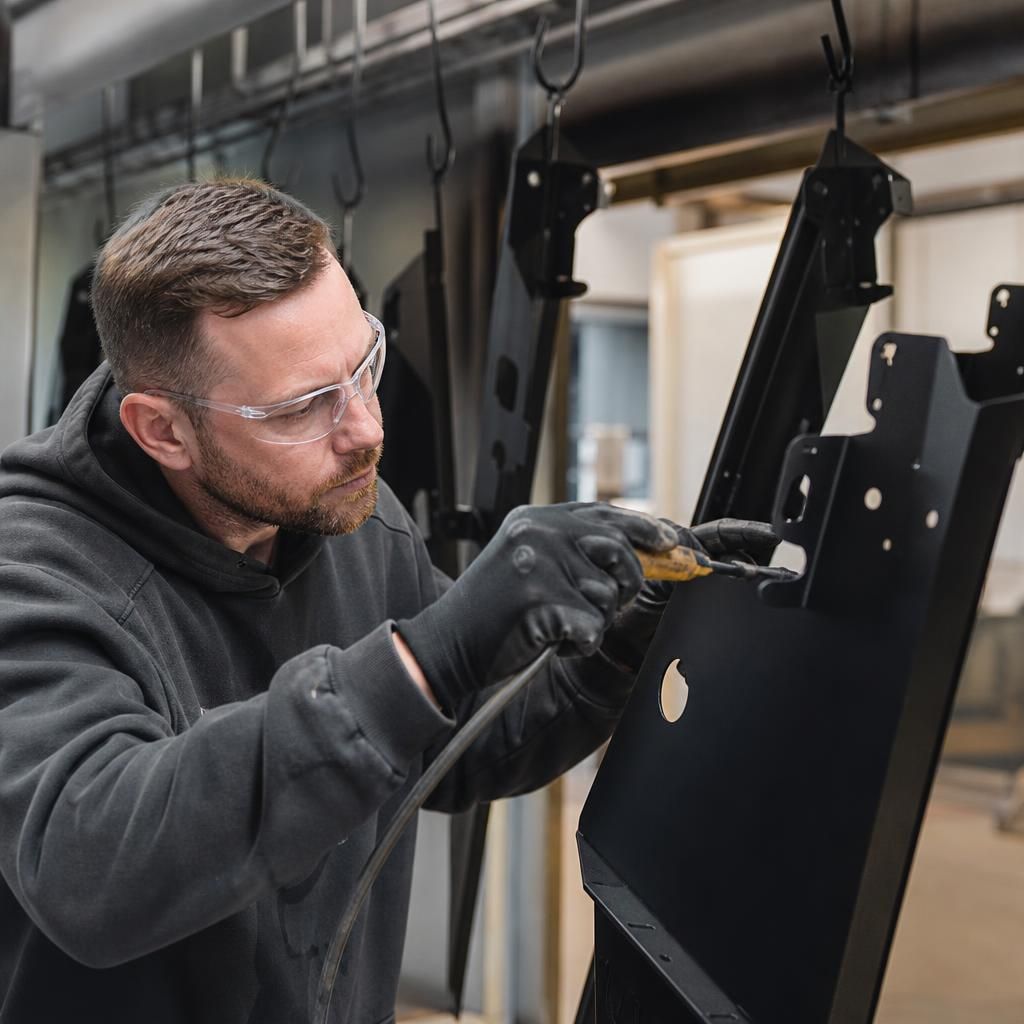
Powder coating repair is most beneficial when the finish performs a functional role as well as improving appearance. On industrial components, the coating may help limit moisture ingress, resist handling wear, provide electrical separation or protect surfaces from process contamination. For these parts, a suitable repair must restore the required protective function rather than simply conceal a visible mark.
Manufacturers and fabricators may also benefit when the same coated component is used repeatedly across a product range or installation. Assessing representative parts can help establish whether the coating system, preparation method and finish are suitable for repeat repair work. This is especially important where repaired components must remain consistent in appearance and performance with the wider assembly.