

What is the process for applying Nylon & Rilsan powder coatings to metal components?
Applying Nylon and Rilsan powder coatings involves preparing and cleaning the metal component, applying the thermoplastic powder to the specified areas, and heating it so the coating melts and forms a continuous protective layer. The finished component is then cooled and inspected for coverage, adhesion and surface quality before dispatch.
The Nylon and Rilsan powder coating process is a controlled thermoplastic application in which prepared metal is heated or otherwise brought to the required application condition, coated with powder, and allowed to form a continuous fused layer. The exact method depends on the component’s size, geometry, required coating thickness, specified finish and intended service conditions.
1. Review of the component and coating specification
Before processing, the component should be assessed to identify the areas to be coated, surfaces that must remain uncoated, dimensional tolerances and any features that could affect powder coverage. Threads, bearing seats, bores, electrical contact points and machined faces may require masking. Racking and suspension points are also planned so that the powder can reach the required surfaces without creating excessive contact marks.
The coating specification normally defines the powder type, colour, finish, target thickness and performance requirements. Nylon and Rilsan grades are selected according to factors such as abrasion, impact, chemical exposure, moisture, temperature and contact with other materials. These requirements are particularly important for components with tight tolerances, moving interfaces or complex profiles.
2. Preparation of the metal
Surface preparation determines how consistently the thermoplastic layer bonds to the component. Oil, grease, dirt, mill scale, rust and previous coatings must be removed using a suitable cleaning and preparation sequence. Mechanical preparation, such as abrasive blasting, may be used where a clean, suitably keyed surface is required. The preparation method must match the base metal and the specified finish, as contamination or an unsuitable surface profile can lead to poor adhesion, pinholes or premature coating failure.
After preparation, the component must be handled and stored in a way that prevents recontamination. Particular attention is needed around recesses, welds, edges and joints, where residues can remain or where powder coverage may be more difficult to control.
3. Masking, racking and preheating
Masking protects areas that must not receive coating and helps preserve dimensional accuracy. Components are then positioned on suitable racks or fixtures to provide electrical contact where required and allow even access to the coating equipment. The arrangement should also minimise areas where powder can accumulate or where the component itself can shield another surface.
Depending on the application method and coating specification, the metal may be heated before powder application. Preheating helps the thermoplastic powder melt and flow over the prepared surface, particularly on heavier sections or components with difficult geometry. Temperature control is important: insufficient heat can prevent proper flow, while excessive heat or prolonged exposure can affect the coating appearance or the substrate.
4. Applying the Nylon or Rilsan powder
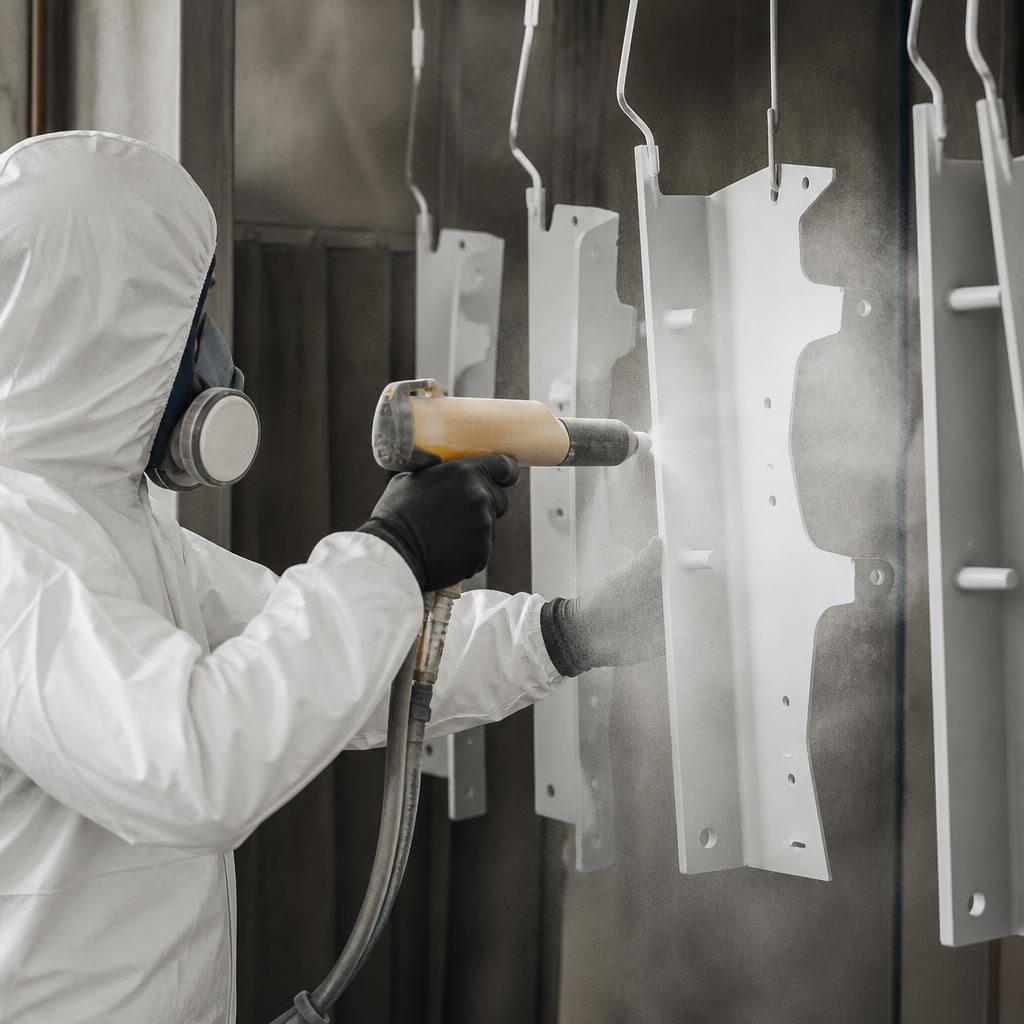
The powder is applied using equipment suited to the component and the selected material. Electrostatic spraying is suitable for many components and allows the operator to direct charged powder towards the prepared metal. Fluidised-bed or other thermoplastic application techniques may be considered for components that can be heated and immersed or coated in a controlled powder bed. The method is chosen according to the part’s dimensions, shape, required build and production requirements.
Application technique affects edge coverage, recesses, internal corners and the transition between coated and masked areas. The operator controls gun distance, powder flow, movement and overlap so that the deposited material is even rather than excessively heavy in one area and insufficient in another. Complex components may require changes in orientation or more than one pass to obtain consistent coverage.
5. Melting and forming the coating
Once deposited, the powder is heated until it melts, flows and joins into a continuous film. Nylon and Rilsan coatings are thermoplastic, so this stage is based on controlled melting and fusion rather than the chemical curing reaction associated with many thermoset powder coatings. The heating cycle must allow the coating to flow sufficiently while avoiding defects such as blistering, runs, trapped contamination or an uneven surface.
For some parts, the coating may be built up through controlled successive applications. This can help achieve the specified thickness or deal with geometry that is difficult to cover in one operation. The number and sequence of applications depend on the material, component and specification rather than being the same for every job.
6. Cooling and removal of masking
After fusion, the component is cooled under controlled conditions so the coating can stabilise without being marked or damaged. Cooling also allows masking materials and fixtures to be removed at an appropriate stage. Care is needed around edges, holes and threaded sections, where premature handling can affect the finish or cause local damage.
7. Inspection and quality checks
Finished parts are inspected against the agreed requirements. Typical checks include:
- Visual appearance, including colour, gloss, texture, runs, pinholes and contamination.
- Coverage of edges, corners, recesses and other difficult areas.
- Coating thickness, using a suitable method for the metal substrate and coating system.
- Adhesion, where testing is required by the specification.
- Correct masking, dimensional clearance and freedom from unwanted coating on functional surfaces.
Any non-conforming area should be assessed before dispatch. Rework may involve removing the affected coating, repeating preparation and applying the material again, subject to the component and the agreed quality requirements.
For repeat batches, consistent racking, preparation, heating, powder application and inspection help produce comparable results from one production run to the next. Providing accurate drawings, masking details, material information and service requirements at the quotation or planning stage allows the coating process to be matched more closely to the component rather than treated as a generic finish.
Some Nylon and Rilsan applications require a compatible primer or bonding layer before the thermoplastic powder is applied. This is determined by the substrate, coating grade, service conditions and chosen application method rather than treated as a standard step for every component.
Where a primer is specified, its coverage and drying or curing condition must be controlled before the nylon-based layer is applied. Poor compatibility, contamination or an unsuitable interval between layers can weaken the coating system, so the complete specification should identify the primer, preparation requirements and final performance criteria.